




The News
BLOOMINGTON, Minn. — Tests of left-wing energy and President Donald Trump’s endorsement will take place in five states Tuesday, as primary season in the Midwest wraps up.
The president has picked favorites in South Carolina, Wisconsin, and Minnesota — helping a senator’s sister (turned senator herself), a Cabinet member’s son-in-law, and a very loyal supporter — but didn’t clear the field. In Wisconsin, the Democratic Socialists of America believe they can nominate their first-ever swing state candidate for governor, after a string of disasters by Democratic Party leaders.
There are no national stakes in Vermont, where Republican Gov. Phil Scott’s popularity has sagged since 2024 and Democrats are competing a little more seriously for the nomination to face him. In Alabama, Republicans will pick their nominee for the 2nd congressional district, re-drawn after the Callais decision to be winnable for their party. In the other four states holding primaries, these are the races to watch.
In the other four states holding primaries, these are the races to watch.
South Carolina US Senate special (R): Republicans are running an accelerated, two-round contest for the late Lindsey Graham’s seat. Darline Graham, who’s serving out her brother’s current term, is running for a full term with the president’s endorsement and nine Republican opponents — a few of whom actually have the resources and name recognition to compete with her.
Forty-three percent of South Carolina Republicans voted for a Graham alternative just three months ago, in the regular primary. Mark Lynch, the upstate appliance chain store owner who did best against Lindsey Graham in May, is running again; so is ex-Gov. Mark Sanford, ex-gubernatorial candidate Rep. Ralph Norman, and Pee Dee-area Rep. Russell Fry, who had hoped to get Trump’s endorsement. Darline Graham participated in one debate, clarifying that she, unlike her brother, would break the filibuster to pass the SAVE America voter ID bill. No real divisions emerged in the field, apart from Sanford and Lynch favoring some congressional role in the US-Israel war with Iran. The top two finishers are expected to meet in a runoff two weeks later.
Connecticut governor (D): Gov. Ned Lamont, who turned 72 this year, is seeking a third term; state Rep. Josh Elliott, who’s 30 years younger, is challenging him from the populist left.
Lamont, who entered politics 20 years ago as an anti-war challenger to Joe Lieberman, has run as a pragmatic Democrat expanding social programs (like paid family leave) while keeping taxes down. Most of Elliott’s campaign budget has come from public financing, and he participated in a televised debate with the governor, who he called “dangerously naive about the moment where in.”
Connecticut’s 1st District (D): Rep. John Larson, who got to Congress during Bill Clinton’s second term, faces the first serious primary challenger of his career: Luke Bronin, a veteran and former Rhodes scholar who became the progressive mayor of Hartford. Larson froze up during a House speech in February, when Democratic anger at its “gerontocracy” was boiling over. Bronin got into the race a few weeks later, and would end up defeating Larson for the local Democratic Party endorsement.
Larson locked in, spending more than $2 million against Bronin and arguing that the state needed his seniority. Two other Democrats with some electoral experience but thin fundraising are also on the ballot. Larson’s allies expect that to help him by peeling away some of the anti-incumbent vote.
Wisconsin Governor (D). This race unfolded in two phases. First came the slow rise of Francesca Hong, while center-left Democrats waited to see who would rise as their alternative to the democratic socialist. Then came the collapse of Lt. Gov. Sara Rodriguez and Gov. Tony Evers’ late endorsement of Milwaukee County Executive David Crowley in an attempt to consolidate electability-minded voters before the primary.
The result was a mess, and difficult to poll, though every pollster has found Hong well ahead of the field. Rodriguez and former Lt. Gov. Mandela Barnes quit the race after tens of thousands of early ballots had already been cast. State Sen. Kelda Roys and Joel Brennan, who’d served in the Evers cabinet, stayed in the race, insisting that voters were tuning in and that they had new openings.
A Hong win would be one of this cycle’s major state election stories, with both socialists and Republicans lifting her up as the future of the Democratic Party.
Wisconsin’s 3rd District (D): Rebecca Cooke is making a third run for the district, after losing the party’s nomination in 2022 and losing the general election in 2024. She ran 3 points ahead of Kamala Harris that year, and became one of the party’s most-watched 2026 candidates — by both parties, as Republicans work to beat her one more time and end her electoral career.
Cooke bridged the Democratic Party’s divisions with endorsements from the center-left Third Way and Sen. Bernie Sanders, I-Vt. But as in 2024, she drew a progressive challenger: Emily Berge, a city councilmember from Eau Claire, who has used Cooke’s endorsements to paint her as the “insider” candidate.
Wisconsin’s 7th District (R): Trump″s endorsement faces a test in a seat he won by 22 points, where Gen Z influencer Michael Alfonso wants to succeed Rep. Tom Tiffany. Alfonso has another advantage: His father-in-law, Transportation Secretary Sean Duffy, won the seat during the 2010 Tea Party wave and established northwest Wisconsin as a GOP stronghold. Alfonso’s light resume didn’t keep away challengers, his most active being Kevin Hermening, who as a young Marine became one of the 66 hostages taken by Iran after the 1979 revolution.
Minnesota US Senate (D): The race between Lt. Gov. Peggy Flanagan and Rep. Angie Craig hasn’t fit comfortably into the “left versus establishment” story of so many primaries. Flanagan, serving with Gov. Tim Walz for two terms, is closely aligned with the Democratic Farmer Labor Party’s leadership; she won the party’s endorsement when Craig backed out of the competition.
Craig ran instead as a hard-charging pragmatist who had fought her way into becoming the top Democrat on the House Agriculture Committee. “I’ve been shaking it up and blowing it up since I got there,” she told Semafor at FarmFest last week.
Flanagan, endorsed by retiring Sen. Tina Smith, has embraced Sanders and defined the race as the latest battle between progressives who know how to win, and big money interests who won’t let them. Craig’s been a stronger fundraiser, benefitting from an array of super PACs that have promoted her and gone after Flanagan. Anger at this year’s deadly ICE raids in Minnesota jolted the race: Craig recanted her vote for the Laken Riley Act, which she still faces protests over.
Minnesota’s 2nd District (D): Craig’s Senate bid freed up her seat in the exurbs of the Twin Cities — a historically Republican area that’s moved towards Democrats since her 2018 House win. (Harris won the district by 6 points.) Progressives, seeing a chance to win a more reliable ally in a blue seat, have backed former state Sen. Matt Little, who won the DFL endorsement in May.
“People are looking for a party with spine,” Little said in an interview in the district. He’s called out the money being spent by PACs on behalf of two rivals: state Sen. Matt Klein and state Rep. Kaela Berg, a working flight attendant and part of the “Blue Collar Brigade” of Democrats with unconventional backgrounds.
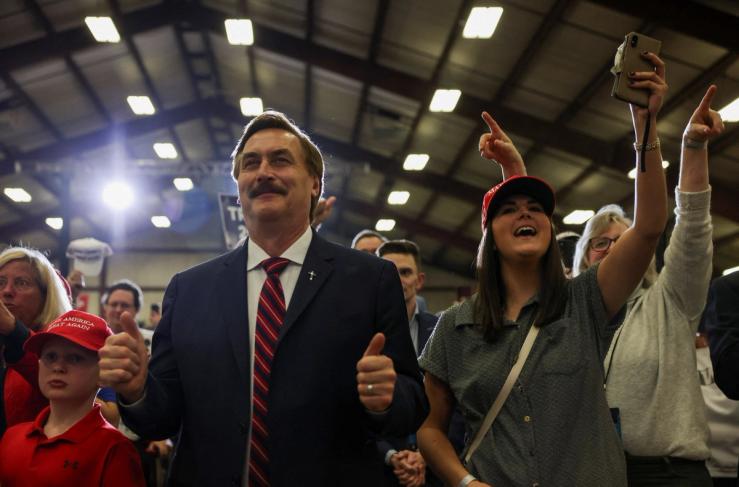
Minnesota Governor (R): Trump’s sway will be tested one more time, for one of his most passionate supporters: MyPillow founder Mike Lindell. The president endorsed Lindell after he couldn’t secure the party’s endorsement at the state GOP convention, and polling shows a tight race between him and state House Speaker Lisa DeMuth. The winner will face Democratic Sen. Amy Klobuchar, whose entry into the race pushed it down on the GOP’s target list. Republicans had hoped to face Walz.
