




The Scoop
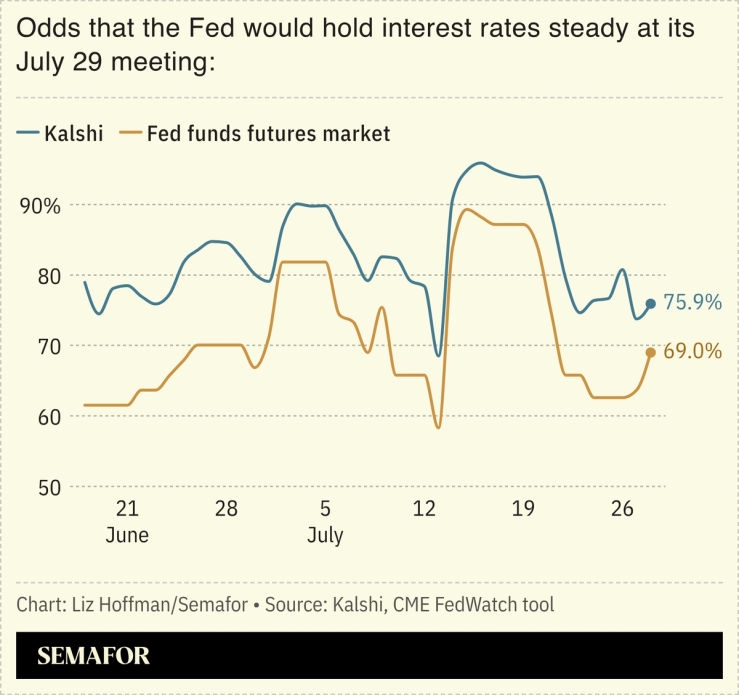
Heading into last week’s Federal Reserve meeting, Wall Street’s favored betting parlor — the Fed funds futures market — put two-thirds odds that the central bank would hold rates steady. Over at Kalshi, the prediction market, the chances were as much as 10 points higher.
They were both right. The Fed held steady.
But in a world where a few basis points separates legends from washouts, a 10-point edge is an enormous windfall for anyone who trusted Kalshi’s numbers over those crunched by CME, the giant futures-exchange operator.
That gap matters because Kalshi is trying to shed its casino reputation, fight back against political opposition, and position itself as a serious player in financial markets. It hired a former Standard Chartered executive to build an institutional business, has encouraged market-makers like Susquehanna to provide trading liquidity, and is building a terminal to compete for traders’ desktop real estate with Bloomberg.
Besides making sure its markets are safe and free from insider trading, winning over Wall Street also requires its bets to be accurate. To that end, Kalshi is out today with some data to help make its case. A study of 2.3 million bets on the platform from its launch in 2021 through the middle of this year, shared first with Semafor, found a high degree of precision, particularly for economic and financial markets like inflation, unemployment, and commodities prices. It uses a measure called the Brier score, which is the gold standard for judging forecasts. Zero is perfect, 0.25 is a coin flip, and a score of 1.0 means being consistently wrong.
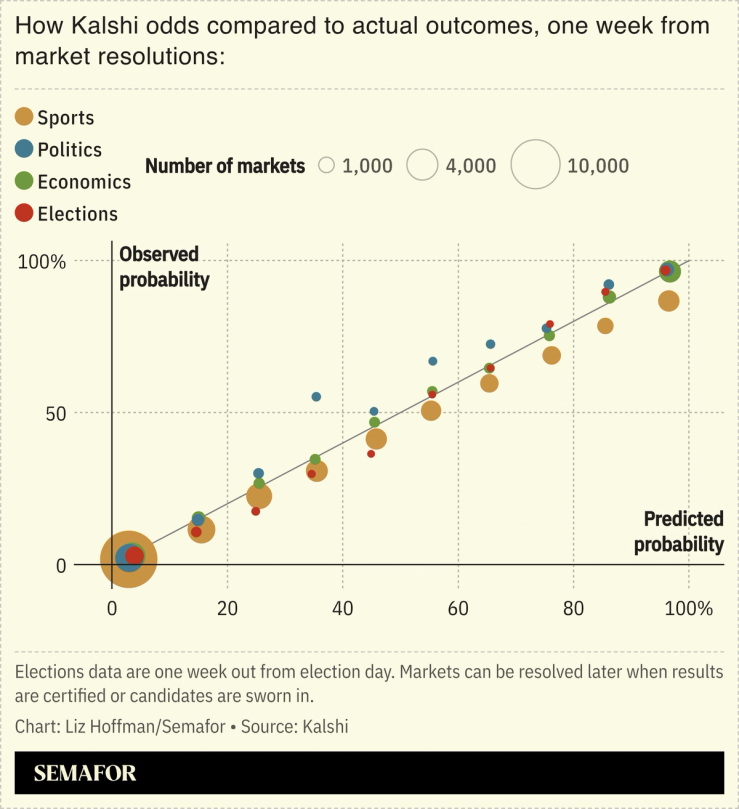
Kalshi markets scored 0.02 just before a market closes — for example, the day of the election or the Fed meeting. Three months before, when even informed guesses are likely to be hazier, that figure was around 0.09, according to the study, which was conducted by Kalshi’s own researchers but draws on publicly available data.
That’s on par with human “superforecasters” — people with a curious but proven ability to call outcomes correctly— and better than leading AI models, according to the Forecasting Research Institute.

Liz’s view
Interest-rate probabilities and job-creation numbers are a huge input into hedge funds’ trading books. Tesla investors want a read on how many cars the company will deliver next quarter. Electric utilities use derivatives to protect themselves against swings in wholesale energy costs. Those players will hook their trading terminals to whichever feed is most accurate.
As I’ve written before, this creates some tension with prediction markets’ efforts to root out insider trading. The best way to nudge a market toward correct outcomes is for someone who already knows the outcome to jump in.
But the study found accuracy was highest in markets hardest to manipulate — elections and economic indicators — and weaker in easier-to-manipulate markets like sports and what words President Donald Trump will say next, known as “mentions” markets.
Wall Street investors who are Kalshi-curious won’t settle for being directionally correct. They need perfection. The closer Kalshi gets, the better its odds of becoming a dues-paying member of high finance.