





David’s view
I doubt that anybody who bundled up for “Menorah in the D,” the 2023 kickoff of Hanukkah in Detroit, knew how much it would end up shaping the 2026 Senate primary.
The event took place two months after Hamas’ Oct. 7 attacks on Israel — in hindsight, a high point of American enthusiasm for the Jewish state. Rep. Haley Stevens, D-Mich., was one of just a few politicians to speak after meeting families of hostages taken by Hamas.
“I take Menorah in the D with me to the United States Congress,” said Stevens. “I will continue to fight for Israel’s existence! Israel comes to me in my dreams! I see Israel’s future! And I know that Israel will continue to exist for the Jewish people!”
By the time Stevens conceded this year’s Senate primary to Abdul El-Sayed, that video had been seen countless times by people voting against her. Barely noticed at the time, it repeatedly went viral on X and TikTok. In July, El-Sayed’s campaign hosted the 19-second clip of her comments on a loop at HaleyFacts.com — “yes, she really said all of this” — with a donation button promising to “make it stop.”
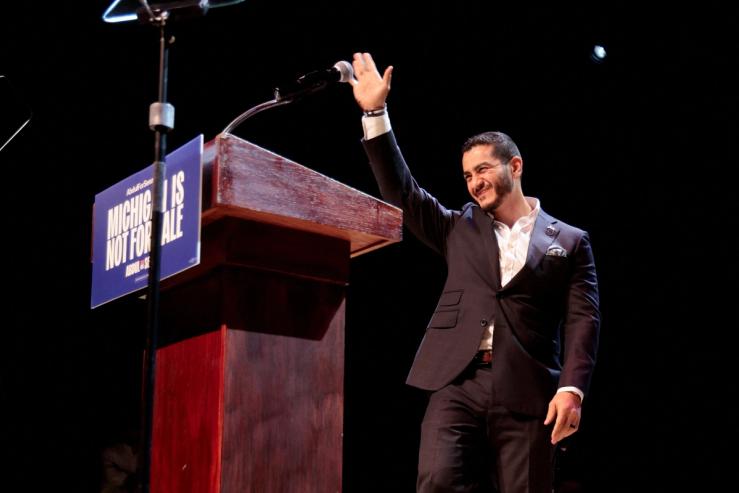
El-Sayed’s narrow victory was the culmination of nearly a decade of work by left-wing activists who are not always active players in the Democratic Party. While his margin of victory was not nearly as high as the polls his team had circulated in the final weeks of the campaign, it was a clear win over AIPAC, the pro-Israel powerhouse that spent in the neighborhood of $30 million for Stevens.
El-Sayed’s nomination is also a win for ridicule. Online Israel critics, whose numbers multiplied throughout 2026, humiliated Stevens. They mocked the congresswoman for reasons beyond her stance on Israel, sharing video of her shouting through a 2020 speech about Covid first responders (“You will see darkness!“), images of her addressing a nearly-empty festival, and supercuts of her pumping her fists.
This struck Stevens and her allies as immature, insulting, and more than a little sexist. They noted, glumly, that left-wingers on social media were often re-sharing Republican clips, creating a feedback loop of Stevens mockery.
Last month, when I asked Stevens about the virality of the “Israel in my dreams” clip, she again reminded me of the context: She was on stage with the families of hostages, weeks after a terrorist attack, with emotions running high.
“Broadly,” she said, “I think the internet isn’t the best place to have discourse around serious and emotional subjects.”
It’s not. But her opponents weren’t trying to have a serious discourse. They were making fun of her, folding a serious argument (that Stevens was captured by her pro-Israel donors) into a silly argument (about Stevens’ personality).
When El-Sayed told me that Stevens couldn’t “string two sentences together,” he meant both that she was a weak candidate and that he believed only money could elevate her over a stronger performer like him. He also benefited from a political environment that is uniquely tolerant of a fanbase acting obnoxiously about a female candidate.
And the final days of Michigan’s primary brought a boom market for ridicule of Stevens. Climate Defiance, the left-wing group whose portfolio includes disrupting both oil barons and Democrats, showed up to film skits criticizing her, with a comedian portraying her. The media didn’t care, but it didn’t need to: Mullaney has more than 200,000 followers on Instagram and more than 100,000 followers on TikTok; her Stevens character was a hit.
There was some more local media attention when Walter Masterson, a left-wing comedian with more than 500,000 YouTube flowers, flew himself to Michigan to troll Stevens.
Local media reported that a “shouting influencer” had wrecked Stevens’ events. Masterson, who had interviewed El-Sayed when the candidate was in New York, wasn’t working with his campaign. But he was surprised by Stevens’ decision to just leave without engaging.
“They’re being pulled into the 21st century, and kicking and screaming because they realize they have to speak to online influencers,” he told me. “They’re calling out for the referee, and there’s no referee anymore.”
President Donald Trump figured out this truism a decade ago by attaching unflattering nicknames to his own opponents. At this point, the only reason not to ridicule candidates is the fear of backlash. That fear keeps diminishing.
Did Stevens outrun the final polls, in part, because some Democrats thought El-Sayed’s supporters were obnoxious? He urged followers on X not to make fun of Stevens’ voice and appearance, but there was a core decision operating underneath that.
El-Sayed and his supporters (correctly) saw the race as a way to make other Democrats cautious about siding with the pro-Israel lobby. What respect was owed to a candidate who needed tens of millions of dollars in outside money, they asked — including ads that accused El-Sayed of being sexist?
Not much was the answer. Maybe just enough to patch things up after the primary.
In this article:

Room for Disagreement
The flip side of Michigan’s uptick in trackers, operatives, and other out-of-context or critical videos: There won’t be a referee in the general election, either. El-Sayed may soon see some of his own supporters’ tactics used against him.
Republicans are already mining his own past videos to criticize him, including one where he observes that “every third video” Instagram markets to him “is going to be some OnlyFans model.”