




Yinka’s view
A push by African countries to build their own space sectors is reshaping competition between the US and China, as governments on the continent seek partners to supply satellites, finance infrastructure, and develop domestic capabilities. But a new report suggests Washington’s approach may no longer align with what African policymakers are seeking.
Governments the world over increasingly view space infrastructure as an economic necessity, using satellite services to improve mineral exploration, telecommunications, weather forecasting, disaster response and national security.
Collectively, African governments nearly doubled their allocated budget year-on-year to $828 million for 2026. The continent’s space economy is projected to exceed $30 billion by 2030, up from $22.6 billion in 2024, according to industry consultancy Space in Africa. As many as 18 countries have developed or acquired at least one satellite as of June 2026 — and six more are planning their first by 2030.
As with many specialized industries, countries that procure complete satellite systems often adopt their suppliers’ technical standards, maintenance networks, and training programs, creating relationships that can last decades and become difficult to unwind. Experts argue those choices will do as much to shape Africa’s future space sector as the satellites themselves.
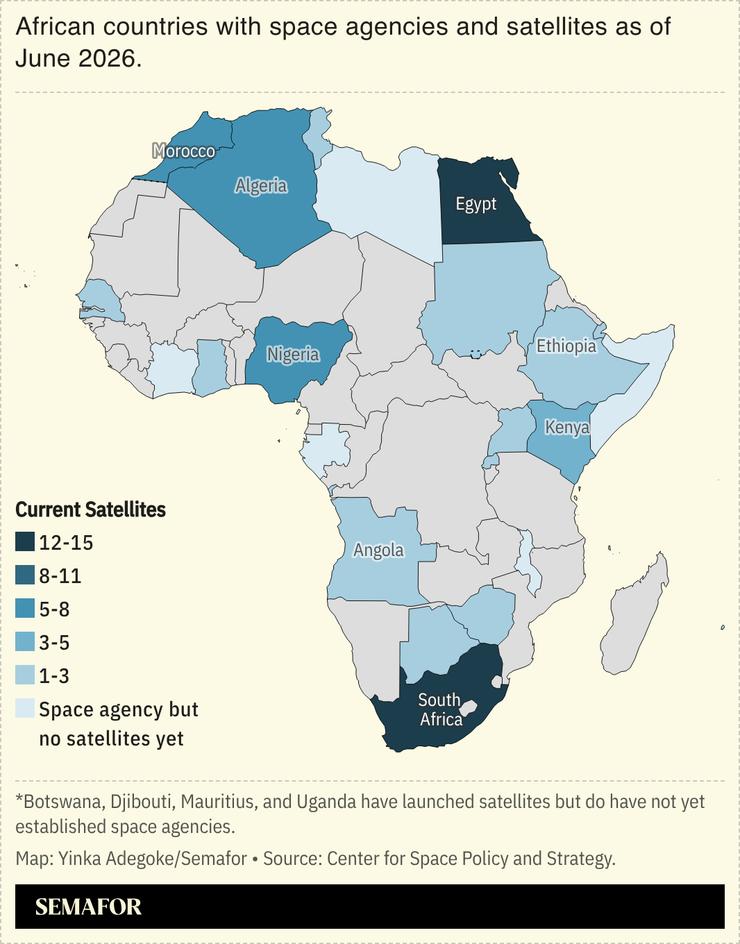
That dynamic increasingly favors China, whose companies have supplied bundled satellite packages — combining hardware, launch services, financing, infrastructure and training — to more than 20 African countries, according to the analysis by the Center for Space Policy and Strategy at the Aerospace Corporation. Europe has offered similar bundled models, while Russia, India, Japan and the UAE also favor integrated partnerships. The US, by contrast, has focused on satellite data, technical training, and regulatory cooperation rather than hardware — and no African satellite has been built by a US company, the report’s author notes. That arguably leaves Washington at a structural disadvantage as African governments seek partners that can help establish domestic space industries.
Most African governments are not choosing sides. Countries including Kenya, Angola and Senegal have cultivated partnerships with China, Europe, Japan and the United States, seeking to maximize technology transfer while avoiding dependence on any one power.

Notable
- China is set to launch Africa’s first lunar science mission in 2029: The Chang’e-8 moon lander mission is due to carry the “Bounced African Low Lunar Sphere” to the moon’s south pole region, in partnership with South Africa, where it will listen for signals from a particularly radio-quiet location.