




The Scoop
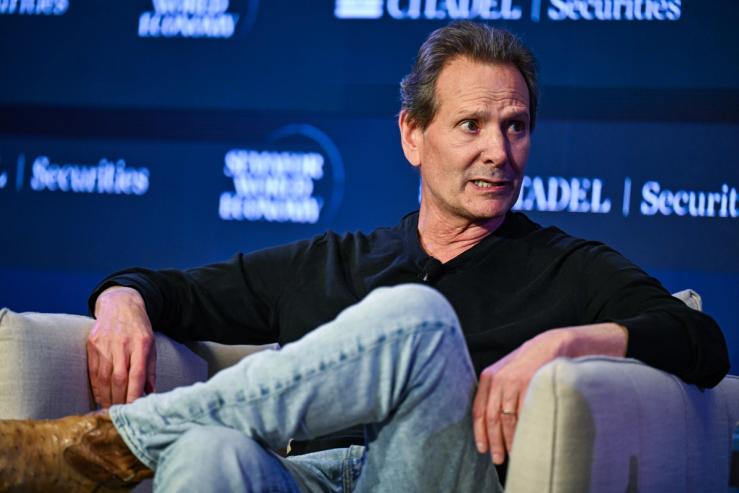
Verizon CEO Dan Schulman is getting his house in order, as the telecom industry braces for the ultimate disruptor, Elon Musk, and as the company’s executives fret about the possibility of a sale.
Schulman will tap a longtime lieutenant with deal chops, Alfonso Villanueva, to run the telecom giant’s $107 billion consumer business, according to people familiar with the matter. He previously ran that wireless division on an interim basis, following the departure earlier this year of longtime executive Sowmyanarayan Sampath, who was seen as CEO-in-waiting.
Villanueva will remain Verizon’s chief transformation officer. He previously oversaw M&A for PayPal under Schulman.
Villanueva’s appointment brings certainty to a unit that represents 78% of Verizon’s revenue but has been without a permanent leader for months. His new position is set to be officially announced Thursday. Verizon didn’t run an outside search process to replace Sampath, some of the people said.
“It’s not a surprise that some employees may be concerned about the direction of the company,” a Verizon spokesperson said. “We’ve gone with a couple of rounds of cost-cutting which have included job cuts.”
Among those concerns: Speculation has swirled among current and former senior Verizon executives that Schulman is readying Verizon’s flagship wireless business for sale to Musk’s SpaceX or another buyer, according to other people familiar with the matter.
Musk looms large over Verizon and its competitors, AT&T and T-Mobile. Semafor reported Wednesday that Musk is exploring ways to grow his spectrum portfolio with an eye on a terrestrial expansion, either via M&A or by competing at next year’s spectrum auction.
Asked directly about whether he would seek to purchase a carrier — specifically, Verizon — Musk in September 2025 said on the All-In podcast: “It’s not out of the question. I suppose that may happen.”
“Any assertion that Verizon is being positioned for a sale to SpaceX — or any other entity — is unequivocally false, unsubstantiated, and entirely without merit,” the Verizon spokesperson said.
SpaceX didn’t respond to a request for comment.
In this article:

Know More
Verizon has been cutting costs, selling off stores, and laying off thousands of employees. While those moves have helped boost shares — and helped it handily outperform AT&T and T-Mobile — they’ve led some employees to worry over the future of the business. With Schulman’s contract only running through 2028, some say they’re concerned the CEO isn’t incentivized to focus on Verizon’s long-term prospects.
Verizon’s spokesperson said Schulman’s contract extension from 2027 to 2028 was a signal from the board of “confidence in his leadership and direction.”
It is unclear who would succeed Schulman. Sampath’s departure, months after he was handed a multimillion-dollar retention package, left the company without an heir apparent. Other than Villanueva, who would be nearly 60 by the time Schulman’s contract expires and an unlikely contender, another executive being considered for the top seat is Abdu Mudesir, a longtime Deutsche Telekom executive who will join Verizon next year, some of the people familiar with the matter said.

The View From the Major Carriers
Buying Verizon, AT&T, or T-Mobile outright comes with regulatory, legal and monetary hurdles. It also would saddle SpaceX with a slow-growing utility business at a time where investors value it for growth, versus buying up all the spectrum and other inputs necessary to build a mobile phone operator from scratch. “The tell for what comes next already sits in the FCC docket,” analyst Roger Entner wrote this week of SpaceX’s attempt to influence spectrum auction rules. “That is not a company shopping for a carrier.”
For their part, the mobile giants are telling investors they aren’t interested in selling — or cutting a wholesale deal with Starlink. “We have the infrastructure in place to put a really robust product in front of them that has been built up over years, and we can do that just fine on our own,” AT&T CEO John Stankey told investors last week.
Asked about competition with Starlink again on CNBC, Stankey said AT&T doesn’t need a satellite partner and can “compete with anyone that will come in.”
“The reality is that they’re coming to the game very late after this industry has been established,” he said. “We have the best broadband product that’s out there...built on the foundation of fiber.”
Likewise, Verizon’s Schulman pushed back when asked about competition from satellite providers like SpaceX and whether the company would enter into its own wholesale deal with Starlink.
“It is very difficult for satellite providers to provide a service that’s even close to what we can provide with our broadband services,” he told investors following the company’s earnings release. “There is no reason that we can see to extend an [mobile virtual network operator] to any satellite player,” he said, referencing Starlink attempts to partner with the major carriers to lease terrestrial towers and offer retail cell phone plans.

Notable
- One friend of Schulman’s may come in handy, should he choose to pursue any deals: He’s known to be close with Goldman Sachs CEO David Solomon, according to people familiar with the matter. Goldman spent years wooing Musk, Solomon noted on an episode of Bloomberg’s Odd Lots. (Schulman and Solomon “have maintained a close personal and professional friendship for many years,” a Verizon spokesperson said, describing their contacts as routine and regular catchups between “long-standing peers.“)