




David’s view
When they’re not fighting each other, which is rare these days, Democrats agree on three points about their midterm election strategy.
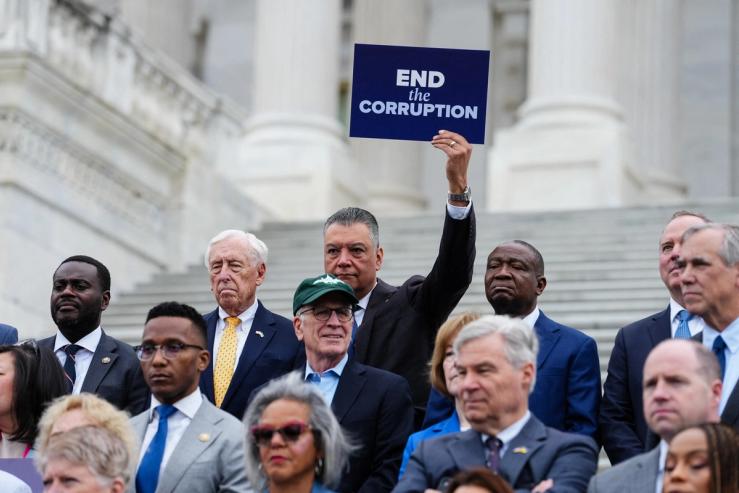
First, they want to talk about affordability. Second, they want to take on corruption. And lastly, the public perception that both parties are crooked makes it hard to talk about the second part.
“My friends who aren’t politically engaged — I say, ‘Trump has made $4 billion since he’s been president, he’s getting a jet from Qatar,’” former Bernie Sanders and Joe Biden adviser Alex Jacquez told me at a progressive conference recently. “And they say, ‘Nancy Pelosi is long on Nvidia.’”
Banning any stock trading by members of Congress is a wildly popular idea, in part thanks to individual lawmakers who made contradictory claims about their own bottom lines. But ironically, when Congress tried to rein itself in 14 years ago, its solution only strengthened the folk wisdom that many lawmakers are getting rich off insider information.
The 2012 disclosure law known as the STOCK Act required members to report any trades made by them or their brokers within 30 days. Five years later, academic researchers found that the law had already been “effective in deterring politicians from exploiting their official positions for personal financial gains.”
What the law didn’t do is dispel the impression that members of Congress are using their access to get rich. It ended up adding a political cost to following reporting requirements, which can generate bad headlines even without evidence that a lawmaker bought or sold stocks with knowledge he or she got from the Hill.
“It did not achieve its design of increasing public confidence in Congress,” said Kedric Payne, the senior director for ethics at the Campaign Legal Center, of the 2012 STOCK Act. “But it did achieve its design of providing more transparency.”
Members of Congress who simply file their paperwork late, an offense far short of insider trading, are hit by the same trust-sapping headline: They “violated the STOCK Act.” Those who set up blind trusts, as the 2012 law encourages, are on the hook if their brokers make money.
That’s what happened with Rep. Tom Kean Jr., R-N.J., whose office reported the trades being made while he was seeking treatment for depression.
“Any normal person reading this story would conjure an image of this member of Congress calling his broker and saying: ‘Buy Johnson & Johnson, buy Exxon,’” said former Rep. Tom Malinowski, a Democrat who lost to Kean in 2022. Republicans blistered Malinowski that year for stock trades he’d made and disclosed late — which didn’t make him less sympathetic to Kean.
“You immediately leap to the conclusion that if this guy’s too sick to be in Congress, why does he have the energy to be stock trading?” added Malinowski. “The reality is that, like the vast majority of Americans who have their retirement savings in the stock market, members of Congress are not directing their trades.”
The “majority of Americans” aren’t convinced. Polls consistently show voters viewing Congress as corrupt.
Entrepreneurial members and candidates respond to this by promising to make the legislative branch an investment priesthood, where serving means subjecting yourself to restrictions you wouldn’t face in the private sector — or in the executive branch, which Republicans don’t want to monitor too closely right now despite a panoply of headlines about self-dealing.
Right now, in fact, House Republicans are preparing to wield their version of an insider trading ban against Democrats who opposed it in a recent floor vote. Those Democrats voted no because, among other reasons, they favored a different approach that would have covered President Donald Trump’s branch of government.
The party is now getting bombarded by GOP attack ads accusing its members of perpetuating insider trading.
“Why would you apply this to a freshman member of Congress and not the president of the United States or the Secretary of Commerce?” said Malinowski. “That makes no sense.”
Scandal leads to new rules, which lead to more scandal. The House’s post-#MeToo rule changes in 2018 clarified that members cannot pursue relationships with their own staff and created a new process for adjudicating harassment claims. Eight years later, a bipartisan push is growing to ban lawmakers from relationships with anyone who works on the Hill. There’s some sincere worry driving these ethics reform campaigns, and a real desire to make Congress incorruptible.
But the impression they leave is of rampant personal corruption, of an institution that’s basically unfixable, populated with crooks who ran to benefit themselves.
It’s a helpful story for this year’s challengers to tell on the campaign trail. And if they win, the people who run against them in two years can tell it about them, too.
In this article:

Room for Disagreement
Dave Levinthal, whose reporting at NOTUS and Business Insider has often focused on members’ personal finances and trades, said that members of Congress wrote their ethics laws; if they don’t like reporters pointing out when their behavior looks bad, they could write new laws.
And while some lawmakers have argued that they’re not directly involved in their trades, Levinthal added, only in-depth investigations can answer the question.
“Anyone who says that is basically asking the public to take their word for it — to trust, but not to verify,” he said. “Because there’s no way to verify what they say, unless you have subpoena power or some extraordinary inside source who can provide that information?”

Notable
- Earlier this month, the Brennan Center released polling that found more than 90% of Americans fretting that corruption was a “big problem” across the government.
- In The New York Times, Charles Homans asks whether voter anger at corruption is rooted in larger frustrations about politics that they don’t think can be solved.