



The News
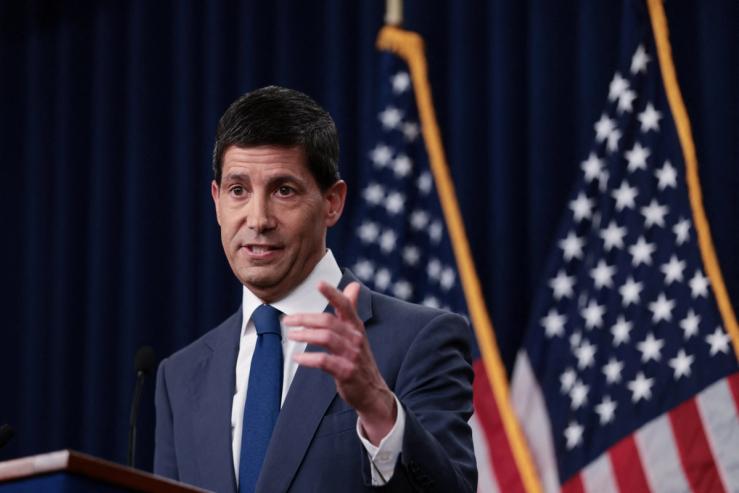
The Federal Reserve said Wednesday afternoon it will leave interest rates unchanged following Kevin Warsh’s second meeting at its helm, a reprieve for President Donald Trump that undercuts his new chair’s continually hawkish rhetoric.
Three bank presidents said the Fed should have raised rates instead, reflecting a lack of confidence in the government’s report that inflation eased in June before the Iran war restarted.
“The five-plus years of inflation above target cannot be cured in nine weeks — or by a single month of modest price decreases,” Warsh, who reiterated his commitment to bringing inflation down to 2%, told reporters.
Asked to reconcile the Fed’s decision to hold rates steady with his lip service to lower prices, Warsh urged patience: “We will deliver … but the suggestion that we’re going to be able to do it with our magic wands is one I want to disabuse you and everyone else of.”
Later, Trump told reporters in the Oval Office that he wasn’t disappointed in Warsh for not lowering rates. “No, Kevin is fantastic,” he said.
“I know he’d love to see lower interest rates, but he’s got a board, and it’s a political board, and they want to keep rates up. But we fight through rates,” Trump continued.

Know More
The Iran war continues to drive oil and energy costs up — but it’s not the only supply shock rippling through the US economy. Tariffs, artificial intelligence, and immigration are also muddying the waters for policymakers.
“A lot of our focus was on trying to understand and identify underlying inflation dynamics amid shocks,” Warsh said. “We’re not looking through them and saying, ‘Oh, they don’t matter.’ What we’re trying to understand is, to what extent are these shocks broadening in their effect.”
Wrash also defended his retreat from so-called forward guidance, or remarks that reveal his thinking on the economy’s trajectory. He pointed to higher yields absent a rate adjustment as proof that “market participants are learning to play the ball, not the referee” amid his silence.
“Surprise is not what we’re solving for,” Warsh said. “What we’re solving for is how to make the best decisions,” including “by not spoon-feeding markets” or “giving nudges.”
His planned remarks at next month’s Jackson Hole Economic Policy Symposium, hosted by the Kansas City Fed, are so far “a blank piece of paper,” Warsh said. He added that he planned to “check back in” with his newly created taskforces before to see how they might inform his speech.
Warsh also defended his appointment of venture capitalist Marc Andreessen, who has backed candidates opposing AI regulation, to one of the taskforces: “The judgments we’re making will be informed by, but not at all determined by, these outside groups.” And he said he would continue to hold regular press conferences, something he’d previously indicated he’d do only if there was news, through the end of the year.
Shelby Talcott contributed reporting.