




Andy’s view
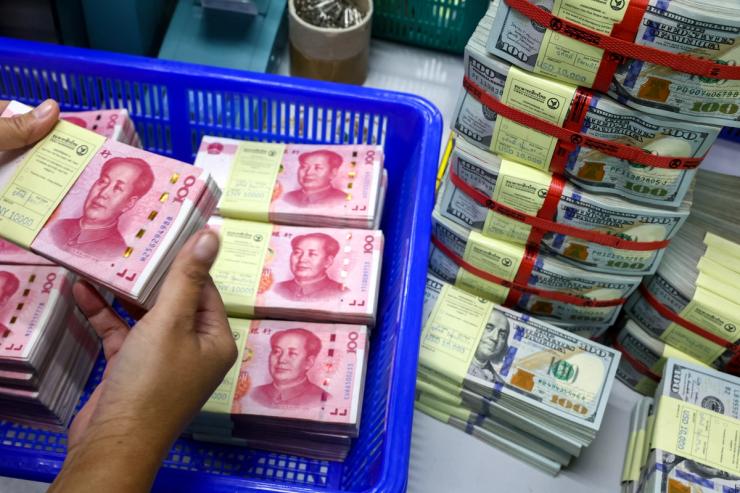
In theory, China’s record-breaking trade surpluses — $125 billion in June alone — should boost the currency, as foreign importers scramble for renminbi to pay for all the EVs, solar panels, and AI-related hardware pouring out of Chinese factories.
In practice, Beijing is trying to ensure the opposite.
The authorities are focused on plugging holes to prevent money fleeing the country and, potentially, crashing the renminbi. Last year, up to $1 trillion is thought to have left. Securities regulators are cracking down on Hong Kong brokerages used as conduits by wealthy individuals to move funds offshore. Big banks and insurers in the territory are vetting their mainland Chinese customers more carefully. Bloomberg reported that HSBC has limited travel to the mainland for its Hong Kong-based private bankers.
Downward pressures on the currency, despite surging overseas sales, highlight the tension at the heart of China’s growth model: External strength is overwhelmed by internal weakness, seen in plunging rates of investment and faltering consumption.
The dissonance is reflected in the gap between the confident pronouncements of Chinese leaders — aimed at an international audience — and their domestic anxieties. Last week, Chinese leader Xi Jinping pitched his country as the vanguard of the new AI era. Yet his administration is doing everything it can to prevent its own citizens from joining the global AI-driven investment boom, one of the greatest asset run-ups in history.
Indeed, some analysts think the recent tightening over financial outflows is partly designed to avoid a stampede by Chinese investors for the Nasdaq.
China’s official GDP data, buoyed by exports, look reasonably solid: In spite of recent weakness, 2026 growth is still expected to meet the government’s 4.5% to 5.0% target. But if the economy is doing so well, why do so many Chinese savers want out?
Capital flight has deep political roots. The country’s entrepreneurs have never forgotten the lessons of “Liberation” in 1949 when the Communists took power, wiping out the landlord class in a bloodbath and seizing their land. To this day, all urban land is owned by the state: Residential property deeds are generally 70-year “land use rights” — not freehold arrangements — and nobody knows what will happen when they expire. In spite of legal safeguards, the wealthy still fear expropriation.
Meager investment returns in China also drive money toward the exits. The government keeps bank interest rates low to support corporate borrowers, penalizing depositors. The stock market is a chronic under-performer. Property prices are down 30% or so from their peak.
And the banking system itself is fragile. China has funded its rapid growth through one of the greatest monetary expansions of all time; Michael Cembalest, the Chairman of Market and Investment Strategy at J.P. Morgan Asset and Wealth Management, notes that Chinese banking assets, at $60 trillion, are now equal to around 50% of global GDP. If China fully opened its capital account, he writes “possible outflows could crush the RMB and trigger a collapse in Chinese equity/real estate markets.”
As a result, vast pools of savings are trapped inside China behind a wall of capital controls.
This arrangement, incidentally, ensures that the renminbi won’t displace the dollar as the world’s preeminent reserve currency any time soon; foreign holders need to know they can get their money in and out of China freely. Indeed, one could make the case that if the renminbi did topple the dollar, we’d all be better off: It would imply a wholesale overhaul of China’s economic model — and, most likely, its legal and political structures — in ways that would help redress global economic imbalances, including wildly lopsided trade.
As it is, economies now being swamped by China’s export surge, especially in Europe, are agitating for China to engineer a currency appreciation.
The economic historian Adam Tooze points out the irony here: To push the currency up against the downward pressure of outbound capital flows, Beijing would have to tighten controls that keep Chinese savings at home. In other words, Tooze writes, “more financial repression is the unmistakable implication of calling for revaluation.”
A likely outcome is that China will resist appreciation, and screw down capital controls even more tightly. In that scenario, China’s long-suffering savers would be double losers.
In this article:

Room for Disagreement
Brad Setser, a former US Treasury official, challenged the consensus view that China is artificially propping up the value of the renminbi. He argued that inflows from China’s massive trade surplus are now larger than the desire to get money out. “The preponderance of evidence suggests that China has been resisting pressure on its currency to appreciate,” Setser wrote. He concluded that it would not be unreasonable for Europe to demand that China allow a stronger renminbi to protect their economies.

Notable
- Iran has reportedly allowed some tankers through the Strait of Hormuz on the condition they settle transactions in renminbi, one of several ways the war has served Beijing’s strategic objectives, Fareed Zakaria argued in The Washington Post.