



The News
President Donald Trump is toying with a return to tariff maximalism, deploying a legally dubious negotiating tactic against Canada that promises to again spike Republican lawmakers’ blood pressure.
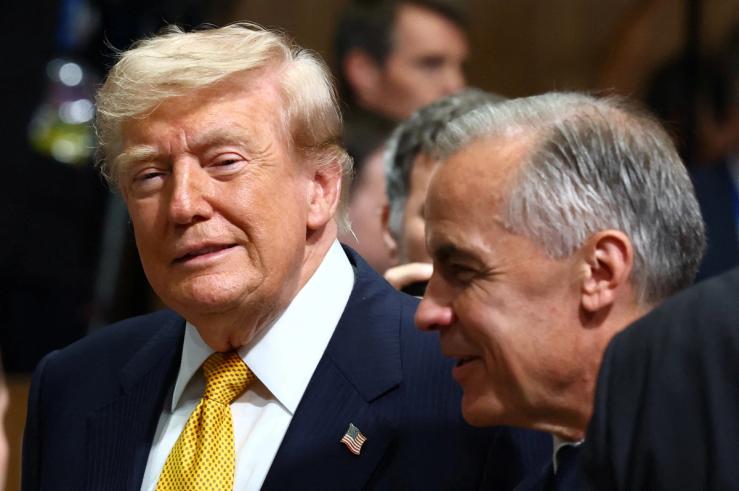
Trump and Canadian Prime Minister Mark Carney agreed Tuesday “to intensify negotiations,” Carney told reporters, before the president imposes 50% tariffs on Canadian alcohol, dairy and more next month. If they can’t reach an agreement, legal challenges are likely to greet the latest levies — injecting further uncertainty into the US economy at the height of a tough midterm campaign for his party.
Republican lawmakers now must swallow a new round of US-Canada trade barriers that have damaged a key alliance and made it harder to insulate their battleground candidates against Trump’s sagging pre-midterm economic approval.
“I’m curious to know a little bit more about the rationale for it,” Senate Majority Leader John Thune said. “As you know, I’m not a huge fan of tariffs as a general rule.”
Thune’s fellow South Dakota Republican Rep. Dusty Johnson used an identical word: “I want to understand more of the administration’s rationale. But Canada is a strong trade partner, and in general, I think our countries would be better off if we had stronger trade deals.”
It’s a different story in Canada, where Carney enjoys broad political support for resisting Trump’s pressure campaign on trade. Six in 10 Canadians view a deal to save the US-Mexico-Canada Agreement as urgent, polling firm Abacus said Tuesday, but only one in five say Canada should make compromises to get one earlier.
The opposition party even wants Carney to go further, suggesting that the US and Canada also revisit a recent deal to share revenue from the new Gordie Howe Bridge connecting Ontario with Detroit.
“What the administration is trying to do here is to amp up pressure on Canada to get them to make more concessions in the USMCA negotiations,” said Peter Harrell, an attorney who served as former President Joe Biden’s senior director of international economics.
“What this might just as easily do in Canada is force them politically to dig in despite the costs — and actually retaliate and escalate in response,” he added.
Administration officials announced the tariffs on Monday, less than a month after USMCA lapsed amid a US desire to renegotiate the pact Trump inked during his first term. All affected goods are viewed as hangups for the US in Trade Representative Jamieson Greer’s negotiations over a new agreement with his Canadian and Mexican counterparts.
“The Canadians have always been willing to engage if engagement means talking and meeting,” Greer told CNBC after Carney discussed what Canada has already proposed.
Those Canadian “proposals are generally for promises to discuss these issues, which we’re already doing — not to actually change these things,” added Greer, set to testify before Congress on Wednesday. “And for us, we want them fixed.”
Greer’s office did not comment for this story.

Know More
If the promised tariffs take effect, they would cover “a very small swath of goods,” University of Toronto professor Joseph Steinberg said, making them “almost entirely symbolic.” He pegged the affected trade at 5.5% of previously tariff-free Canadian exports.
The tariffs would also almost certainly face a court challenge, likely by US importers — who filed the suits that spurred the Supreme Court to overturn Trump’s most sweeping tariffs earlier this year.
Greer signaled Tuesday that the administration is working on a new way to replace those broad levies, since its previous strategy to sustain them expires at the end of this week.
The US and Canada have each “muddied the waters to the extent that litigation [of any USMCA violations] is not going to be fruitful for either side,” Steinberg said.
The US’ bigger problem is its invocation of Section 338 of the 1930 Trade Act to announce the latest Canadian tariffs. This week is the first time that the statute has been used in such a way.
“This will be a fun one to see litigated,” Harrell said, since “it is unclear if this statute is still on the books.” He also questioned whether Section 338 can be used without first involving the International Trade Commission.
USMCA remains in effect while talks continue. Officials on all sides are hoping to reach a fresh agreement by the end of the year, a Mexican official said this week.
“There is a view up here and elsewhere that maybe this could end up as a series of rolling 30-day notices, upping the pressure as we get into the crux of the [USMCA] negotiations,” said University of Toronto professor Drew Fagan, a former Canadian government official.
The new tariff threat arrived as northern US states grappled with the air-quality effects of Canadian wildfire smoke, the subject of a separate tariff warning from Trump. Wildfire tariff talks are continuing separately, a senior administration official said Monday.
But the fallout from the smoke migration may be helping the administration indirectly by easing pushback from northern border-state GOP lawmakers.
“My kids can’t even go outside because Canada can’t manage their forestry, [so] something has to be done to compel them,” Rep. Tom Barrett, R-Mich., said when asked about the tariffs. “I’m not endorsing things; I’m just telling you that wildfires are a f*cking mess.”
Other congressional Republicans reiterated the reservations they had about previous tariffs on Canadian goods — namely, their effect on already-high consumer prices.
“I voted against the Canadian tariffs before and I think there were good reasons for that,” said Rep. Kevin Kiley, I-Calif., who caucuses with Republicans. “This has created major or significant increases in costs across a number of sectors, so clearly, any escalation or return to that would raise the same concerns.”

Room for Disagreement
A handful of GOP lawmakers who have spoken out against tariffs, including some from midwestern states whose agricultural industries got walloped as a result, were optimistic that Trump’s new levies would get Canada to cave on USMCA.
“I don’t like tariffs, but I understand what he’s doing,” said Rep. Joe Wilson, R-S.C.
“Even though I’m not a fan of tariffs, there are a lot of reasonable people who understand that engagement is so important, and that’s what’s key here to move forward,” said Rep. Adrian Smith, R-Neb., who chairs the House’s trade subcommittee.

Eleanor and Nicholas’ View
Republicans told us earlier this year that Canada should just ignore Trump’s tough talk, dismissing the president’s attacks as “just a blip.” That advice is looking increasingly obsolete.
Economically, this week’s tariffs won’t change much: Even if officials can’t find an off-ramp or if the courts don’t strike them down, they’ll affect only a fraction of exports.
Politically, it’s a different story: US-Canada relations aren’t guaranteed to look the same on the other side of this.
“There’s always been a very strong demand from voters here in Canada to fight back in some way,” Steinberg said. Now, “making concessions … in the aftermath of what appears to be a reasonably significant concession on the Gordie Howe Bridge is a politically difficult thing for them to do.”

Notable
- The Cato Institute’s Scott Lincicome described Section 338 as “the nuclear option for Trump tariffs” to The Associated Press.
- Canada is preparing for the Gordie Howe Bridge to open next week as scheduled but scrapping plans for a joint celebration with the US in light of Trump’s trade escalation, the Canadian Broadcasting Corporation reports.
Burgess Everett contributed.