




The News
The future of college athletics may hinge on a last gasp of bipartisan collaboration in the Senate in the dog days of summer.
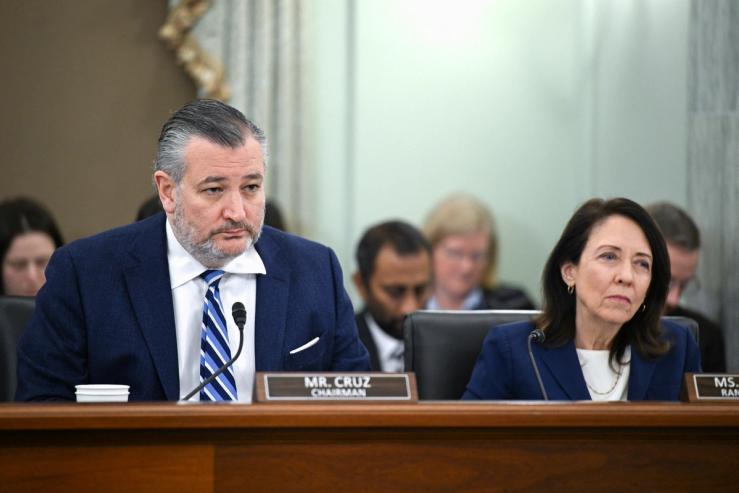
Sens. Ted Cruz, R-Texas, and Maria Cantwell, D-Wash., are racing to win the support of the two most powerful college sports conferences in the country, the Big Ten and the SEC, for their proposal to create national rules of the road for young athletes, coaches, and the system. Big Ten and SEC skepticism of the duo’s latest legislative rewrite complicates their efforts to break a filibuster — and the bill probably needs a lot more than 60 votes to convince the House to take it up.
The two athletic conferences standing have schools in 26 states, a brawny bipartisan geographic and political footprint. And with billions of dollars in potential broadcast revenue and scholarship value at stake in the talks, the senators are stepping up their lobbying push to clinch the deal.
“This bill accomplishes a great deal of what they and every other commissioner have been asking Congress to accomplish,” Cruz told Semafor in an interview this week of his latest talks with Big 10 and SEC leaders. “Those conversations were very positive. And I have also spoken to many of the member schools of the SEC and Big Ten.”
Cruz wants to finalize a deal before the college sports season begins in late August, to give athletes and colleges some certainty heading into the academic year. The Big Ten and SEC are open to a deal but remain concerned that the Commerce Committee’s bill puts them at risk for significant state-level litigation and lacks sufficient antitrust protections, according to a summary of their concerns obtained by Semafor. The bill would likely have 60 votes on the Senate floor as written, but with support from the two conferences could probably win over roughly 75 senators — and House GOP leaders from power conference states, according to a person working on the bill.
Democrats and Republican leaders both surveyed members last week on the college sports plan, which indicated an uncertain whip count on the floor and work still to do on amending the plan, according to senators and aides. Cruz and Cantwell are competing for floor time with Russia sanctions, government funding, and other priorities with six weeks left in session before the election.
A House bill has repeatedly stalled across the Capitol. Cruz contended the Senate bill can’t wait for the lame duck — or even worse, the next Congress.
“I don’t think we have another year to waste. We’re seeing irreparable damage,” Cruz said. “My hope is that the president will sign this into law before this school year starts, so that this upcoming season no longer has to go through the chaos that is doing so much damage to the athletes, to the schools, to the conferences, and to the fans.”
His bipartisan proposal would preserve student athletes’ ability to make endorsement money, limit transfers and eligibility, allow colleges to pool media rights, regulate agents, and prevent football coaches from leaving midseason. It avoids weighing in on whether student athletes are university employees, a polarizing issue that could have tanked any deal.
Major conferences, including the Big Ten and SEC, have long pressed Congress to step in as college sports has been upended by ongoing legal action and other shifting norms, from the transfer portal to the rise of paid student athletes.
But now, in the red zone, the details are preventing an easy touchdown.
Cantwell told Semafor that she and Cruz are open to changing the bill further to win over the biggest and most influential athletic programs. But senators in both parties told Semafor that they won’t back the bill unless their home universities from those conferences get on board.
“I’m withholding my support until Chairman Cruz and others involved can find a way forward that would satisfy the Big Ten,” said Sen. Jim Banks, R-Ind., whose state has two schools in the conference. “It’s unfair to cap the Big Ten’s growth and screw the Big Ten and allow other conferences to grow.”
Asked what might happen if nothing is done, Banks quipped: “Well, then Indiana University would win another national championship in football and basketball. So I’m all for that.”
Yet Cruz sees no time to waste, as non-revenue-generating sports continue to fold at universities big and small, hampering US competitiveness in Olympic sports. What’s more, inaction could shut down a valuable education pipeline.
“If we don’t act, hundreds of thousands of those scholarship positions will go away, and that is the avenue for over time millions of young men and women to go and get a college degree and get skills that put them on a path to success,” Cruz said. “All of that is jeopardized by the status quo.”
In this article:

Know More
Other college sports conferences say the bipartisan bill is the only real deal on the table. Atlantic Coast Conference Commissioner Jim Phillips said this month that the Cruz-Cantwell plan “represents the best chance for Congress to assist college sports and address some of the majority issues that plague it.”
The Big Ten and SEC also want legislation to pass to avoid further disruption to college sports but worry that the bill “might actually just make things worse” than the current system, said a person familiar with conversations. The person said the ban on a super league is actually not the conference’s top concern.
“We are willing to give a lot and eat a sh*t sandwich in exchange for meaningful antitrust protections and preemption,” the person said. “I don’t think that this bill provides meaningfully what we need from that perspective to justify many of the things that are in here.”
A Big Ten spokesperson told Semafor the conference’s position hasn’t changed: “We still do not support the bill in its current form but continue to engage with the bill’s sponsors and other legislative partners in an effort to make improvements.”
Donde Plowman, Chancellor of the University of Tennessee and the chair of the SEC’s presidents and chancellors, told Semafor that the current system is “unsustainable” and praised the bill’s limits on transfers and eligibility.
“The SEC has also been clear and transparent with our congressional stakeholders about critical amendments to the bill, such as antitrust and preemption language,” Plowman said. “We are eager to see refined bill language as time to a vote draws near, and are hopeful updated language will address these important issues.”
Sen. Gary Peters, D-Mich., said he’s open to a compromise, as are Michigan and Michigan State: “They like a lot of aspects of the bill, so there’s just some particular ones that they have issues with.”
The University of Texas and Texas A&M, however, “made clear they don’t like it. It just needs some work,” said Sen. John Cornyn, R-Texas.
The impasse has frustrated the bill’s supporters. Some blame the Big Ten and SEC for thwarting the legislation.
“Those two leagues are all about the money,” said Sen. Roger Marshall, R-Kan., a former collegiate athlete in track. “I’m afraid they’re putting money ahead of academics and ahead of amateurism.”
The bill has major Washington endorsers in its corner. Cruz said President Donald Trump is “enthusiastically supporting” him. Senate Majority Leader John Thune, R-S.D., a former college athlete, is also backing the plan.
Thune told Semafor that “everybody comes in here and pounds on us about we need something” and that passing the bill will be a “major accomplishment.” He also said he wants to know that the bill has a path to break a filibuster before he sends it to the floor.

Room for Disagreement
Not every senator from a Big Ten state is holding out for the sake of one school in the conference.
“I consulted a wide variety of stakeholders on the issue. University of Wisconsin, Marquette University … the Big Ten, labor, ACLU, civil rights groups,” said Sen. Tammy Baldwin, D-Wis. “I voted against it [in committee] based on all of that.”

Burgess’s view
Every year, the calls for Congress to do something about the chaotic condition of college athletics grow louder. Cruz and Cantwell responded, a sign that bipartisan dealmaking isn’t totally dead in the Trump era.
But on this particular issue, cross-aisle cooperation isn’t enough. Each state has its own unique perspective on college athletics; Alabama and Michigan, with iconic football teams, see it differently than Vermont or South Dakota.
As Thune considers when to call the vote, it looks impossible to mitigate all risk: No version will make everyone happy.

Notable
- The House bill was pulled in May, Roll Call reported, leaving the Senate’s legislation as the vehicle for a deal.