




The Scoop
Artificial intelligence made it possible for anyone to build apps. Applied Intuition, the $15 billion startup that supplies the software infrastructure behind self-driving cars, autonomous trucks, mining equipment and military drones, wants to do the same thing for the world of autonomous machines.
On Tuesday, the company unveiled Dana, a new service that allows developers to use natural language to simplify the building and testing of autonomous machines. Customers with almost no technical background can collect and label sensor data, run simulations, and validate that a robotic device or vehicle behaves safely in the real world.
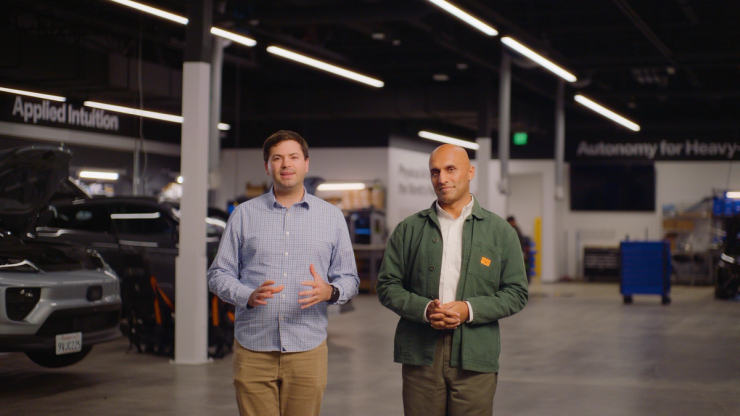
“Imagine you have a teenage son who wants to create an autonomous lawnmower, or a room-cleaning robot. You would need a team of probably 5 to 8 engineers today,” said Qasar Younis, CEO and co-founder of Applied Intuition. “We want to push that down to virtually one person.”
At first, Dana will be available mainly to Applied Intuition’s large enterprise customers, starting with those in the automotive, trucking and heavy industries, where the company’s tooling runs deepest. In the coming months, the company plans to add more functionality and self-serve features to allow a wider range of use cases and users, eventually reaching individual tinkerers.
The plan marks a new direction for Applied Intuition, which made a name for itself signing up major companies like Porsche, Isuzu and Komatsu, which are willing to pay top dollar for help designing state-of-the-art software.
“The only way we get to intelligence on a billion machines is we make it ubiquitous,” Younis said. He compares this moment in robotics to the web of the mid-1990s, when the idea of a billion websites sounded absurd because building one still required specialists. “I think the use cases that will emerge by lowering the barrier to develop autonomous systems and deploy intelligence are beyond what we can imagine right now.”
Dana’s core selling point is that customers don’t have to start from scratch. The platform is built atop data collection, software development, safety guardrails and tooling amassed by Applied Intuition for nearly a decade.
In this article:

Step Back
Applied Intuition’s Sunnyvale headquarters are unlike most Silicon Valley startups. Cars, trucks, and big rigs sit in various states of disassembly as engineers test and validate software designed to turn otherwise ordinary machines into rolling robots.
In one section of an enormous garage, a pickup truck is being programmed to enter the battlefield, without a driver, and launch anti-drone munitions. Around the corner, a self-driving truck is a guinea pig for autonomous driving software destined for Japanese roads.
In the offices above the garage, employees work in slippers at spotless desks — a mandate inspired by Japanese culture that Younis picked up while working for Bosch in Japan.
Younis, who cut his teeth at General Motors in Detroit before beginning his Silicon Valley career, saw an opportunity in helping traditional automakers catch up to the tech industry on software. Applied Intuition, for instance, is building the operating systems that run everything from infotainment systems to automatic doors.
The company has since diversified into other industries like construction, agriculture and defense. The automotive industry, he says, accounts for roughly a third of the company’s revenue today.
Along the way, Applied Intuition has collected a decade’s worth of data and expertise on imbuing most things that move with “physical intelligence.”
Peter Ludwig, Applied Intuition’s co-founder and chief technology officer, talks about entirely new categories. “Imagine if you could buy a robot to maintain your garden. There’s going to be a lot of people right now that just have unmaintained gardens that are going to buy that thing because they want a nice garden,” he said.
There is also a missing-link effect in robotics: Every gap that gets automated creates demand to automate the ones around it. In a biotech lab, robotic pipetting machines can already run experiments, but humans still have to set them up and ferry samples from station to station. A robot that fills that gap turns it into a facility that runs around the clock.
Younis sees a repeat of the smartphone era, when years of infrastructure-building suddenly gave way to an explosion of applications: The universe of physical AI applications, he added, “really will make the App Store look small.”
One example is the construction industry. In the US especially, construction costs have skyrocketed and the labor force has dwindled, slowing the development of infrastructure and new housing. “We would build a much bigger solar farm, we would build many more windmills, effectively, if we had the labor to do it,” Ludwig said.

Know More
Dana looks less like the industrial software it replaces and more like a chatbot. In a demo, an Applied Intuition product manager typed casual requests into a chat window: “Show me a segment set.” The system pulled up camera footage from the company’s data-collection cars in Stuttgart, Tokyo and San Francisco, with labeled data that companies can use to train or finetune their own models.
“There are parts of our platform that you almost need a PhD just to understand,” Ludwig said. Dana puts an easy-to-understand AI agent on top of all of it.
The difference shows up in tasks like validating automatic emergency braking. Automakers used to assign systems engineers to read the entire New Car Assessment Program handbook, translate dozens of requirements into test scenarios by hand, and run them. Now Dana runs the simulations and returns a graded report on how the braking system performs, along with the specific situations where the car fails to stop in time and suggestions on what to fix.
Asked for a snowy day, Dana’s world models regenerate an entire driving scene in snow, rain or sunshine, across every camera on the car. Simulated traffic is populated by AI drivers trained through reinforcement learning to be deliberately difficult, cutting off the test vehicle to probe its weaknesses.
Applied Intuition has been using Dana internally for over four months and with select customers like Isuzu and heavy-equipment manufacturer Komatsu.

Reed’s view
Marc Andreessen (who happens to one of Applied Intuition’s major investors) once wrote that software was eating the world. He was right, but software could only reprogram so much. When we have software that can see, understand and manipulate its surroundings reliably, the physical world gets eaten, too.
We’re obviously not there yet, and it may require robots with hands as dextrous as the human versions to fully complete the transition. But I don’t think people have fully digested how profound this change will be.
These advancements are often looked at through the lens of labor replacement, but that is extremely narrow. It will be more like 3D printing reality itself.

Room for Disagreement
Not everyone thinks a world where anyone can automate anything is one we should sprint toward. MIT economist Daron Acemoglu, who won the Nobel Prize in 2024, has spent years assembling evidence that automation’s gains don’t automatically reach workers. His research with Pascual Restrepo found that every industrial robot added per thousand workers measurably reduced employment and wages in the communities where it landed.
AI aimed squarely at replacing human labor, he has written, is “the worst of all possible worlds.” It makes productivity gains for business owners and displacement for everyone else. Stanford’s Erik Brynjolfsson calls this “The Turing Trap.” Technology that augments humans spreads prosperity, but technology built to imitate and substitute for them concentrates it. Lowering the barrier to physical AI so that one person can do the work of eight engineers is precisely the kind of change both men would say demands as much attention to who benefits as to what gets built.