




Reed’s view
Over the last decade, experts in artificial intelligence learned a “bitter lesson”: Their own knowledge was getting in the way of progress. “The actual contents of minds are tremendously, irredeemably complex,” computer scientist Richard Sutton wrote in 2019. The most successful AI breakthroughs involved humans getting out of the way and allowing increasingly powerful computers to take over.
The same humbling lesson is now being learned by scientists in the field of biology. I’ve spent most of this week in Boston, meeting with leading thinkers in biotech for a podcast series airing later this fall. It’s clear that what we think of as science has changed, and is about to change even more.
There’s a new generation of drugs about to hit the market that didn’t originate with elegant hypotheses, but rather from brute-force analyses of massive datasets. Future discoveries and therapies will come not from a human-like understanding of science, but by simple pattern recognition of new biological information at scale. It’s as if an unfathomable amount of spaghetti is being thrown against the biggest wall ever by computers and robots.
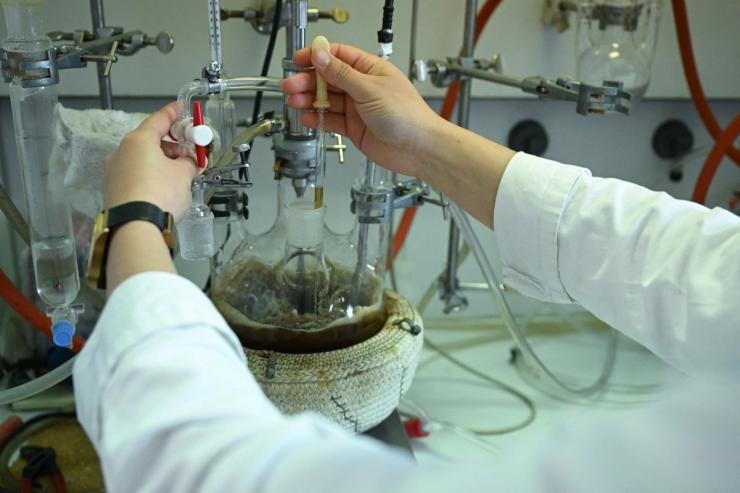
New scientific methods using nanotechnology and AI allow us to measure more aspects of human biology, such as the thousands of proteins found in human blood. Better computational methods are finding meaningful patterns in that data, making it even more valuable. And in the coming years, humanoid robots with dexterous hands will automate the other parts of lab work, such as handling mice, or slicing thin layers of tissue. Every lab will be able to operate 24/7, making it possible to do experiments that today take too long and cost too much.
Cloud labs will be able to use an AI chatbot to conceive of a research study, then simply hit a button to have it carried out in real life. AI models will operate in agentic loops, running physical experiments in fully automated labs, analyzing the results and then coming up with new experiments based on the findings.
Sutton’s bitter lesson is applicable to biology because so much of the human body — not just the mind — is still beyond our understanding. And we’ll find the way forward by industrializing trial-and-error experimentation until the breakthroughs materialize.
What comes next is going to be strange and, at times, controversial (imagine animal studies in this coming era). It will also save a lot of lives.

Notable
- Biohub, the Mark Zuckerberg-funded institute, unveiled in May an AI “world model of protein biology,” Axios reported.
- Nvidia last month announced BioNeMo, an agentic toolkit meant to accelerate scientific discovery.