




The News
Senate Democrats are adopting a new strategy in their Maine Senate primary: staying all the way out of it.
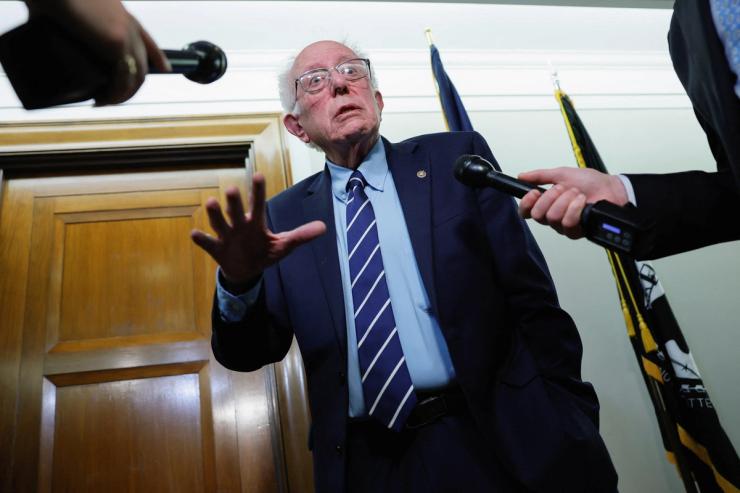
Chief among them is Bernie Sanders, who propelled Graham Platner’s rise and supported the gubernatorial bid of Troy Jackson. Though Jackson is seeking the progressive mantle in the race to replace Platner on the ballot, the Vermont independent is done with trying to be a Pine Tree State kingmaker.
“It’s an unprecedented moment. The people of Maine should work it out themselves,” Sanders told Semafor this week. “Right now it’s best that the people of Maine make their own decisions without outside influence.”
Sanders is no outlier as the Maine Democratic Party weighs who to nominate. Democratic lawmakers seem to have gotten the message that their forays into Vacationland did not help their effort to defeat Sen. Susan Collins, R-Maine, according to interviews this week with multiple senators.
It’s a massive course correction for the party, which was bitterly divided over Platner even before he was accused of sexual assault.
Despite the proxy battle that this year’s Senate primaries have become, pitting the left against the mainstream, there’s little upside for any senators to put their fingerprints on the Maine do-over. Sen. Peter Welch, D-Vt., said that Mainers “don’t need outside advice or interference.”
The neutrality also suggests that Democrats are wary of backing relatively unknown candidates after Platner’s political demise.
Jordan Wood, a Senate candidate who ran for Congress in Maine’s battleground district, said that “it seems DC has finally learned how to read the room. Mainers will choose their next senator — not Chuck Schumer, not Washington lobbyists.”
The Senate minority leader, whose reservations about Platner were vindicated by the candidate’s implosion, is staying on the sidelines; so is the Democratic Senatorial Campaign Committee. Both had supported Maine Gov. Janet Mills against Platner.
A DSCC spokesperson said that “Maine Democrats are selecting their new nominee, and the DSCC looks forward to working with the Democratic nominee to defeat Susan Collins and win a Senate majority.”
“Maine is trying to run a process that works for Maine, and I want to leave them to it,” said Sen. Elizabeth Warren, D-Mass., who endorsed Platner in March. “They’re trying to put together a process, and I want to give them plenty of space to do that.”
Still, there is intense interest in the race, and Schumer is eager to get a nominee. He believes his party’s chances of defeating Collins are better than they were before Platner imploded, according to a person familiar with his thinking.
He has one advantage already: It will be a completely different campaign, without the negative advertising bomb that Republicans had planned for Platner.
“It’s winnable, because I think there’s a lot of energy and momentum for change,” said Sen. Chris Van Hollen, D-Md., a former DSCC chair. “Independents in Maine, working people in Maine, they are fed up with the Washington status quo.”
Collins told Semafor that “it’s certainly an unusual situation” not to know who she is running against, but said that she’s still not weighing in on the candidates: “It’s up to them to decide.”
Maine Sen. Angus King, a former governor and an independent who caucuses with Democrats, said he has “no comment” on the process, which starts with delegate selection this weekend and culminates in a nominating convention on July 25.
Among the candidates running: former state Senate president Jackson, Wood, former Centers for Disease Control and Prevention official Nirav Shah, Maine Secretary of State Shenna Bellows, and brewer Dan Kleban.
Jackson, Shah, and Bellows ran for governor. Collins previously defeated Bellows in 2014.
Bellows has not spoken to Schumer or the DSCC, according to a person familiar with the matter. And though no Senate Democrats have endorsed a candidate yet, Shah has drawn opposition from Sens. Dick Durbin and Tammy Duckworth of Illinois, both of whom criticized him for presiding over a deadly Legionnaires’ disease outbreak in Illinois.
Shah said in a statement that “every day Democrats spend attacking Democrats is another day Collins doesn’t have to answer for her record,” adding that his own record is vindicated by his work with the Biden administration and that “Collins herself praised our COVID response in Maine.”
In this article:

Know More
Incumbent Democrats’ disinterest in endorsing stems from political realities as well as practical ones. The scandal-plagued Platner is a cautionary tale for senators about the risk of giving valuable backing to poorly vetted candidates.
And compared with Mills and Platner, most of the new candidates are relatively unknown among Senate Democrats. There’s basically no time to get to know them.
“People think that we’re following every single one of these. I’m not familiar with all the candidates,” said Sen. Chris Murphy, D-Conn. “Nobody’s going to put their name behind a candidate that they haven’t met.”
Across the country, Democrats have been fighting out their party’s direction in Senate primaries, which will culminate this summer when the party’s nominees in Maine, Minnesota, and Michigan are all decided and the tumultuous primary season ends.
But of those, Maine’s seat is the only one currently held by a Republican. It’s the only state represented by a Republican this cycle that Kamala Harris won in 2024, and it’s an absolutely crucial piece of Democrats’ plan to win back the majority by flipping four states.
Mainers have “a very important choice to make, and then we’ve got 100 days until the election, and a win in Maine is critical,” said Sen. Mark Kelly, D-Ariz., who remained neutral in the first primary. “I just felt this one was up to the Mainers. That’s where I am right now.”

Room for Disagreement
One national group did jump into the race on Wednesday: The United Auto Workers endorsed Jackson. There are no auto plants in Maine, but the group represents nearly 2,000 Mainers in other industries.
“Troy will fight like hell for labor, because he comes from labor,” said Shawn Fain, the UAW president.

Burgess’s view
DC Democrats clearly screwed up this race. Platner’s backers stuck with him too long with so many red flags, and Schumer and the DSCC were rightly skeptical of him. But the recruitment of Mills was a flop, too: She didn’t seem to really want the smoke that came with a contested primary, and waited too long to get in.
The coterie of Democratic senators who have endorsed candidates like Peggy Flanagan in Minnesota or Abdul El-Sayed in Michigan are surely tempted to wade into the unusual race for Maine’s nomination, as they seek to push the party to more aggressively confront Trump.
But all I’ve heard from sources since Platner’s exit is that the national party’s presence isn’t desired in Maine.

Notable
- Democrats are reckoning with their decisions to support Platner amid all the red flags, NOTUS reported this week.