



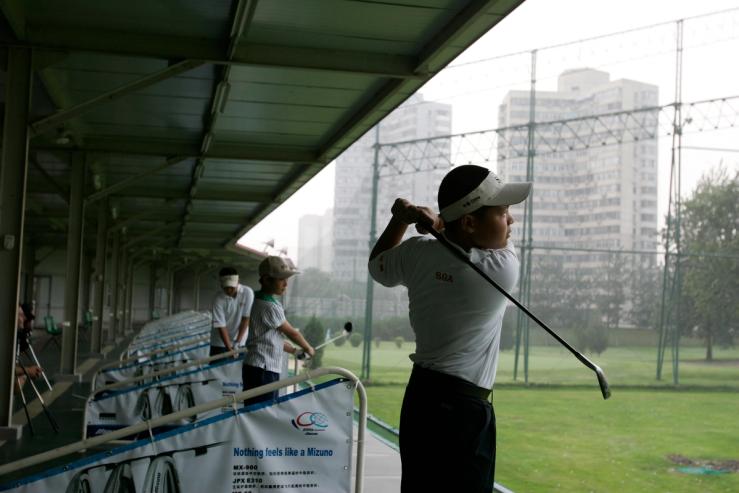
In addition to his job running Beijing’s international airport, Li Peiying was also the president of the nearby Tianzhu Golf & Country Club, where I was an early member. “Boss Li” was an ebullient figure who dressed in baggy suits and walked with a limp. A former beat policeman, he had climbed to the top of the airport authority through its security apparatus.
The club boasted 27 holes, sprawling villas alongside the fairways, and a luxurious clubhouse. He installed his younger brother, a scratch golfer, as general manager.
Only after Li was detained on corruption charges in 2007 did members learn that he’d funneled millions of dollars of airport money into the golfing facility. In effect, the site had become Li’s personal property; he’d stolen a golf course.
The brazenness was astonishing. Tianzhu was one of the most visible sporting venues in China, sitting just off an airport route heavily traveled by motorcades carrying the country’s top leaders. Li also flew around China in a private jet, another shocking breach of Party discipline. Evidently, Li thought he had political immunity. But in the end, he was convicted of embezzling around $12 million and executed in 2009. His brother went to jail.
Chinese leader Xi Jinping’s pitiless anti-corruption campaign, which he launched shortly after taking over as party leader in 2012, was supposed to end this kind of money grab. So far, more than 2.3 million officials have been investigated and punished.
Instead, graft has become even more shameless, and the sums involved are growing exponentially larger. Last week, a Chinese court sentenced a municipal official in Nanjing to death for accepting bribes worth a staggering $325 million, one of the biggest hauls ever.
The case against Yang Youlin, the executive deputy director of the Nanjing Economic and Technological Development Zone, highlights the progression of corruption under Xi.
The road to illicit riches used to run primarily through real estate; golf courses and villas, often built on land seized from farmers, were the ultimate money-making scam. Today, with property tanking, the more lucrative opportunities are in technology, where Xi is directing the country’s wealth. Yang’s industrial zone focuses on LCD screens, new energy vehicles, batteries, robotics, speciality chemicals, and biomedicine.
Economists have long puzzled over how China has managed such rapid, sustained growth despite endemic corruption that has sunk the prospects of many other developing economies.
Yuen Yuen Ang, a political scientist at Johns Hopkins University, came up with the best explanation, theorizing that not all forms of corruption are equally bad.
In her 2020 book, China’s Gilded Age, Ang argued that much of the graft in the country has taken the form of “access money,” which is qualitatively different to “petty theft” or “grand theft” common elsewhere. The Chinese variant actually stimulates economic activity as corrupt officials sell the rights to monetize unproductive state assets to private enterprises. Ang calls access money “the steroids of capitalism” — growth-enhancing drugs.
But growth has now slowed. Private enterprise is under the thumb of the state. And graft is so pervasive — collecting and laundering $325 million requires an extensive network of collaborators — it’s undermining Xi’s entire industrial agenda. Several years ago, a massive corruption scandal that engulfed the Big Fund, a state-backed financial vehicle, disrupted China’s efforts to achieve self-sufficiency in semiconductors. More recently, the country’s military modernization program has been jolted by revelations of corruption at the highest levels of the People’s Liberation Army, including practically the entire top command of the rocket force.
In fact, the answer to corruption is staring Xi in the face: Spectacular graft is the result of political control over the economy, and the concentration of power in the hands of individual officials. China’s high-risk, high-reward business culture fuels the problem, along with the absence of checks and balances, including investigative media.
Soon after “Boss Li” was put to death, a state-run distressed asset management company took over the Tianzhu golf course. A new general manager raised ducks in the water traps, and served them at lunch in the clubhouse. Eventually, the course was sold off to a quasi-private business, which brought in Gary Player, the South African golfing legend, to redesign the course.
Renamed The Players Club, it now stands as a reminder of Xi’s muddled, contradictory — and ultimately doomed — efforts to clean up a corruption mess. In the meantime, Xi has banned officials from playing golf.