




The News
A US aviation firm is readying a proposal to collect geological data in the DR Congo, joining several foreign companies who are mapping key mining information in a bid to unlock what could be trillions of dollars in precious mineral material in the central African nation.
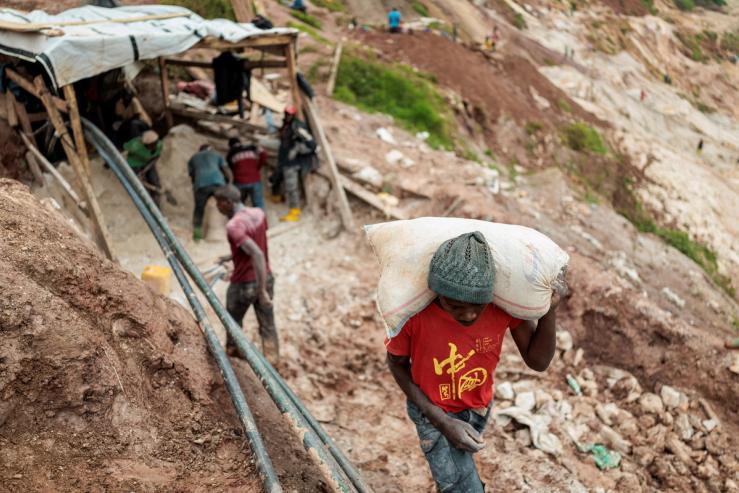
The plan comes as foreign competition heats up, especially among US and Chinese firms, for mineral resources in DR Congo, the world’s biggest source of mined cobalt, which is key for the renewable energy transition. Though China has long been dominant in DR Congo’s extractive sector — Chinese companies control most producing assets in DR Congo’s copper-cobalt mines — the US is looking to expand its footprint. In December, Washington and Kinshasa signed a deal to grant US companies preferential access to critical minerals,
Mapping Congolese mines for key geological data is a key component of new projects, and Washington is eager for those projects to gain ground. As part of that push, US-based Dynamic Aviation is preparing a technical and financial proposal to collect, integrate, and analyze DR Congo’s geological data, after the company’s CEO pitched the plan to DR Congo President Félix Tshisekedi in Houston in June, where he was attending a World Cup match.
“The president has done a very good job of reframing the Congolese-US relationship,” Michael P. Murphy, an adviser to Dynamic, told Semafor. “Because of that reframing, there is a priority for American companies to make investments and bring expertise to Congo.”
If the plan is approved, Dynamic would join Spain’s Xcalibur geophysics company and the US investment firm Atlas Park to survey mines in the country. Dynamic and Xcalibur said the data would belong to the Congolese government, while Atlas Park’s findings are expected to be shared with DR Congo’s national geological service.
Jean-Claude Mputu, deputy director at Resource Matters, a nonprofit focused on natural-resource governance, said the US is having to play catch-up with China in DR Congo, and obtaining geological data is key to those efforts. “The Americans are arriving in a copper and cobalt market where the Chinese have almost taken everything,” he told Semafor.
In this article:

Know More
Xcalibur has already mapped parts of DR Congo, and in January it signed an agreement for a new state-backed airborne survey, which Victor González, an executive at Xcalibur, said could start “in the next few weeks.” The company’s CEO said DR Congo is large and its geological information is less complete than Australia’s, which he described as the global benchmark for government geological data. “The world is open. It’s competition,” Andrés Blanco said, adding that different mapping companies can provide different solutions and that their data can later be combined in a broader government database. (Atlas Park’s five-year deal to provide AI-powered mineral mapping was announced just days after Xcalibur’s).
Kinshasa says the data work will help accelerate mineral discoveries and make the sector more investable, supporting comments from a mining ministry spokesperson that “a very large part of DR Congo has not yet been explored.” Analysts say DR Congo’s weak geological coverage raises the risk for Western investors seeking new exploration targets. Only about 20% of the country has been mapped, and modern geological data can “facilitate and de-risk Western greenfield investment,” Gracelin Baskaran of CSIS wrote.
Mputu said DR Congo has for years negotiated mining rights using figures supplied by the same companies seeking those rights. He pointed to Sicomines, the heavily criticized Chinese-backed copper-cobalt venture behind the country’s 2008 minerals-for-infrastructure deal. The agreement was renegotiated after years of criticism over whether DR Congo had undervalued the mining assets it put on the table. “If there are 100,000 tons and the person tells you there are 20,000, imagine the loss,” Mputu said.
Chinese firms own or hold stakes in 15 of DR Congo’s largest copper and cobalt mines, including CMOC’s Tenke Fungurume and Kisanfu, two of the world’s biggest cobalt operations. Chinese firms also control up to 80% of critical mineral production in DR Congo, and in 2024 the country’s trade with China was around $28 billion, compared to about $1.6 billion with the US.

Step Back
DR Congo’s mineral wealth is key to its economy. The country produced 3.2 million tons of copper last year, behind only Chile and the extractive sector accounts for about 14% of GDP. Mining generated about $28.7 billion in exports in 2023, roughly 97% of DR Congo’s total export earnings.
But there could be much more to the story. US trade officials estimate that most of DR Congo’s mineral resources remain untapped and are worth about $24 trillion. One of the biggest stores of historical data on that untapped mineral base is still in Belgium, DR Congo’s former colonial ruler, at the AfricaMuseum, which holds millions of geological records.
KoBold Metals, the US exploration company backed by Bill Gates and Jeff Bezos, struck a deal with Kinshasa last year to digitize the records, but the work stalled after the museum refused to hand over access. Belgian officials said they could not give an overseas private company exclusive access to millions of documents on DR Congo’s geology. The museum says it will digitize the records itself and send copies to Congolese authorities.

The View From Zambia
Resource-rich Zambia has put geological data at the center of its copper mining strategy, and has started to draw the kind of diversified mining capital DR Congo is also seeking. Zambia’s government has run a nationwide high-resolution airborne survey with Xcalibur that was 53% complete in January, building a digital store for old maps, survey reports, and mineral data. The government says the data will produce reliable geological information, unlock mining investment and support its target of lifting copper output to 3 million tonnes a year by 2031.

Notable
- The AfricaMuseum in Belgium has pledged to digitize troves of documents charting the rich subsoil of DR Congo and make them public within five years.