



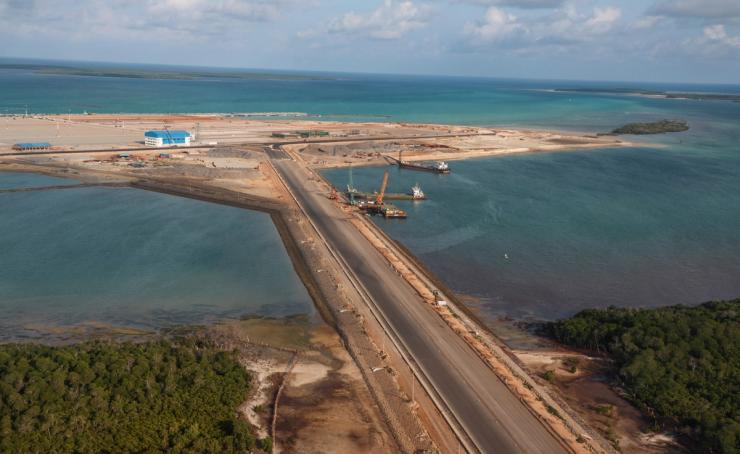
Across Africa, governments have spent decades announcing ports without thinking about connecting railways, highways without paved feeder roads, and pipelines without ancillary terminals. Each project may make sense on its own, yet too many struggle because the surrounding infrastructure is so patchy.
Nigerian billionaire Aliko Dangote’s decision to build a $17 billion refinery at Kenya’s Lamu port has brought that problem into sharp focus. The project will sit at the heart of the long-delayed African Union-backed LAPSSET transport corridor linking Kenya, Ethiopia, and South Sudan. For years, LAPSSET has been criticized as another grand African plan that never quite arrived. Dangote’s refinery could become the industrial anchor the corridor has been waiting for.
I’ve become increasingly convinced by the idea of “corridor finance” because it offers a compelling explanation for why so many continental megaprojects struggle. Serious investors are beginning to realize that individual mega-assets in Africa struggle because, without various other pieces of infrastructure — call them dependencies or feeder nodes — these assets take much longer to fully come onstream, if at all. A significant share of the high cost of financing African infrastructure comes from investors pricing in this risk.
That’s the basic premise of corridor finance. A refinery, for example, cannot succeed without reliable ports, power, pipelines, roads, storage facilities, predictable regulations, and customers.
When one link fails, the entire project becomes riskier and more expensive to finance. That helps explain why African countries have announced thousands of infrastructure projects that never move beyond the planning stage. Many analyses focus on the relatively low default rates of projects that secure financing — the “survivors.” But that overlooks the far larger number of proposals that never reach financial close because critical complementary investments never materialize.
Dangote’s own experience demonstrates both sides of the equation. His Lagos refinery took 11 years from concept to full operation and ultimately cost more than twice its original budget because he had to build not just a refinery but much of the supporting infrastructure around it. That experience explains why, in Lamu, he is securing land, arranging financing, pushing for regulatory changes, and relying on his own distribution network to create demand. In effect, he is filling corridor nodes himself in an effort to reduce the risks that normally make African megaprojects harder to finance.
The advantage is that synchronized investment across connected infrastructure, rather than simply financing an anchor project, could attract more private capital, spread risk across complementary investments, and make it far more likely that expensive assets generate economic activity instead of becoming isolated monuments to overambition. It also offers development banks a more realistic way of thinking about infrastructure — not as a collection of standalone projects, but as interconnected systems whose success depends on each link in the chain.
But corridor finance also carries risks. It requires governments, regulators, lenders, and private investors to coordinate not just financing but the operator network itself — something few existing institutions are designed to do. That leaves limited instruments for managing the risk that one missing link derails an entire corridor. And because corridor projects demand substantial upfront commitments, they can divert scarce public resources from smaller but equally vital investments.
The broader lesson is not that Africa needs more billionaire industrialists. Africa cannot replicate Dangote; there is only one. But development finance institutions can certainly replicate the method by treating consequential projects as corridors from the outset, coordinating finance across ports, power, transport, industrial facilities, and the operators that connect them rather than funding each piece in isolation.
As Dangote’s Lagos refinery demonstrated, every major project in Africa is really a corridor. The question is whether governments and financiers are finally prepared to fund and structure them that way.
Bright Simons is the honorary vice president at IMANI, a think tank in Accra, Ghana, and a visiting senior fellow at London think tank ODI Global.