




Burgess’s view
The last time I talked to Lindsey Graham in June, he was trying to be pragmatic about President Donald Trump’s tentative deal to end the war with Iran. The time before that, he was gently panning — but accepting — Trump’s decision to endorse Ken Paxton over John Cornyn in the Texas Senate Republican primary.
“I’ll leave it up to the president to endorse who he likes,” Graham said then. Explaining the president’s decision to oust a respected GOP colleague, Graham said that Trump is “looking at people that were not there when he needed them the most.”
Of course, Graham had already won his own Trump endorsement this election cycle. He famously cast aside his very public doubts about Trump early on to become something of a consigliere to the mercurial president. He declared “count me out” after the Capitol riot and Trump’s attempt to overturn the 2020 election, but within a few weeks he’d gone to visit Trump and mend fences. The two spoke shortly before Graham’s death, Trump said on Sunday.
Graham lived multiple political lives since he became a senator in 2003. He helped break a deadlock over judicial nominees in 2005 and wrote the “Gang of Eight” immigration bill in 2013 with his best friend, the late Sen. John McCain, R-Ariz. But as his former colleague, Lamar Alexander of Tennessee, likes to say: “When you are in public life, people remember the last thing you do.”
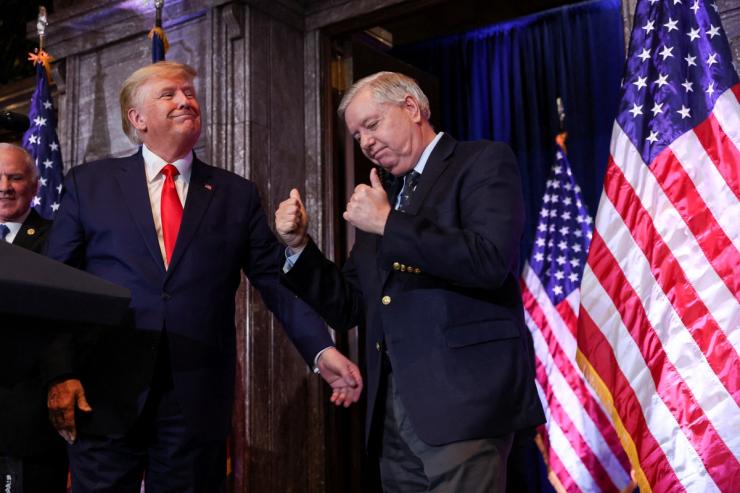
After his sudden death this weekend, the South Carolina GOP senator’s legacy is inextricably linked to Trump.
Sometimes Trump listened to him. Sometimes he didn’t. But the golf invitations to Mar-a-Lago kept coming — and Graham continued his efforts to gently nudge the president one way or another. Gradually, Graham became less focused on maintaining relationships with the Capitol Hill press corps or making big deals with the other side of the aisle, jettisoning the bipartisanship of the pre-Trump Washington. Graham quickly learned that, in the new Trumpified era of politics, results were often directly tied to whoever last talked to Trump. And boy, did Graham talk to Trump.
Graham spent months haggling with Trump before relaying that the president was finally backing a popular bipartisan Russia sanctions package only to see the bill continue to stall. That work continued up until his sudden death: just two days ago, he and a bipartisan group of senators said they were closer than ever to moving forward on the Russia penalties.
Graham didn’t always see eye-to-eye with the president. He was clearly skeptical of Trump’s deal with Iran — now disintegrating by the day — declaring “it would be a good deal if you could land it.” And, no, he didn’t think much of that Paxton endorsement.
But the days of going after Trump directly were long gone; Graham learned to pick his spots, speaking with the president privately and perhaps revealing a bit of their conversation later on TV. In recent weeks, he’d gone to bat for Trump’s priorities like voter ID and a third party-line spending bill — even as some of his colleagues privately recoiled. His last conversation with Trump was about the voter ID-focused SAVE America Act, which lacks the votes to pass the Senate. Trump recalled telling Graham that “we’re going to get it done” anyway.
To understand Graham, it’s important to digest how restless he was as a man and a politician. A lifelong bachelor, Graham’s identity as a senator and as a person were tightly intertwined — and that meant nonstop movement. He liked a cocktail party, too.
Forget lazing in upstate South Carolina over the two-week July 4 recess. Graham had just returned from a foreign trip to Turkey and Ukraine. Senate Minority Whip Dick Durbin, D-Ill., recalled that at a dinner at the US ambassador’s residence there, Graham “was working every senator on a strategy to end the war in Ukraine. Typical Lindsey.”
This year, Graham had accrued a Capitol Police security detail amidst the Iran conflict and often had little time for pleasantries: “Not now,” he’d say under his breath when reporters tried to stop him, often pointing at the phone glued to his ear. Who was on the other end of that call, we wondered? Is it Trump?
It’s true that Graham had lost some juice with Democrats despite spending years as a dealmaker in the Senate, but he was still close with Durbin and worked closely with Sen. Richard Blumenthal, D-Conn., on the Russia sanctions. It wouldn’t be accurate to say he’d become totally partisan — he supported the arcane “blue slip” allowing home state senators to block judicial nominees, for example and Democratic statements mourning Graham flooded in on Sunday morning. But his alliance with Trump also made it difficult to cut deals that once defined his own brand of maverick politics.
In 2018, Graham’s immigration compromise imploded and he blamed the Trump administration for “poisoning the well.” It was an instructive moment — this was never going to be a hands-off president when it came to aisle-crossing legislation. Graham understood there were clear limits to what could be done solely as a legislator.
So Graham gradually shifted strategies, talking to Trump regularly and growing closer with his allies and advisers. He jammed through Trump’s judicial nominees as Senate Judiciary chairman, famously culminating in the lightning quick confirmation of Supreme Court Justice Amy Coney Barrett in 2020 just days before the presidential election that Trump lost. Graham was old friends with the next president, Joe Biden, but Trump was still his guy. Other Republicans thought Trump would now fade away, but not Graham.
And by the time Trump finally won his second term in 2024, Graham was now Senate Budget chairman and in a position to move Trump’s agenda: He pushed Trump’s plan to cut taxes and Medicaid spending and spend billions on national security, then passed a follow-up party-line immigration enforcement bill earlier this year. He wanted to do a third party-line bill before the election — once again eliciting eye rolls from his colleagues. Graham was up for reelection himself: Couldn’t he just take it easy for a few months?
Of course the answer was no. Lindsey Graham was never going to sit still.

Notable
- Graham’s death creates an unexpected vacancy in the Senate — complicating Trump’s agenda, The Washington Post reports.