





The Scoop
A company headed by the brother of the Ghanaian president has refused to hand back a $100 million gold mine at the center of an ownership row, defying a ruling by an international court, documents seen by Semafor show.
A 2023 earn-in agreement, which would enable the Ghanaian firm to acquire equity, was disputed by investors who say the company failed to fulfill the terms that would have enabled it to take ownership, accusing it of forging signatures to facilitate the transfer and seizing the site, according to the documents. The company has denied the allegations.
The dispute over the Black Volta gold mine in northwest Ghana is emblematic not only of the growing wariness among international investors around mining projects in Africa’s biggest gold producer, but also of the challenges faced by African policymakers trying to increase revenues from natural resources without deterring foreign firms.
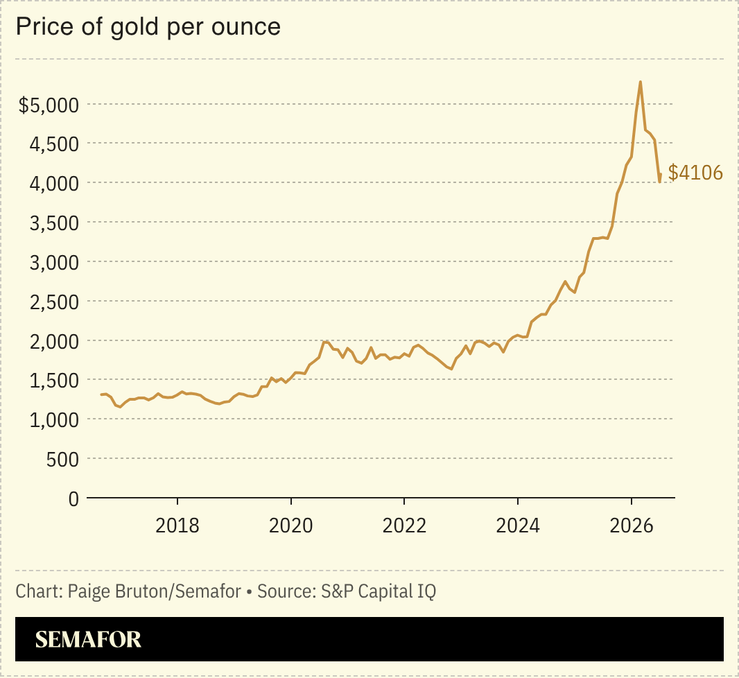
Ghana’s government is looking to its mining sector as a way to build long-term growth after emerging from its worst economic crisis in decades, which required a $3 billion bailout from the International Monetary Fund. But the issues underpinning the Black Volta mine dispute — about the rule of law, alleged political influence, and regulatory oversight — threaten to damage Ghana’s reputation among international investors and increase the risk premium attached to the country’s mining sector, just as the country is overhauling its approach to strategic mineral resources to capitalize on soaring gold prices.

Know More
The Wa-Lawra gold belt in northwest Ghana, where the Black Volta mine is located, is considered one of the country’s most promising undeveloped gold belts. It was first identified by local mining company Ashanti Goldfields in the late 1990s, and Azumah Resources, a gold explorer and developer primarily backed by US private equity, acquired prospecting licences in the belt in 2006. Mining concessions related to Black Volta were granted in 2014, according to local media reports.
In arbitration court documents seen by Semafor, Ghanaian mining firm Engineers & Planners — whose founder and CEO Ibrahim Mahama is a brother of Ghana’s President John Dramani Mahama — said Azumah’s shareholders offered it the right to acquire the Black Volta project for $100 million in 2023. Azumah’s investors have denied this, saying any acquisition rights were subject to E&P’s compliance with a series of other obligations.” E&P in July 2025 secured a $120 million loan from West Africa’s development finance institution, funds it said were for acquiring the site.
But the sale has been disputed by Azumah’s investors, who say E&P failed to fulfill the terms that would have enabled the Ghanaian firm to take ownership, accusing the company of seizing the site and forging signatures to facilitate the transfer of shares. E&P has denied the allegations. Azumah has denied selling or authorizing such a sale entirely, rejecting E&P’s accusations that it reneged on an agreement.
In a ruling dated Oct. 23, 2025, the International Chamber of Commerce’s International Court of Arbitration, which sat in London, ordered E&P to stop “trespassing on, occupying, or otherwise interfering with the Black Volta and Sankofa Mine Sites.”
The court sat in private and the details are confidential, but the ruling was disclosed months later during a hearing at the High Court of England and Wales, where Azumah’s investors sought to enforce the arbitration court’s ruling. The contracts were established in accordance with English law, and the UK was designated as the site for any dispute resolution, according to James Wallbank, managing partner of Ibaera Capital, a US private equity fund that is among Azumah’s investors.
On June 8 of this year, the High Court ruled that E&P “failed to comply” with the arbitration court’s order. But that second ruling has also been ignored, according to Azumah’s investors. “Over the last nine months, the International Court of Arbitration and now the English High Court have both issued notices to E&P advising them to stop trespassing on the Black Volta project and return assets to the international investors,” Wallbank said in an interview.
Bobby Banson, a lawyer representing E&P, denied that the mine had been occupied. “E&P is neither occupying the Black Volta Mines nor has it taken over the operations of the Mine or its resources,” Banson told Semafor in an email. He continued: “E&P has instructed its lawyers to take steps to set aside the order from the English Court.” He also accused those opposed to E&P in the arbitration case of carrying out “PR gimmicks.”
Representatives of both sides in the case — E&P and Azumah’s investors — said the International Court of Arbitration is due to make a final judgment at a hearing scheduled to take place in September.

Alexis’s view
The legal battle — one involving a familial connection to the Ghanaian presidency — highlights deeper tensions around mining in Africa’s top gold producer.
Separately, Australian firm Cassius Mining and Nasdaq-listed, UK-headquartered Blue Gold are both locked in arbitration cases against Ghanaian authorities, where the companies are each seeking hundreds of millions of dollars. They allege that mineral rights agreements have not been honored — accusations denied by Ghana.
The optics have been particularly damaging for the country’s image within the global mining industry. In April, Ghanaian authorities denied accusations of favoritism towards the president’s brother when they rejected a bid by South African company Gold Fields to operate the Damang gold mine, which it had operated for more than two decades. Instead, E&P was selected to take over. Government spokesman Felix Kwakye Ofosu said the president “recused himself” from discussions about the Damang mining lease to avoid any conflict of interest due to his brother’s role at E&P.
Criticism from opposition parliamentarians over a potential conflict of interest came as Mahama’s administration unveiled overhauled mining regulations as part of a broader economic “reset agenda.” New rules stating that surface mining must be carried out by companies entirely owned by Ghanaian citizens, and underground operations must be at least 50% locally owned, have prompted international investors to express concern that they’re being shut out. Reuters in April reported that Ghana’s Minerals Commission had instructed international miners, including AngloGold Ashanti, Newmont, and Zijin Mining to transition mining operations to local contractors by December 2026 or face sanctions.
Ghana’s reputation for good governance is also increasingly being scrutinized. The country has long been considered among the continent’s more investor-friendly countries. Conflict-hit DR Congo — also home to prized minerals — and regional giant Nigeria perennially score less favorably on ease of doing business indexes, while the Sahelian countries of Burkina Faso, Mali, and Niger have changed their mining codes in recent years to boost state revenue and ownership stakes at the expense of foreign mining companies after military juntas seized power.
But an op-ed in South Africa’s Daily Maverick last month said the question being asked in boardrooms from Johannesburg to London was whether Ghana’s gold shake-up was “a mere fig leaf for state capture.” Meanwhile, opposition politicians have accused the president of crony capitalist tendencies in the treatment of his brother. The government has repeatedly denied these accusations.
For centuries, other countries benefited from Ghana’s natural resources to such an extent that when the country was a British colony, it was referred to as the Gold Coast. So it makes sense to pursue ways to retain more wealth locally.
But the underlying question is whether Ghana’s mining reset is genuinely geared towards broad-based economic development, or enriching a small group of politically connected individuals. In either case, the way it is being viewed internationally means the new approach is unlikely to attract greater investment.

Room for Disagreement
Ghana’s president — who returned to office for a second term in January 2025, eight years after his first stint in power ended — has repeatedly said his government is committed to improved management of the country’s natural resources to foster economic growth. “Ghana is determined to ensure that our natural wealth translates into long-term national value creation rather than perpetual extraction without transformation,” he said in June at the Chatham House think tank, in London.
He said measures implemented by his administration, such as the 2025 creation of a new regulatory body, reflect a “broader commitment to resource governance, transparency and economic sovereignty.” Another policy change, overtly focused on increasing revenue in the local mining sector when commodity prices rise, was the introduction of a new sliding scale gold royalty system that links state revenues to rising bullion prices.

Notable
- Ghana’s mining policy overhaul amounts to “resource nationalism by regulation,” wrote Jason Holden in a S&P Global Market Intelligence article.

Correction
An earlier version of this story incorrectly stated that E&P’s lawyer, Bobby Banson, dismissed the continuation of proceedings in the arbitration court and the subsequent ruling as “PR gimmicks.”