



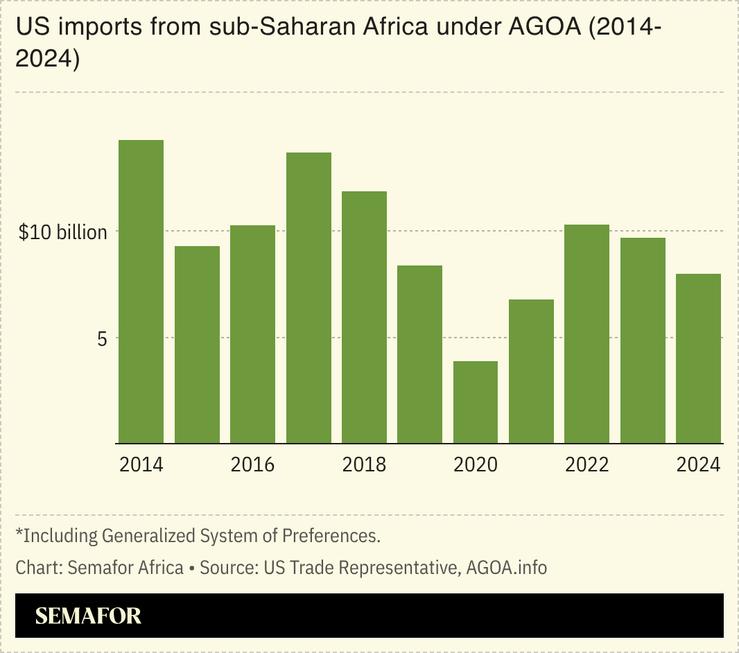
Washington is having the wrong debate about the African Growth and Opportunity Act. Congress is consumed with whether to extend the preferential trade program, when the more important question is what comes after it.
AGOA remains one of the most successful pillars of US engagement with Africa, helping build export industries, create jobs, and prove that trade drives development. But if renewing AGOA is the ambition, the US has already set its sights too low.
While Washington debates another extension, its rivals are designing the next generation of commercial ties with Africa. The EU supplied 20% of sub-Saharan Africa’s imports in 2023. China was close behind at 19%, while the US supplied just 5%, roughly at the same level it has been since AGOA was introduced in 2000.
Brussels and Beijing aren’t simply competing for Africa’s imports and exports. They’re competing to shape the rules, supply chains, and investment flows that will define some of the world’s fastest-growing markets.
The EU has spent years negotiating reciprocal Economic Partnership Agreements while treating the African Continental Free Trade Area (AfCFTA) as the foundation for an eventual continent-to-continent free trade deal. China has moved to near-universal duty-free, quota-free access for African exports. France, the Gulf states, Türkiye, and India are making similar long-term commitments across infrastructure, manufacturing, energy, digital industries, and critical minerals.
They have all internalized the same reality: The road to long-term economic competitiveness runs through Africa. The US should understand this too. That requires putting AGOA in its proper place as one instrument in a much broader commercial strategy.
The first shift is conceptual. Washington still approaches Africa country by country, while Africa is organizing itself as a continental market. The US should make the AfCFTA — not dozens of bilateral relationships — the organizing framework for its economic engagement, while pursuing reciprocal agreements with countries ready to move beyond one-way preferences.
The second shift is from trade alone to trade and investment together. Market access no longer distinguishes the American offer — capital does.
A US-African Union working group, launched this year, should become the centerpiece of a long-term investment strategy spanning supply chains. Critical minerals belong inside that agenda — not as the destination, but as the gateway to processing and value addition. Bilateral minerals partnerships should reinforce that continental strategy, not substitute for it.
The third shift is from reacting to shaping. Washington has spent six years trying to conclude what would be America’s first free trade agreement in sub-Saharan Africa, with Kenya, this was meant to be one of the aims of AGOA. The US should finish the job. Done right, a reciprocal Kenya deal becomes the model for modernizing US bilateral relationships across the continent.
The US should also restore technical engagement with the AfCFTA Secretariat. Under Prosper Africa and USAID, it once supported work on customs procedures, digital trade, and rules of origin — capacity that disappeared with USAID’s dismantling. Those rules are still being written. If Washington isn’t helping write them, others will. An updated relationship will also require personnel with the skills to engage institutions at both country and continental levels.
AGOA demonstrated that trade preferences can build markets and create jobs. But it was designed for a different Africa and a different global economy. AGOA was never the whole strategy and should not be the ceiling of America’s ambition.
Daniele Nyirandutiye is a senior fellow at the Center for American Progress.