




Andy’s view
Like US President Donald Trump, Chinese leader Xi Jinping has grand urban visions, a penchant for iconic projects, and particular tastes in architecture: Xi favors traditional Chinese aesthetics, Trump neoclassicism. Both are attempting historic makeovers of their capitals, with an eye to their own legacies.
It’s not going well for either of them.
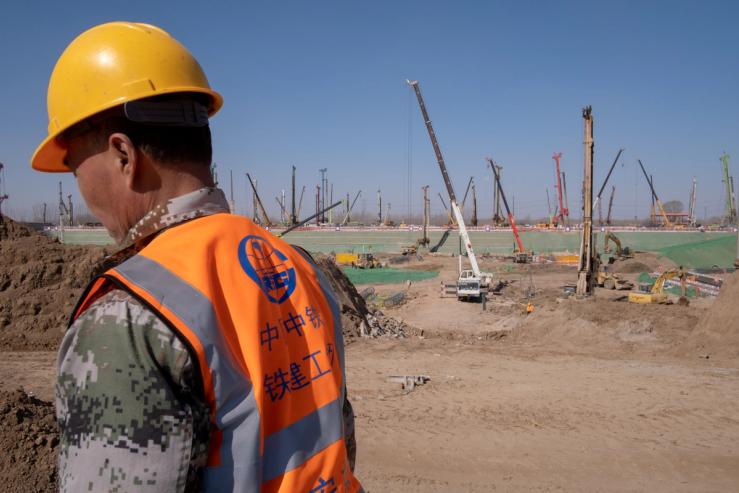
Of course, the construction stakes are orders of magnitude different: Trump is expected to spend just over $1 billion on 18 engineering projects in Washington, DC, including a White House ballroom, according to a New York Times analysis; Xi has already put more than $100 billion into building a supercity from scratch to relieve pressure on traffic-clogged Beijing. But both face mounting challenges — environmental obstacles, political pushback, and widespread skepticism toward ego-driven public works programs. Neither Americans nor Chinese, it turns out, are easily sold on urban dreams.
In many ways, Trump and Xi are kindred spirits. They’re both proud nationalists — and publicly celebrate that connection. At their recent Beijing summit, Xi proposed a dinner toast to his “Great Rejuvenation of the Chinese Nation” as well as Trump’s “Make America Great Again,” suggesting the two can “go hand in hand.”
But their personalities, and political instincts, converge most strikingly around cities.
One of Trump’s signature domestic moves was unleashing masked immigration agents to go after undocumented migrants who he says are ruining American urban life, bringing crime, stealing jobs, and inflating home prices. Xi, too, blames internal migrants as contributors to what he calls “big city sickness.” Soon after taking office as China’s president in 2013, Xi ordered tens of thousands of temporary residents removed from Beijing, bulldozing their shanty homes and small businesses, ostensibly as part of a “beautification” campaign.
Both speak the language of urban utopianism. On the campaign trail, Trump proposed building 10 futuristic “Freedom Cities” on empty federal land where young families could set up home, moving around in flying cars. That idea has gone nowhere. Now, his White House ballroom project, featuring gilded Corinthian columns, is the subject of a legal dispute; a judge ordered his name removed from the Kennedy Center; military veteran groups have come out against his proposed triumphal arch; and algae is blooming in the newly renovated Lincoln Memorial Reflecting Pool. Last week, late-night comedians gleefully seized on a viral clip of one visitor describing the water as “puke green.”
Xi, meanwhile, has banned “weird” modernist buildings nationwide and his emerging metropolis, Xiong’an, is intended to embody his “New Era” of high-tech, egalitarian, and sustainable development — all expressed through classical Chinese shapes and styles. (As it happens, Xiong’an has also been plagued by water issues: It’s located just south of Beijing on a giant floodplain, downstream of a heavily polluted freshwater lake, which has required some $10 billion of investment in water remediation, dikes, dams, levees and pump stations.)
Xiong’an has other problems, too. It lacks highway and rail connections, the upshot of which is that the universities, hospitals, and state enterprises that were supposed to relocate there from Beijing are dragging their heels. Andrew Stokols, a US urban planning scholar who researches Xiong’an, told me that “almost everyone I talk to in China thinks Xiong’an is a failure,” although they can’t say so openly since it is Xi’s pet project.
Recent visitors describe eerily empty streets there, a possible sign of passive resistance to Xi’s imperial style, in much the same way that his top-down economic program has induced a “lying flat” phenomenon — a pervasive despondency about the future, accompanied by an alarming plunge in marriages and fertility rates. What’s so notable about the pushback to Xiong’an is that it involves powerful state actors; Xi can’t even persuade his own massive state enterprises to heed his order to move. Stokols said some have formally shifted their headquarters but “most of the key people still stay in Beijing or just go and come back on weekends.”
In the US, critics paint Trump as a would-be authoritarian. Writing in the New Yorker about the president’s plans for a 250-foot triumphal arch, twice as tall as the Lincoln Memorial, Adam Gopnik decries “the architecture of autocracy.”
Perversely, though, Trump’s oversized monuments in Washington, DC, and Xi’s gigantic urban tableau on the outskirts of Beijing, point not so much to their political power, but to its limits.

Notable
- China’s politics are stuck in a “visibility trap” that siphons investment away from “human capital, public service provision, and ecological sustainability” into projects that “make the country’s development look far more spectacular than it really is,” Georgetown University professor Ning Leng argued in Foreign Affairs.