




The News
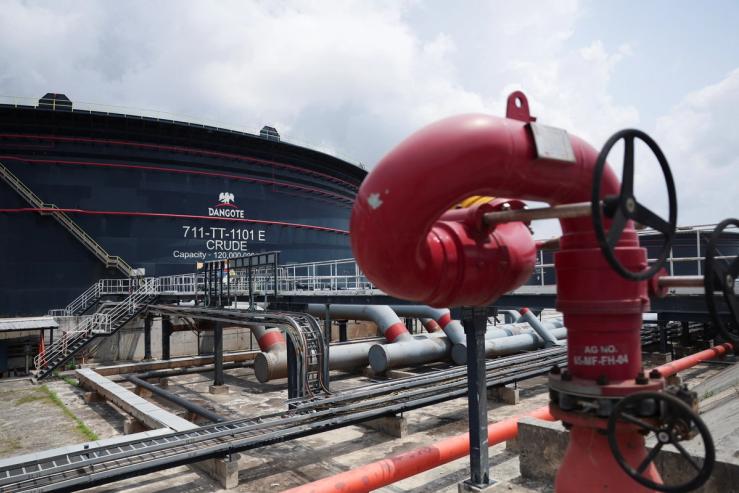
Dangote Refinery’s highly anticipated listing on Nigeria’s main stock exchange is expected to be a “landmark moment,” the exchange’s CEO told Semafor, as the continent’s largest oil refiner plans a $4 billion pan-African IPO by the end of the year.
The blockbuster listing could help the bourse attract other large African companies by showing that Nigeria’s capital market can support “complex, globally significant transactions,” Temi Popoola said. The exchange’s main index recorded a 51% return in 2025 — among the largest in the world — and has kept up momentum this year as anticipation grows ahead of the listing. The Dangote Refinery wants to raise around $4 billion at a valuation of $40 billion, which would be the largest-ever IPO in Africa and would roughly equal the value of all new listings combined on Nigeria’s exchange in 2025.
Popoola said the listing will not only help amplify Nigeria’s investment profile internationally, but also build “a pipeline of high-quality issuers that can access capital efficiently.” The exchange’s priority is to “deepen participation, attract more issuers, enhance liquidity” and strengthen the capital market’s role in aiding economic transformation, he added. Nigeria’s bourse has pushed to increase capital market activity in recent years by mandating quicker transaction settlements, extending trading hours, and making a strategic investment in the newly formed Ethiopian Securities Exchange, Popoola said.
In this article:

Know More
The Dangote Refinery’s march towards an IPO has coincided with key performance milestones this year. The plant reached its full capacity of producing 650,000 barrels a day in February, and became the world’s largest exporter of aviation fuel in April, according to S&P Global’s data. Export blockades caused by the Iran war have raised demand for the refinery’s fuels in African countries such as Cameroon, Côte d’Ivoire, and Ghana.
Aliko Dangote, Africa’s richest man, told the Financial Times that he wants to invest $45 billion across his empire by 2030 to implement a pan-African expansion agenda — from East Africa to Ethiopia — that will see the group generate up to $100 billion in revenue by the end of this decade. Dangote’s plan to take the refinery public is in line with efforts to list shares of its mammoth fertilizer and cement units in Nigeria and London respectively.

Alexander’s view
Nigerians who missed out on previous listings by large companies — such as by MTN’s in 2019 — see the upcoming IPO as a rare opportunity to get a slice of a company poised to dominate the local energy market.
The Dangote Refinery has become the ultimate determiner of gasoline prices in Nigeria since it came online in 2024, as it is able to supply all of the country’s domestic fuel needs. The plant’s leading role in Nigeria’s increased domestic oil refining capacity contributed to S&P Global’s ratings upgrade last month.
But the buzz around the IPO also invites scrutiny about the extent to which one large company’s prospects can be judged as representing a nation’s economic trajectory. While capital markets “often serve as an early indicator of economic confidence,” as Popoola put it to me, the reality on Nigeria’s main street is that consumer purchasing power has been weakened this year by the Iran war that has boosted Dangote Refinery’s fortunes. Inflation has risen for three consecutive months up to May, which leaves less money to buy refinery shares for households that are increasingly having less money for food.
That said, a large successful listing in Nigeria would demonstrate that African stock markets can help companies raise money that can re-enter the economy and raise overall productivity. Dangote is Nigeria’s biggest tax payer and if his refinery becomes the largest in the world and functions optimally, the government gets more money for public goods.

Room for Disagreement
African stock markets have raised about $220 billion in equity in the last 25 years, yet trading is still generally low and confined to a few large companies, the OECD said in a report last year. In Kenya, where the Dangote Refinery also plans to list, more than a third of the bourse’s capitalization is tied to the value of state-owned telecom group Safaricom. That market “remains volatile, which presents a risk of a market collapse due to concentration risk,” Nairobi private equity firm Cytonn cautioned in a recent note.

Notable
- Dangote Refinery rejected claims that it is knowingly enabling Nigerian marketers to reimport its refined fuels from an offshore trading hub in Togo, arguing that it would go against the company’s commercial interests.