




David’s view
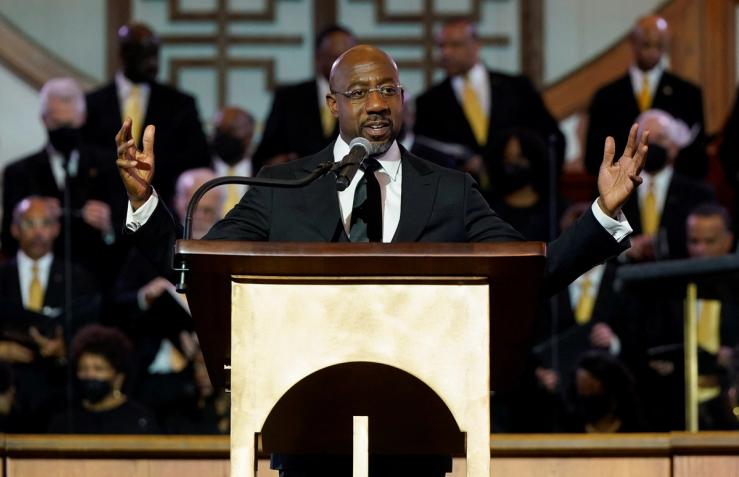
Raphael Warnock and Mike Johnson sat down one-on-one this month for a reason that was bigger than their stated topic.
Publicly, the Republican House speaker was requesting time with the Georgia Democratic senator after Warnock questioned how Johnson, a devout Christian, could “say a prayer” then vote to cut $1 trillion from Medicaid. Privately, they ended up at a respectful impasse over how they saw their respective Christian faiths.
Warnock, who talked with me about it this week, said Johnson sees the moral mandates for equitable treatment of the poor as individualistic, with no implications for government or systems. The only Democratic pastor in Congress had another view, drawn from the traditions of the “anti-slavery church.” Justice is a central theme of the scriptures; nations are judged based on their treatment of the poor.
“It is an American church, literally born fighting for freedom,” Warnock told me. “Its mission is to bear witness against any idea that we can be in Christ, and divided.”
A trio of other Democratic pastors and seminarians are trying to join Warnock on the Hill next year while campaigning on a similar comfort linking their Christianity with their politics: James Talarico in Texas, Sarah Trone Garriott in Iowa, and Adam Hamilton in Kansas.
Their willingness to ground progressive beliefs in faith is a mirror image of the longtime ease with which conservative Republicans have tied their Christianity to their politics. That hasn’t stopped the GOP from mocking their faith as faddishly liberal, so concerned with social justice that it has nothing to say to true believers.
It’s an argument designed to appeal to more conventional Christian voters in their red states, particularly evangelicals, rather than the increasingly secular electorate overall. Progressive Christian Democrats are betting it won’t work, that the GOP is making a mistake by dismissing open-minded faiths in a less conservative country.
“If the Republican Party wants to return to their self-righteous and morally condescending position of 20 years ago, be my guest,” said Rep. Sarah McBride, D-Del.
Talarico’s opponents, for example, have portrayed his progressive church — and his seminary-trained readiness to defend LGBTQ+ rights and abortion on Biblical grounds — as ungodly.
“I’ve never seen so much blasphemy from anyone running for office,” Texas Lt. Gov. Dan Patrick said at this month’s state GOP convention. Patrick added that he would “pray for that guy,” because Talarico would be “going to hell for sure” based on his campaigning.
Republicans have even tried to use Talarico’s views against other candidates. Among them are 2021 comments republished this week on the Activist Theology podcast, where Talarico talked about his pastor’s roots in “Christian anarchist tradition” and confessed that he was a “Christian who hates Christianity.”
The National Republican Congressional Committee jumped in to ask whether South Texas Democrats like Rep. Henry Cuellar agreed with his “fake-faith, open-borders, anti-family extremism.” Unsurprisingly, they ignored the question — but Talarico isn’t a “fake” Christian.
He’s a more Warnock-esque Christian, drawing on the more radical tradition that’s embedded in the Black church and running through more liberal, activist Protestant denominations.
Talarico’s faith is distinct from the Catholicism that Vice President JD Vance embraced in 2019, which sees a central place for Christianity in American life that’s focused on traditional social values like family formation — not social justice.
This year’s religious Democrats support an expansive state with generous benefits that uplift the poor, because (to oversimplify a little) that’s what Jesus would have wanted. They support a progressive social agenda because they believe in changing as the culture changes.
“Sometimes the culture leads the church,” Hamilton said five years ago, discussing his United Methodist Church’s shift toward LGBTQ+ acceptance.
In Iowa, Trone Garriott may have an even stronger chance of victory than Talarico, despite his national buzz. Still, her background as a Lutheran minister has fueled multiple GOP attacks.
Republicans have gone after her for participating in a Satanist wedding during her training and for criticizing Christian nationalism with analysis like: “This is not a Christian nation. It’s a nation for all of us.”
For all their confidence that progressive Christianity won’t play in red states, however, Warnock serves as a powerful counterpoint. He’s talking more about faith and politics ahead of his new book release, but his past writing amounts to a roadmap for the current crop of candidates.
“The Black church cannot afford to be radical on the question of racial justice and reactionary when it comes to justice and equality for women, gays and lesbians, brown “illegal” immigrants, and just about everyone and everything else,” Warnock wrote in The Divided Mind of the Black Church, years before he ran for Senate.
“It cannot fully live out its vocation as a liberationist church and be a xenophobic church at the same time.”
In this article:

Room for Disagreement
Conservative Christians think they have a good handle on left-wing Christianity and don’t worry about losing religious voters to the Democrats. They point to declining church attendance at liberal Protestant churches, contrasting that with reports of new Catholic and Orthodox conversion, led by men who want strong foundations for marriage and self-improvement.
What does the religious left have to offer? “Talarico is adamant that he is a Christian — he is a Presbyterian seminarian,” Gary Bauer wrote for James Dobson’s Family Institute. “But he is not alone in his attempt to hijack the Gospel of Jesus Christ for a Marxist, anti-life, anti-family agenda.”

Notable
- In Mother Jones, Kiera Butler reports on how the Southern Baptist Convention “appears to be making a significant course correction in the form of a sharp rightward tack,” rejecting more progressive ideas.
- In First Things, Matthew Schmitz asks what the increasing prominence of conservative Catholicism means for the country. “If more Americans are entering the Church, if Catholic terms are increasingly central to public debates, then that may be a sign that God still has plans for the United States.”