




Reed’s view
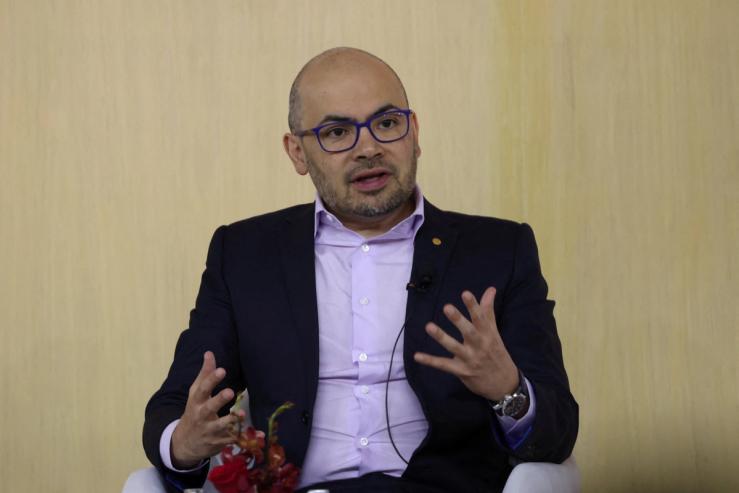
I made my first trip to Cannes Lions, the “festival of creativity,” this year. Naturally, Google DeepMind CEO Demis Hassabis wanted to talk about creativity.
But that topic is a landmine. Where AI and the creative industries intersect, there are lawsuits and high emotion. A Google employee told me AI played the role of villain at Cannes last year; this year people were more open, but still wary.
Most skeptics draw a bright moral line: AI that cures cancer or discovers climate-friendly materials is good; AI that makes music, films, or art is not. Creativity, one person told me, is supposed to be hard.
And after talking with Hassabis, who won a Nobel Prize for the “good” kind of AI, I came away thinking that technology doesn’t really draw a distinction.
For AI to truly revolutionize science, it needs a form of creativity it currently doesn’t possess. Right now, AI can generate an image no one has seen before, but Hassabis describes true creativity as a system that can formulate a genuinely new concept that doesn’t just extrapolate from what humans already know. He calls it the Einstein test: Given only the evidence available to Einstein, could today’s AI models rediscover relativity? Probably not.
To discover that missing algorithmic piece, it may require an AI that has an understanding of the physical world in a way text-based systems don’t. And that means training models on human-made visual and auditory creations.
Just like Einstein, who ventured beyond textbooks to imagine riding trains that travel near the speed of light, AI needs to understand “the world of atoms, not just the world of bits, or the world of logic.”
That idea connects Hassabis’ work in AI to his earlier career in neuroscience. In a 2007 paper that studied patients with hippocampal damage, he found that memory and imagination appeared to share a constructive mechanism: one rebuilds the past; the other recombines its pieces into something new.
Hassabis said he designed games the same way. Before writing the code, he would picture a child using the interface, anticipate where they might struggle and imagine what would make the game fun. He was, in effect, running a simulation in his head.
At Cannes, he put it plainly: “Imagination is a type of simulation.” Simulations let an intelligence test many possibilities before choosing a path.
DeepMind’s early work on games was a research ladder toward systems capable of tackling protein folding and drug discovery. Video models may follow the same path. The capabilities that help someone generate an advertisement could also help AI understand the physical world, train a robot, or analyze images of cells and molecules. “Some of these things are inseparable,” Hassabis said.
Technological progress rarely arrives in cleanly separable pieces. Who benefits and who pays for AI progress is a legitimate debate. What we may not be able to do is embrace the machinery of scientific imagination while rejecting that same machinery in art.

Notable
- Google is investing about $75 million in A24 , the independent film studio behind recent successes like Backrooms and Marty Supreme, to help bolster the creative process with AI tools, The Wall Street Journal reported.