



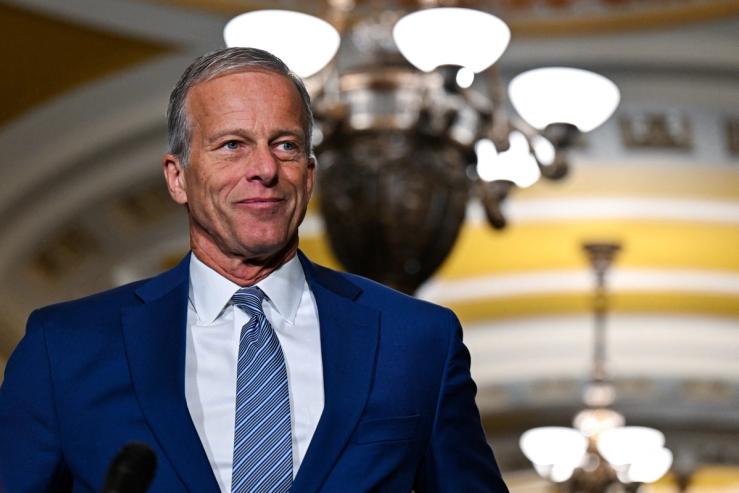

The News
John Thune and Donald Trump’s relationship is in a tight spot, but the Senate majority leader told Semafor on Tuesday that he expects to seek reelection as the chamber’s top Republican next January.
“We’ve really accomplished, in my view, great things,” the South Dakota Republican said of his party, ticking off tax cuts, immigration legislation and speedier confirmation of Trump’s nominees. “Hopefully we’ll have a good outcome in November. But my expectation would be, yeah” to another term as leader.
That will be welcome news for many Senate Republicans, who see Thune as a steady presence in Trump’s chaotic Washington. But GOP senators have a lot more challenges to get through before that fall leadership election — starting with a Trump visit for lunch on Wednesday that will lay bare the divisions among them.
The president is not giving up on his quests to kill the filibuster and to pass a voter ID bill, even as an increasing number of Republicans make clear neither of those things will happen. As members of Thune’s own conference keep battling over that voter ID bill, there’s also plenty of intraparty tension over Trump’s deal to end the Iran war.
Add in Trump’s frosty dynamic with two senators he helped push out of office this year, and it’s easy to see why Thune revealed a sense that time is running out before the election. Retiring and ousted senators mean, he said, that his “53-seat majority is more like 46 now.”
“This job is harder — in my observation, at least — harder than it’s ever been,” Thune said, citing polarization, Democrats’ opposition to Trump and the GOP’s slim majorities in both chambers.
It’s enough agita for Thune’s onetime rival in the leader’s race, Texan John Cornyn of Texas, to start quoting Garth Brooks to him: “Thank God for unanswered prayers,” Cornyn has quipped to Thune, revealing a relief that he’s not in the top job.
Thune declined to firmly answer the “good question” whether he’ll run for another Senate term in 2028, adding that he’s focused intensely on South Dakota and will decide “down the road.” He contemplated retirement in 2022 but ran again with an eye on succeeding Mitch McConnell as leader, then narrowly defeated Cornyn in 2024.
Thune got to the Senate 22 years ago by pulling off a historic upset of the then-Democratic leader. He’s faced plenty of calls for his own political demise this Congress from Trump’s online base, despite powering through to results amid a choppy run of government shutdowns, moribund productivity and shaky coordination with the White House.
He’s currently riding high off a fresh victory, the overwhelming passage of a bipartisan housing bill that’s faded from headlines thanks to the war talks. Thune called it a “strong win” on affordability and urged GOP candidates to “get out and talk about it.”
A couple of more wins are in his sights before November, including a farm bill, funding the government and a huge college sports bill (a high priority for the former university basketball player).
All of those goals align with Trump, though — but Trump’s highest priorities are things he can’t deliver. And so, Thune is often forced to level with a president who’s used to getting what he wants.
“I shoot straight. I call them like I see them,” Thune said about determining where the votes are in the Senate. “And that doesn’t always get the warm and fuzzy response that you would hope for. But it’s the real world that we have to deal with here.”
Trump’s rogue moves have frustrated Thune’s party regularly over the past two months. His White House ballroom security push and “anti-weaponization” fund delayed a $70 billion immigration spending bill before his latest fixation on voter ID and installing Bill Pulte as intelligence chief caused fresh problems for an expired surveillance law.
“The White House has their way of doing things, and I’ve just learned over time, you’ve got to be adaptable,” Thune said. “We’ve had some things teed up and ready to go, and things that took longer because of timing issues related to some of the things that the White House was doing or not doing.”
White House spokesperson Abigail Jackson said that the voter ID bill known as SAVE America “has always been a top priority for President Trump and it remains one.” She reiterated that “the White House and President Trump have enjoyed working closely with Leader Thune and Senate Republicans to deliver on many important promises to the American people.”
Still, Thune said he sees no “realistic way” to kill the legislative filibuster with just GOP votes or to overcome a filibuster of the voter ID measure. He sees no evidence a talking filibuster will work either.
Then there’s Sen. Rick Scott, R-Fla., who sent his own legislative agenda to senators this week ahead of a meeting with Trump that he, not the leader, requested.
Scott ran against Thune in 2024 but offered no criticism of the majority leader on Tuesday.
“He’s doing fine,” Scott said. “I’m not the leader. John’s got a hard job.”
In this article:

Know More
Thune said he and Trump still have a good working relationship and that he expects the two to ramp up coordination ahead of the midterms.
“We need him, obviously,” Thune said. He alluded to Trump’s ample financial resources and “huge ability to turn out Republican base voters.”
Although they split on the primary losses of Cornyn and Louisiana Sen. Bill Cassidy, Thune and Trump worked closely to clear the field for Michael Whatley in North Carolina, Rep. Ashley Hinson in Iowa, and former Rep. Mike Rogers in Michigan.
Trump also backed several GOP incumbents like Sens. Lindsey Graham of South Carolina, Shelley Moore Capito of West Virginia, and Mike Rounds of South Dakota, which may have avoided further intraparty schisms.
“The press has made a lot out of it, but Leader Thune and his team are in daily, if not hourly, communication with the president’s team,” said Sen. Steve Daines, R-Mont.
Thune, as successful Hill leaders often do, offered a notably sunnier view of November than some of his colleagues. While Cornyn and others worry about losing the Senate, he’s still holding out hope that Republicans can add to their majority.
“If you look at the generic ballot, we’re hanging in there. And you know, the president weighs in heavily in a lot of these states,” Thune said. “And if his numbers improve in certain places, then we’re on a good track.”

Room for Disagreement
The Trump-driven focus on a star-crossed voter ID push is complicating the midterms more than Thune admits, in the eyes of some GOP senators.
“Every minute we spend on it, we’re not spending on something that can get my colleagues reelected, which is the Number One priority for me,” said Sen. Thom Tillis, R-N.C., who is retiring at the end of the year.

Burgess’s view
Thune has a low-ego way of stepping himself out of the spotlight, and his answer about reelection as leader reflects that. It seems like a safe bet that he will run for a second term and guide his conference for the entirety of Trump’s second term.
There are no obvious contenders to take him on, for one, and it’s an open question who else really wants the job right now.
But Thune and Trump need to do more to get on the same page and avoid the legislative and political divides that have plagued Republicans this spring. Things will only get more difficult for them both if Democrats have a good midterm.

Notable
- Trump is on a collision course with Republicans on the SAVE America Act, Iran and more, The Wall Street Journal reports.