



The News
A conservative challenger to a member of House Republican leadership is homing in on a massive data center in their home state, and their battle could be a proving ground for right-wing skepticism of AI growth.
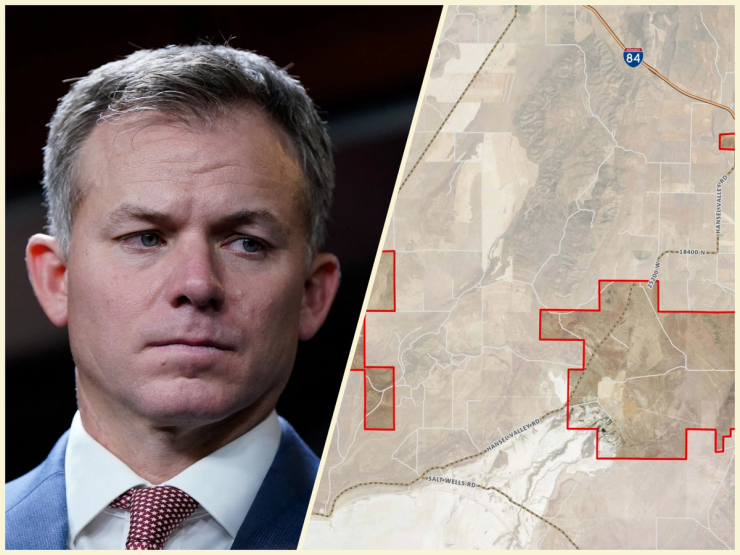
Utah Rep. Blake Moore is heavily favored in Tuesday’s primary over state legislator Karianne Lisonbee — but in the last weeks of the campaign, she has sought to gain ground by undercutting Moore’s position on the 20,000-acre Stratos data center project. Lisonbee has stood against Stratos, while Moore has called for more engagement with local stakeholders without taking a firm stance.
Their intraparty fight is the latest example of political blowback to the AI-fueled boom in data center construction across the country. Although polls show that more Democrats than Republicans are strong critics of data centers, the projects’ rise is still exacerbating tensions between the GOP’s pro-business wing and its populist-fueled resistance to AI.
“I absolutely think the [Stratos data center] will be an issue that impacts the outcome of this primary race,” Lisonbee said in a statement to Semafor. Accusing Moore of having “doubled down on his support of the data center,” she predicted that “most voters will align with me on this issue.”
Lisonbee is aiming to capitalize on the surge in voter engagement around the data center, which is set to be built in Box Elder County in Utah’s rural northwest. Despite the project’s high-profile backing from Canadian millionaire Kevin O’Leary, Stratos has halved its scope as activists campaign to oust local politicians seen as supportive.
Moore, in a statement, said that tech companies “need to respond to citizens’ feedback, show how they’re going to invest in natural resources, and help lower, not increase, energy prices for impacted areas. We should empower the local areas making these decisions, not attempt to avoid tough conversations.”
He also knocked his opponent for “trying to distance herself from ‘the process’ when she was a strong supporter of it during her time in the state legislature,” a reference to her previous support for a state-level government agency involved in the data center project.
Moore has a valuable endorsement from President Donald Trump and history on his side. Lisonbee handily defeated him at the state nominating convention earlier this year, but Moore, who will still be on the ballot, is undeterred; he also lost at the convention in 2024 but still cruised to victory in the primary.
Brenna Williams, an organizer of an anti-Stratos data center group, said Lisonbee’s focus on the data center would help her with undecided voters: “It’s definitely a voting issue for folks, especially at the local level.”
“I know who my vote would go for — it’s not Blake Moore, and in the past, he would have always gotten my vote,” Williams added.
Moore has touted the potential economic and national security benefits of the project while also calling for more local input as it proceeds. Lisonbee has aligned herself more broadly with local-control-focused curbs on AI, like those recently signed into Florida law by GOP Gov. Ron DeSantis.
But she’s also not in favor of one-size-fits-all data center regulation.
“I am a strong proponent of federalism. I am not sure regulating data centers from Washington, DC, is the answer,” she said. “Each state and region of our nation is so different.”
In this article:

Know More
The Stratos project isn’t the only obstacle to reelection Moore faces. The incumbent’s links to a past Utah redistricting effort have made him some MAGA enemies, now that the state is poised to adopt a new map that’s likely to net Democrats a blue seat.
“There are some people who are upset about that, because we basically handed over a seat to the Democratic Party,” said Don Guymon, chair of the Davis County Republican Party, which is backing Lisonbee. “It’s hard to beat an incumbent, but I think Rep. Lisonbee has momentum on her side.”
Yet Moore has made some inroads in Lisonbee’s statehouse backyard. The president of the Utah state Senate backs him, while Lisonbee has picked up a sizable bloc of support from her fellow state legislators, including leaders in the Utah state House.
Sen. John Curtis, R-Utah, has previously indicated he’d back Moore. The state’s other Republican senator, Mike Lee, told Semafor he was “not getting involved in the federal primaries in Utah.”

Room for Disagreement
Lisonbee’s data center stance may have caught on, but she’s still facing long odds. FEC filings showed Moore entering June with more than 30 times as much cash on hand as Lisonbee, and his internal polling showed him with a sizable lead.
Even some activists who opposed Stratos told Semafor they were skeptical it might sway the primary.
“I think it is an issue on people’s minds, but I don’t know if that will actually make a difference in Blake versus Karianne,” said Conner Radcliffe, the president of Utah Civic Compact, a group opposing the data center.

Nicholas’s view
Regardless of whether Lisonbee can pull off the upset, hers won’t be the last Republican challenge to seize on the party’s split over data centers. With an estimated $130 billion in data center projects blocked by protests in the first quarter of this year, according to one study, it’s clear that the political blowback is growing to what, for many communities, amounts to the physical manifestation of the AI boom.
Politicians on both sides of the aisle will have to retool their approaches accordingly.

Notable
- Some estimates project Stratos’ energy consumption and production at full strength could dwarf Utah’s, The New York Times reported.
Burgess Everett contributed to this report.