




Ben’s view
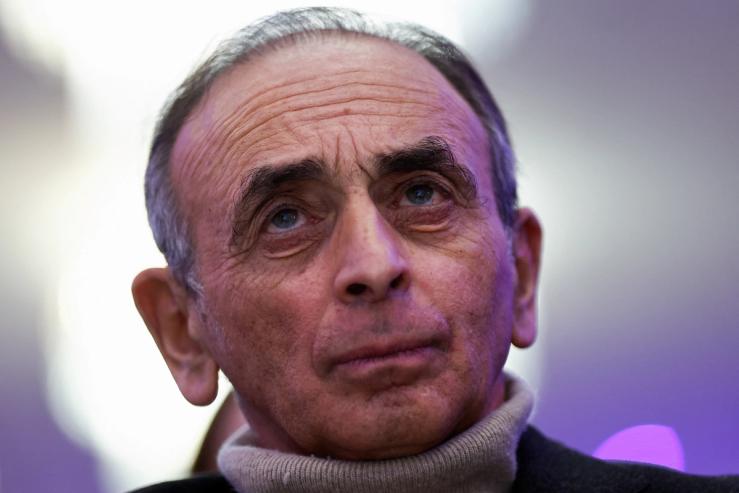
The French writer and presidential candidate Éric Zemmour was in Washington earlier this month meeting with Trump officials, but he didn’t make it to the White House. (It is, fittingly, harder to clear foreigners on short notice.)
Zemmour’s 2014 polemic The Suicide of France was recently released in English translation by Encounter Books, as the divisive and influential European anti-immigration politics of the 2010s remain current across the Atlantic.
Zemmour ran for president of his country in 2022 as the right-wing alternative to the country’s far-right party, known now as the National Rally. Prior to the campaign, he had often been in the news for getting fined for hate speech over things he’d said in television debates. Zemmour’s career and his histrionic message — that France is in a civilizational crisis, facing religious colonization from Islam alongside commercial and technological onslaughts from China and the United States — should have made him a gadfly. But months before the election, he was polling ahead of the better-known National Rally, led by Marine Le Pen, before sliding to a 12% finish.
Zemmour told me over bottled water in his suite at the Trump International Hotel in New York about his meetings with senior Trump administration officials.
They differed on some issues — the Iran war, for instance. But “when we talked, for example, about immigration, you clearly see that there, we’re broadly in agreement.” Ditto “the fight against wokeism.”
“I make the same analysis as MAGA on the critiques of globalization and the necessity of protecting ourselves from Chinese colonization and the Chinese commercial wave,” Zemmour said. (We spoke in French with the occasional assistance of his translator, Nathan Pinkoski.)
Perhaps the most interesting thing about Zemmour, who indicated that he’s running again next year — “a priori, it will be me” on the Reconquête party line — is that he rejects the most basic analysis of American politics: that it’s always about the economy.
“The economy, obviously, is important, but it’s overcome by the identity divide,” he said.
Zemmour’s diagnosis is not the standard analysis of why centrist leaders everywhere, from Emmanuel Macron in France to Keir Starmer in the UK and Joe Biden in the US, have grown so profoundly unpopular. More popular explanations from right and left are inflation, the “affordability crisis,” and wealth inequality.
This inverts the usual analysis of American politics, that our bitter culture wars will always resolve down to questions like affordability. James Carville’s old line, “It’s the economy, stupid,” is an unquestioned truism. In France, Le Pen and her allies are leading in polls by softening their apocalyptic rhetoric and instead promising big-government populist economic relief.
And yet there are other ways of seeing the moment. Certainly, public figures these days talk a lot about affordability, and there’s no questioning national anger at inflation. But there are real competing forces. President Donald Trump’s final television ads focused on transgender rights. The Gaza war fueled the core of support for Zohran Mamdani and his generation of New York socialists.
When Le Pen and others on the old far right pit elites against the people, Zemmour argues that in Europe there’s a different divide: “The Labour Party is collapsing, the Conservative Party is collapsing, in favor of two parties: one that is pro-Palestinian, pro-Muslim — the Greens — and the other, [Nigel] Farage and Reform, which is anti-immigration.”
Zemmour is dismissive of what he sees as the outmoded politics of figures from Le Pen to the American populist Steve Bannon, whom he sees as embodying “the divide of the 1990s between populists and globalists.” But Bannon, too, told me Saturday that he feels the right shifting. “The MAGA movement’s been populist until now, but it’s going to get much more nationalistic,” he said. “The younger generation is ultra-nationalistic, I can feel it.’”
The upshot of this is that while many analysts of American politics believe the country’s bitter culture wars will be subsumed by battles over economic visions and resources, there’s a parallel future in which the battles over culture intensify. Texas Republican nominee Ken Paxton, for instance, beat an incumbent Republican in a race that turned, in part, into a battle over who would be more anti-Muslim. Bannon rails against visas for skilled workers — not just undocumented immigrants.
If there’s an obvious hole in this argument, it’s in how anger over immigration seems unmoored from the religious and civilizational issues Zemmour prefers to talk about. I noted that the bitter US immigration politics are driven largely by Christian immigrants of European descent.
“Even South Americans — they’re Europeans. It’s not the same thing as Muslims. We have the same cultural base,” he said. “I’m not saying everything is fine.”

Room for Disagreement
Other political thinkers and writers don’t see such a clear dichotomy between economics-driven politics and culture wars. In her 2016 book, Strangers in Their Own Land, Arlie Russell Hochschild explores why Americans who depend on the federal government the most also seem to hate it so much. She coined the concept of “deep story” — politics as a personal narrative (true or not) that weaves status, economics and cultural attitudes together.
Francis Fukuyama’s view is closer to Zemmour’s. He argues in his 2018 book Identity that the unifying theme of modern politics is the transcendent need for recognition and dignity. Material motivations alone, Fukuyama points out, cannot explain many people’s political choices. But Fukuyama also argues that economic and cultural upheaval are what gave us our current politics, with identity serving as a language of backlash.