




The News
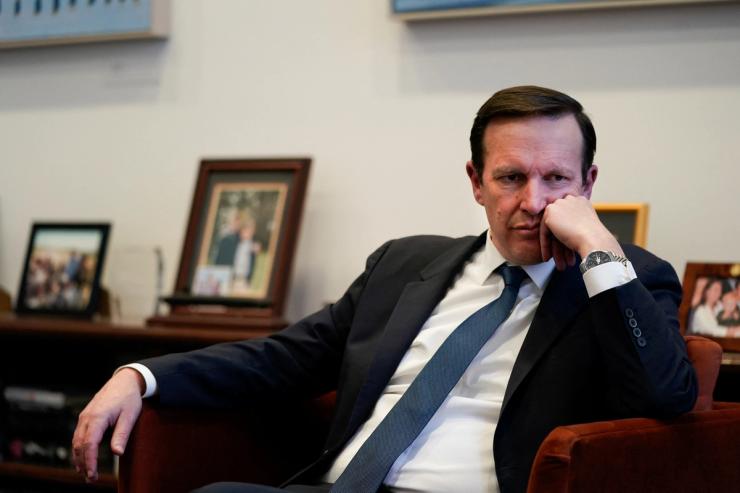
Sen. Chris Murphy, D-Conn., isn’t necessarily running for president — but he is writing to help define how the next Democratic president should make policy.
His new book, “Crisis of the Common Good,” advocates for a new “economic nationalism,” stopping short of socialism, while adapting to the changes that two Trump administrations wrought.
He spoke with Semafor about his call for the party to pick bigger fights to reestablish its identity. “If we focus all of our energy just on Trump’s corruption and don’t admit that the whole system is corrupt, I don’t think we’re credible messengers,” he said.

The View From Chris Murphy
The following transcript has been edited for length and clarity.
David Weigel: The theme of this book seems to be that Americans have accepted an idea of for-profit supremacy, created by conservative judges, that’s limiting their ambitions for how the country could change. Am I reading it right?
Chris Murphy: That’s obviously why the book is structured around six cults. What is a cult? A cult is a system of false beliefs that benefit one powerful person, or a handful of powerful people. I think we are living in a world of cults, things we believe to be true that actually aren’t, that make most of us miserable, and a few people wealthy and happy.
The cult of profit is this idea that a successful company is one that abuses its workers and treats the community in which it sits miserably, but makes disgusting amounts of profit.
We don’t have to define the success of our economy simply through profit taking. We could design an economy that incentivized companies to treat workers better and pay higher wages and pay CEOs less. That’s just a choice that we’re making. There’s fatalism in both the left and the right about the way that our economy is designed today.
How often do you hear this from fellow Democrats? Some version of: “Well, we can’t do that. Look at the effect it would have on profits. Doing that would make us look like communists.”
We live in this construct today where it appears there’s only two choices for our economy: Market fundamentalism or socialism. Those are not the only choices. We could build what I describe in the book as a common good capitalism, where we’re trying to create more millionaires and fewer trillionaires — where we reward success, but we don’t hoard success in the hands of a few people. We’ve allowed ourselves to be bought into this false paradigm, where there’s only two choices: The government owns and runs everything, or there are no rules.
National identity and local identity are really important to human beings. Democrats should be for economic nationalism – a much more responsible version of it than Republicans proffer, but we should make things in the United States. People want to belong to healthy local places, and the celebration of local identity and local pride is a positive thing, and, and it shouldn’t be captured only by the right.
Where does immigration fit into this? How much do you think Democrats are limited by being a pro-immigration party, running against an America First party? When it says we need to restore the community and cohesion of 40 or 50 years ago, the answer includes mass deportation.
The basic argument of this book is that in a country where people have less purpose and connection in their lives, the more likely they are to be captured by scapegoat politics. It is not true that immigrants and Muslims and gay children are corrupting this nation. But in a world of scarcity where people are fighting over crumbs, and they have no dignity in their work, and fewer friends in their life.
My basic idea here is that if you created a common good economy, where people had more access to economic power, if you created more healthy communities where people are members of things like churches and labor unions, they would be happier and less anxious and less likely to fall for Trump’s lies about who’s to blame for their tough situation.
In other democracies, with very robust social safety nets and some of the ideas you like, anti-immigration parties have been thriving. What’s the right level of immigration for America? I assume it’s not what it was in the first year of the Biden administration.
I spent five months left in a room with James Lankford coming up with the toughest border security bill that Democrats had ever had ever supported. And I think that is because having a rules-based immigration system, and having a secure controlled border, is really important in a multicultural society.
When you don’t have those clear rules, it does breed resentments. So in 2023, when 9,000 people were crossing that border on a daily basis, that should have been immediately unacceptable to Democrats, because it suggested there were no rules any longer as to how you enter the country or how you become a member of our community.
In order to preserve a nation that is proudly multicultural and proudly welcomes immigrants, you have to have real control at the border, and you have to have a system of laws. Yeah, there were aspects of that bill I wrote that were tough and controversial and opposed by the left, like the emergency lever that would shut off the border for portions of time when the numbers got too high. But I think that’s how you maintain broad support for immigration, to have a system where the rules apply to everybody.