




Andy’s view
The US is aiming for the stars again. To win its superpower competition with China, that may be its best bet.
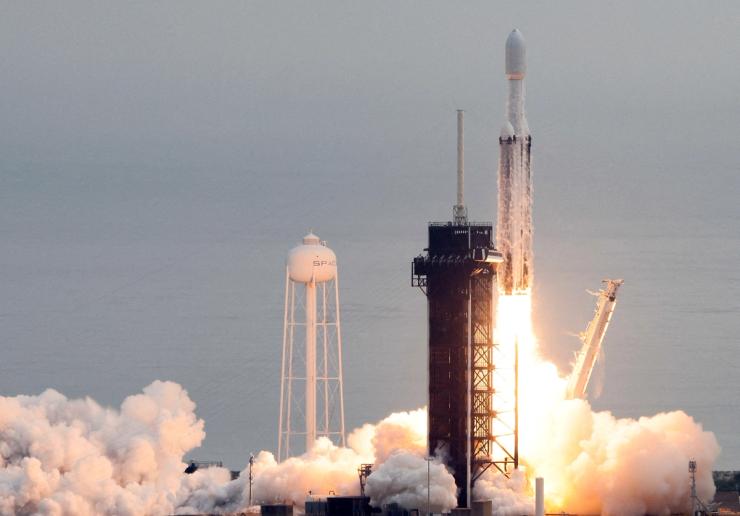
Last week’s SpaceX IPO created an instant $2 trillion-plus market behemoth, larger than the top-10 listed Chinese technology companies combined. Later this year, OpenAI and Anthropic are themselves aiming to IPO, each already with valuations that approximate the $1 trillion mark.
More importantly, Musk’s engineering breakthroughs and the technical advances from frontier AI labs have inspired a constellation of startups. Space in particular offers a new commercial frontier where the US now holds a decisive advantage over its main geopolitical rival. China hasn’t yet developed a reusable rocket, and its AI labs have already pivoted to focusing on low-cost technology rather than the cutting edge.
Across both, China is an animating driver. My colleague Reed Albergotti reported that the White House’s decision to impose export limits on Anthropic was driven by concern over Chinese access; Delian Asparouhov, the founder of Varda, a Silicon Valley startup that aspires to produce novel pharmaceuticals in space, goes further: “Whoever nails economic activity in low Earth orbit by default basically wins the rest of the solar system,” he said recently. “I just don’t want to see a world where the Chinese figure this stuff out first.”
But that’s not the only reason for the incredible advances. The US is at its competitive best when gazing heavenwards. The 1960s Space Race with the Soviet Union galvanized the nation and spawned innovations like microchips, computer integrated circuits, and commercial fuel cells.
Who knows whether Elon Musk will ever manage to establish human settlements on Mars, or factories on the moon, or even if orbital AI data centers can be made to work. But his vision to turn humanity into a multi-planetary species gets the country pointed in the right direction: forward.
So much of Washington’s current industrial strategy aimed at countering China is backward looking. The very idea of a manufacturing renaissance is rooted in a 1950s ideal of prosperous factory towns and well-paid blue-collar jobs. But that era is over; the US will never again be competitive in traditional industries like shipbuilding, where China now produces more than half the world’s supply. And in an array of high-tech sectors such as EVs, batteries, and other clean tech, China has pulled so far ahead it’s debatable whether the US will ever be able to catch up.
Besides, industrial catch-up is colossally expensive. According to William Blair, an investment banking and financial services firm, it will take $360 billion to $450 billion in global investment by 2030 just to break China’s rare earth monopoly — a national security priority, and a prerequisite for rebuilding America’s dilapidated industrial base.
I’m in China next week to attend the summer edition of Davos, which takes place this year in the northern industrial city of Dalian, a center for shipbuilding, petrochemicals, and software outsourcing. Much has changed since I left the country in 2018, not least China cementing its status as the dominant global power in a range of industries, but also its epic real estate bust that has left cities like Dalian awash in debt.
Living now in the US, I’m far from convinced that, as Chinese leader Xi Jinping seems to believe, “the East is rising and the West is declining.”
There’s every reason to believe that the US will succeed — if it plays to its strengths. That means mobilizing the country’s entrepreneurial energy, extreme risk-taking culture, and deep pools of capital to pioneer new areas of technology. Rather than reshoring yesterday’s industries, the US would be better off tooling up for tomorrow’s.
Two decades ago, Musk gave himself only a 10% chance of successfully launching and scaling SpaceX. But he now operates almost 10,000 satellites. China has no more than a few hundred. Musk’s “Gigabays” in Texas, where he’s assembling his giant Starship vehicles, is the template.

Notable
- A leading Chinese economist says China shouldn’t try to copy SpaceX: Instead, Shen Yingchun says Beijing should use the “national will” to concentrate first on addressing issues like infrastructure and standard-setting.
- What happened to the great rebirth of American manufacturing? Writing in the Financial Times, Brooke Masters argues that “large-scale re-industrialization is harder than it sounds,” and tangible results are limited.