




Tim’s view
The wave of record-breaking public offerings for AI megacompanies that has Wall Street fixated this week is also buoying energy startups that see a chance to win back investors’ favor after the disappointing climate tech boom of the early 2020s.
In the past quarter or so, a rising number of energy tech startups have hit the public market. Geothermal pioneer Fervo raised $1.9 billion; small nuclear reactor manufacturer X-energy raised more than $1 billion, joining a series of other nuclear startups with more on the way; last week the gas generator manufacturer Innio raised $2.4 billion and on Tuesday a similar company, ERock, raised $600 million. These companies all have two things in common: A plan to get rich selling electrons to data centers, and a conviction that the stock market is the best place to find the capital they need to do so.
The hullabaloo around the SpaceX IPO, which is expected to be the largest in history when it hits the Nasdaq tomorrow, plus the similarly massive upcoming Anthropic and OpenAI debuts, could pose a risk for future energy tech aspirants. As my colleague Rohan Goswani observed, “the sheer amount of money these AI giants will need raises concerns they’ll crowd out fast followers.”
But for now, it seems more likely that the rising tide will lift many boats, Beau Bohm, global co-head of equity capital markets at investment bank Cantor Fitzgerald, told me. Gigantic AI IPOs “expand overall appetite for the infrastructure thesis more broadly,” he said. “The actual risk to this cohort of new energy tech IPOs is a softening of the overall AI demand narrative, not necessarily competition from these mega AI offerings. If these deals perform well, investors are going to have a lot more appetite to deploy capital into the picks and shovels around AI.”
That’s a marked turnaround from the sour vibe that many of these companies, which until a year or two ago would have been more often classed as “climate tech,” faced from retail investors in the past five years. Around 2021, there was a boom in climate tech startups going public, often via special-purpose acquisition companies (SPACs), as investors, flush with cheap capital and exuberant about fighting climate change, were willing to assign high valuations to dozens of startups with no revenue and unclear paths to growth. But as cash and hardware got more expensive, customers failed to materialize, and capital-intensive bets on innovative manufacturing processes didn’t pan out, many of these companies saw their share prices quickly crushed, if they managed to survive at all.
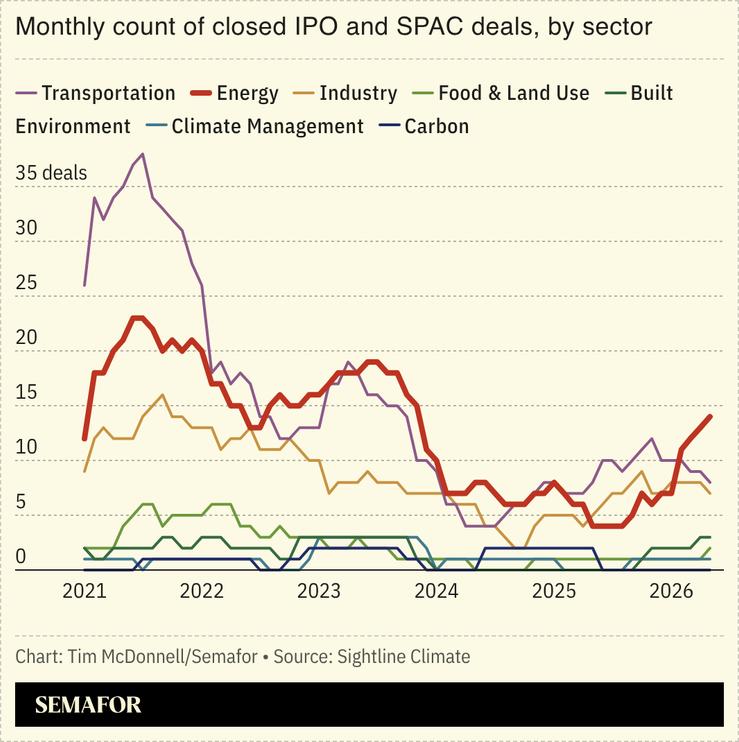
That boom was led by EV and transportation battery companies, which drew the most and biggest deals. Now, energy producers are clearly in the driver’s seat, Kim Zou, CEO of the climate tech intelligence firm Sightline Climate, told me. But while data centers clearly offer the kind of crystal-clear customer base that climate tech usually lacked, for companies chasing novel tech that is still years away from delivery, like advanced nuclear, “it’s an open question whether all of these companies going public are going to have the real commercial traction needed in the next few years to scale,” she said. Since their respective IPOs, Fervo’s stock price is down 10%, and X-energy’s is down 38%.
But that hasn’t stopped new entrants from making their move. On Tuesday, Shahal Khan, CEO of the investment firm Burkhan World, announced that his privately-held data center power project Tachyon9 will merge with the publicly-listed AI infrastructure company Nixxy. The deal, according to a planning document Khan shared with me, involves the transfer of $64 million in power equipment, plus land options and other sweeteners, and will target a valuation of at least $1 billion when it is completed.
“I usually wouldn’t do something like that,” Khan said, adding that his typical approach would be to build Tachyon9 up toward its own conventional IPO. But with the amount of AI chips that tech companies are already sitting on, waiting only for a sufficient power supply, there’s no time to waste. “The market valuations have been so strong, and the capital out there in the market for us with what we’ve built is so massive, and we’ve got such a small timeline, that I have to do this really quickly to get this company public,” he said. “If we don’t have power, the entire AI trade can collapse in on itself.”

Notable
- Climate activists’ years-long push for “sustainable finance” rules hasn’t worked because they misunderstand some key facts about Wall Street, a new Columbia University report argues.