




The News
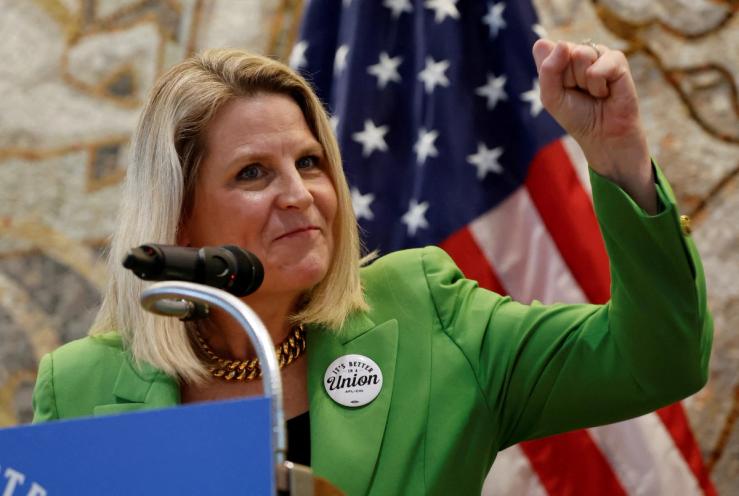
AFL-CIO President Liz Shuler is skeptical of a proposal floated on the left and right that leading artificial intelligence firms cede equity to the Trump administration in order to distribute their returns among Americans, she told Semafor.
“We think that our plan forward is actually a more responsible way to use technology to benefit the people,” Shuler said in an interview about how the union federation plans to center AI in upcoming elections coming out of its annual convention this past week.
Ceding equity, she said, “is not something that has necessarily been our vision of how this economy can work better for working people.”
Shuler also said unions will try to influence state and local AI legislation and turn the technology into “a key driver” in upcoming elections: “The only organized force left in the country to rebalance those scales is the labor movement … so we plan to use that,” Shuler said.

The View From Liz Shuler
This transcript has been edited for length and clarity.
Eleanor Mueller: The AFL-CIO put out a new poll that found workers trust unions more than anyone to protect them from the negative effects of AI. Coming out of this week, what is the game plan to make that happen?
Liz Shuler: We are going to be running it like a comprehensive campaign, where we’re using every tool and lever we have to galvanize our members. … We’re organizing through … our infrastructure of central labor councils throughout the country to get people channeled into their state legislatures … like we did in places like Massachusetts and Illinois and New York. … We think that’s really where the game is, because there’s not much happening at the federal level with the tech bros in charge of the White House.
And then of course the electoral piece, the political piece, and making this issue of AI and putting workers at the center a key driver in both the midterms and certainly the presidential, because this is going to affect every workplace, every job, every industry, and it really does cut across party lines. And so that trust that you spoke of, we’re the unique messenger that can actually bridge the gap of folks who are really anxious and concerned about this and … channel that anxiety and fear into results.
Is that playbook complicated at all by the role that building trades are playing in data centers’ construction?
We’ve debated that on the floor of the convention. We were resolved that it was not going to be an issue that was pitting workers against communities, and so we came out of the convention with a unified approach to say … we have to make sure that we’re putting those guardrails in place … but AI, obviously being powered by the infrastructure that data centers provide, has to be done with the support of the community and in a coalition with the community to make sure these data centers pay their fair share; that they’re building them responsibly; that water and electricity use is done with care and protection; and that they’re done with good union jobs, because there’s obviously always the threat of that being offshored. … So we’re saying we can have both.
So it sounds like you would not support something like a data center moratorium.
No.
Trump again today repeated this idea that maybe AI companies should give equity to the federal government to provide returns to the American public. Is that something that you think is a good idea?
I have heard him talk about this concept in other different industries [as] schemes that he’s put forward that seem to never manifest, and certainly not to benefit working people, so we think that our plan forward is actually a more responsible way to use technology to benefit the people. … If we’re not building an AI future that benefits workers, then what are we doing this for? … Trump has shown his hand that he is not interested in putting meaningful protections in place to make sure that the companies aren’t just running away with the profits and running over the top of us with an all-out quest to take over our society. … We say no, we put our foot down, we mobilize and organize, and that’s what this convention was about — that we’re going to make sure that workers are the ones driving this.
So what’s important isn’t the returns, but the way those returns are created.
Yeah, and we haven’t taken a position [when] Trump’s tried to do this in a couple different industries. It’s not something that has necessarily been our vision of how this economy can work better for working people.
Samsung recently saw tens of thousands of workers threatening to strike over AI. Do you think we’ll see more workers getting ready to walk out this year?
That’s an interesting question, because yes, we’ve been watching our siblings overseas and we’ve been working globally with our union counterparts across the world to have an approach to AI and safeguards for workers that’s cohesive. … I think the US is actually on the forefront. … That’s a challenge to get all of our unions on the same page … but this one is certainly increasing in our alarm and our fear and anxiety and frustration, because we’re seeing how fast it’s evolving, how the concentration of wealth has been building, and the only organized force left in the country to rebalance those scales is the labor movement. … So we plan to use that, and so this is going to be, leading into the election, a galvanizing issue, and certainly we think it will be the driving issue.