





David’s view
As Tom Steyer became the least successful self-funding candidate in modern US political history this week, his initial years in Democratic politics felt like a fever dream.
Steyer, who liked to say that he became a hedge fund billionaire “by accident,” joined Democratic politics at the start of its modern crisis. In 2014, the party despaired at the success of the Koch donor network — decades of right-wing philanthropy that paid off in the tea party movement.
Where were the left’s billionaires who could fight back? Steyer was one of them, a hyper-energetic San Franciscan who wore tartan ties with a four-in-hand knot, committing to bundle a historic amount of money for Democrats who’d fight climate change.
“Is it going to take $100 million?” he told The New York Times then. “I have no idea.”
That election ended up being a Democratic disaster, with non-college educated support for the party collapsing, presaging the rise of Donald Trump. Steyer’s runs for president and governor didn’t work, either; $558 million bought him no delegates and a third-place finish in his home state, below a British political strategist who became a citizen five years ago.
Why couldn’t Steyer pull this off? What did his 12 years as a “donor-doer” leave behind for his party?
Quite a lot, mostly related to the ballot measures he funded before getting more tied to national politics. But as he grew more ambitious, Steyer embodied the Democratic Party’s problems.
He operated in a campaign finance regime where the ultra-wealthy have ever more ways to influence elections, meaning the party needed people like him to compete. But his gubernatorial campaign rolled out when the most popular way for Democrats to keep their coalition together became blaming billionaires (of which he is one).
Talking with Democrats this week, as it became clear that Steyer was going to lose, I heard a number of explanations for what he did wrong. Some of their reasoning came with an angle; Steyer hired Fight Agency, the New York-based firm that angered some local Democrats by electing Zohran Mamdani and angered more by elevating Graham Platner.
For everybody Steyer was paying, many people wanted to see him fail. But another factor in his faceplant was unique to California.
This was the state’s fourth gubernatorial election under the increasingly loathed “top two” system, and the first without a clearly dominant candidate. The California Democratic Party stoked, and at least partially believes, the fears that a glut of Democratic candidates could produce a general election between two Republicans.
With no mechanism for shrinking the field, the party paid for polling that showed the risk of a lockout rising — then, after Eric Swalwell quit in disgrace, former Health and Human Services Secretary Xavier Becerra surging into a tie with Trump-backed Republican Steve Hilton. Its final poll showed Becerra clearly ahead.
And that was, ultimately, the end of Steyer.
“No one was excited about Becerra, but everyone I talked to was worried about two Republicans advancing, and kept asking who Democratic leaders wanted us to vote for,” Cenk Uygur, the LA-based progressive activist and commentator, told me. “The jungle primary has had an ironic effect on progressives here.”
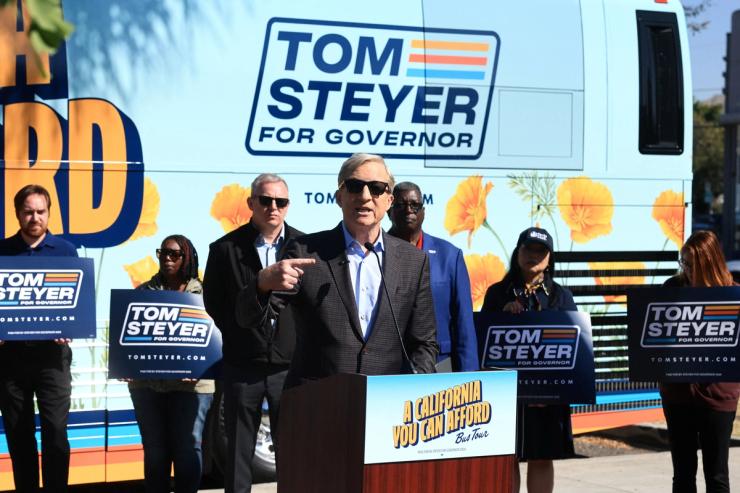
But why did Becerra, not Steyer, benefit from Swalwell’s collapse? Steyer’s spending made him omnipresent on Californians’ TVs, iPads, and phones. Look at a screen, and there he was, jabbing his finger at the viewer, apologizing for not supporting single-payer healthcare in 2020 (“Bernie was right”), celebrating his status as a class traitor.
It was a simpler message than Becerra’s: Steyer could not be bought. In the final weeks of the race, when pro-Becerra money slightly balanced out the ad wars, Steyer took to quoting Franklin D. Roosevelt’s peroration from his 1936 landslide campaign: “They are unanimous in their hatred for me, and I welcome their hatred.”
The consensus I heard in response to that: It’s not 1936. It’s not even 2018, when JB Pritzker and his wallet convinced Illinois Democrats to nominate him to beat an ultra-wealthy Republican governor.
Since then, for liberals, wealth has come to signal conservatism and the ascension of Donald Trump. As one Steyer strategist put it to me, his first name in debates and news stories was effectively “billionaire.”
Getting that brand through a Democratic primary was like pushing a camel through the eye of a needle — even when that camel supports a wealth tax on himself.
In this article:

Room for Disagreement
By the end of the gubernatorial race, Steyer did become the clear choice of progressive voters. His camp’s critique of Becerra’s corporate support did end up breaking through, as seen in his strength in the final ballots, returned when Democratic voters had stopped sweating the “lockout.”
But Steyer never stopped being asked about, or apologizing for, investments (private prisons, fossil fuels) he had made before running.