




The Scoop
Saudi authorities expect to spend more money canceling projects at NEOM than building them over the next five years, the latest sign of retrenchment of what was one of the world’s most ambitious development projects.
The vast, futuristic new city in northwestern Saudi Arabia was at one point projected to cost more than $1 trillion to build. Now, NEOM’s budget for 2026 through to 2030 includes 60 billion riyals ($16 billion) in anticipated payments to contractors to terminate long-term agreements, according to people familiar with the matter. The payments, tied to penalty clauses, demonstrate that even halting parts of the project will be expensive nearly a decade after Crown Prince Mohammed bin Salman unveiled the development.
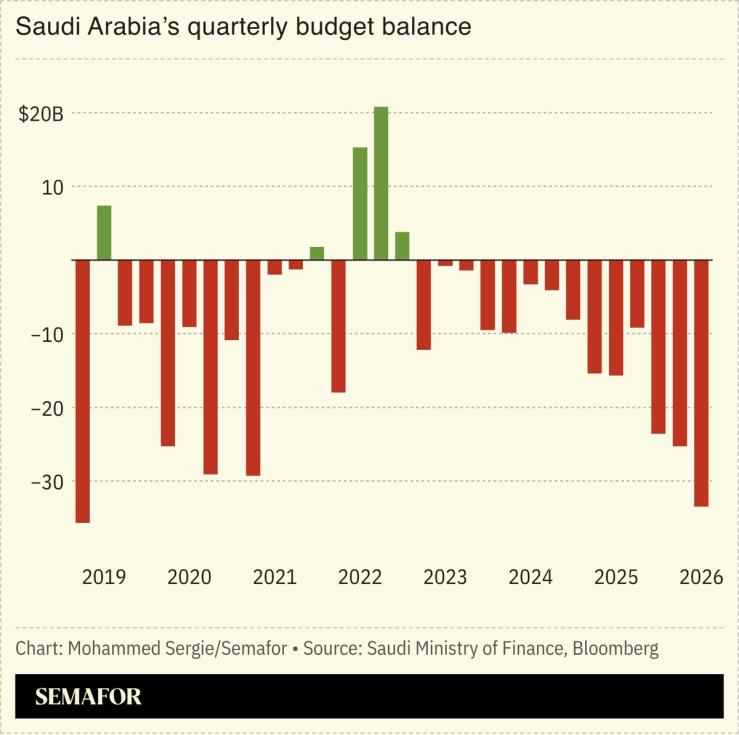
Years of budget deficits and missing targets for foreign investment have led the government to embark on a wave of cutbacks to its ambitions as it reevaluates the cost of its plan to transform the economy and slash its dependence on oil. The kingdom is also accelerating spending on defense — which has taken on an even greater importance because of the war with Iran — and investments tied to artificial intelligence, logistics, and infrastructure needed for Expo 2030 and the 2034 men’s soccer World Cup.
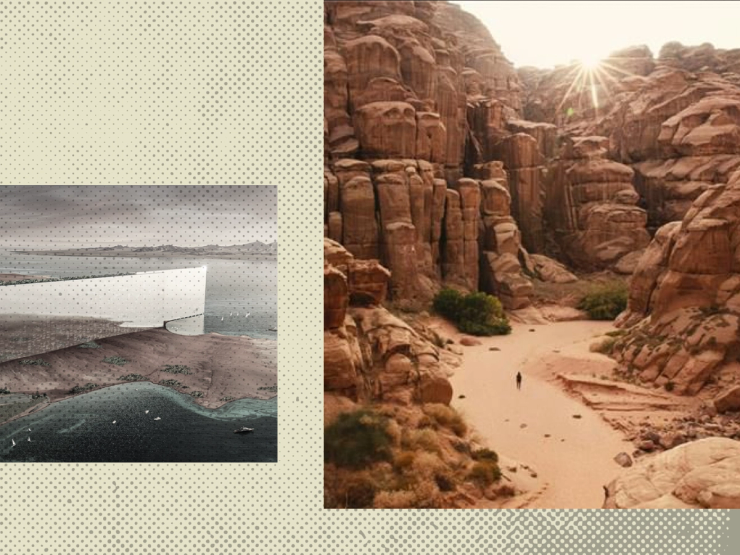
The projected cancellation costs to halt construction on projects like The Line, a pair of mirrored skyscrapers running from the coast into the desert, are equal to more than a third of the government’s projected 2026 budget deficit. The final amount it will have to pay to cancel contracts may change depending on negotiations with contractors, the people said.
The pullback at NEOM follows a strategic review launched after Aiman Al-Mudaifer took over as chief executive last year. The review has led to layoffs, corporate restructuring, and a reassessment of development plans across the site, Semafor previously reported.
NEOM didn’t respond to requests for comment.

Know More
NEOM, which is both a company and the name of the region being developed in northwestern Saudi Arabia, is controlled by the kingdom’s sovereign wealth fund. It has already started canceling a raft of contracts to conserve cash and refocus on investments more likely to make a return. Public Investment Fund governor Yasir Al Rumayyan said in April that no projects had been canceled, adding that the fund was reprioritizing spending under its new 2026-2030 strategy.
Saudi Arabia has embarked on a slew of costly investment plans over the past decade and many of the sovereign wealth fund’s diversification projects have yet to pay off. That has combined to make the kingdom a net borrower rather than an exporter of capital, and it hasn’t been able to meet its targets for attracting foreign direct investment to help plug the gap.
The kingdom has spent $64 billion on NEOM so far, the people said. There’s little to show for it, other than parts of the industrial city OXAGON, where the port has become an important node for bringing in goods following the Iran war and the effective closure of the Strait of Hormuz. That’s helped the Saudi economy remain resilient and play a bigger role as a logistics hub for the Gulf.
An $8.4 billion green hydrogen project there is also nearing completion. NEOM still plans to spend 40 billion riyals on new development, mostly related to developing the OXAGON industrial city and utilities. The aim is to establish the infrastructure to attract other firms to build data centers or manufacturing facilities in the area.
That is a reflection of the kingdom’s shifting priorities and greater focus on bringing in foreign investors. In addition to halting work on The Line, NEOM also won’t allocate new funding until next decade to tourism projects MAGNA, a string of Red Sea coastal resorts spanning 120 kilometers (75 miles), or TROJENA, a mountaintop winter sports destination that the government had hoped could host the 2029 Asian Winter Games, Semafor previously reported.
A luxury yacht resort island called Sindalah was closed soon after a grand launch party in 2024, and it remains unclear if it will reopen.
Last month, NEOM canceled a contract with Spain’s Webuild for a highspeed rail line. And earlier this year, it scrapped a separate $4.7 billion contract with Webuild as well as deals with Malaysia’s Eversendai Corporation and South Korea’s Hyundai Engineering & Construction.

Notable
- Mohammed bin Salman’s utopian city NEOM was undone by the laws of physics and finance, the Financial Times reported.