




The News
Two telecom tower companies are committing more than $200 million to DR Congo, betting that rising data use and growing demand from the mining sector will transform one of Africa’s largest underdeveloped telecom markets.
The investment comes as African internet data consumption is projected to quadruple over the next five years. With 110 million people and mobile penetration still well below saturation, DR Congo offers the scale investors want in a market where much of the network buildout remains ahead.
Eastcastle Infrastructure, a Jersey-based operator with towers in DR Congo and Nigeria, is investing another $100 million in Congo over the next 18 months after spending nearly $200 million since entering the market five years ago, CEO Peter Lewis told Semafor. London-listed Helios Towers, the country’s largest independent tower operator by reported sites, announced a $110 million investment this year. Its DR Congo chief, Maixent Bekangba, said the spending is the company’s 2026 capex for the market, up 77% from last year and its biggest annual Congo investment in five years. About a third of growing customer demand comes from Kolwezi and Lubumbashi in the southern copper-and-cobalt belt, where mines rely on connectivity to manage operations and link sites to headquarters.
The country’s growing strategic importance as a supplier of critical minerals has also helped attract foreign capital after years of investor caution, said Albert Kabeya, a telecom consultant who works with DR Congo’s telecommunications regulator. Operators are focused on data and mobile money services, which are driving revenue growth and creating incentives to extend coverage and add capacity, Kabeya said.
“I can’t think of another African market other than Nigeria where you’ve got that kind of demand,” Lewis said, noting that while most African countries build hundreds of towers annually, DR Congo and Nigeria are now building thousands.

Know More
DR Congo is one of Africa’s fastest-growing large economies, with the IMF forecasting 5.9% growth this year against 4.3% for sub-Saharan Africa. It is also a large mobile market still underpenetrated, with more than 70 million mobile subscriptions at the end of 2025 but only two-thirds penetration. Gilbert Nkuli, an industry expert who helped launch the DR Congo’s first digital cellular network, told Semafor operators first focused on major cities before turning to rural areas in a country roughly the size of Western Europe, where the vast territory and spread out population, with much of it still unreached, made expansion harder. He said the country remains far behind its peers. “A very big delay,” he said. “With more than 100 million people, the market is immense.”
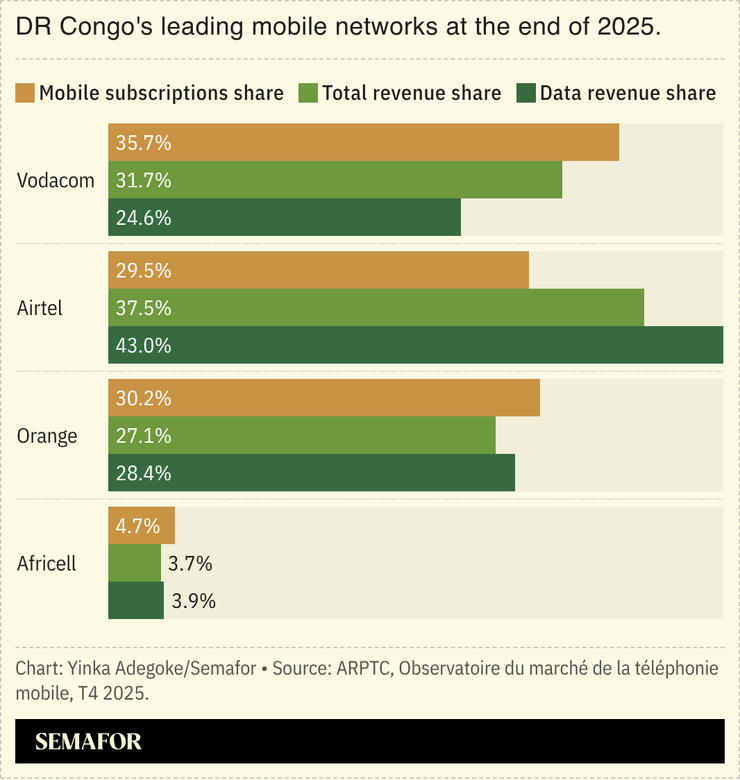
Industry experts estimate DR Congo has about 5,000 to 6,000 towers, well short of the number needed just to close the country’s coverage gap. Demand for data is already changing the revenue map: Airtel was third in subscribers at the end of 2025, behind Vodacom and Orange, but led the market in mobile data revenue and overall revenue, the telecom regulator said.
That shift is reflected in demand from mobile operators, which need more capacity on existing sites and more sites where data traffic is growing, with Bekangba saying Helios has enough signed demand for its 2026 buildout and Eastcastle saying all of the sites it is currently building are backed by commitments from mobile operators. “Data is what drives revenue, not voice,” Lewis said. “But for data to work, you need capacity.”

Step Back
DR Congo’s mobile market generated about $2.4 billion in revenue in 2025, up from about $2.1 billion a year earlier, the telecom regulator said. By the fourth quarter, mobile data had passed voice as the sector’s biggest source of revenue, reaching more than 55% of total telecom revenue, a level the regulator said had never been recorded before.
DR Congo’s mobile market is served by four operators, including the local businesses of South Africa’s Vodacom Group, India’s Bharti Airtel and France’s Orange, which hold roughly equal market shares.

Notable
- Sub-Saharan Africa’s digital infrastructure spending reached about $7 billion in 2024, mostly in mobile networks. Providers are expected to spend $7 billion to $8 billion a year through 2030.