



The News
Barely a day after President Donald Trump signed an order on advanced artificial intelligence technology, the industry pivoted to harder lobbying of Congress to address the patchwork of state and local laws it’s contending with.
But AI giants are likely too late, as prospects for passage of any bill this year grow narrower by the day.
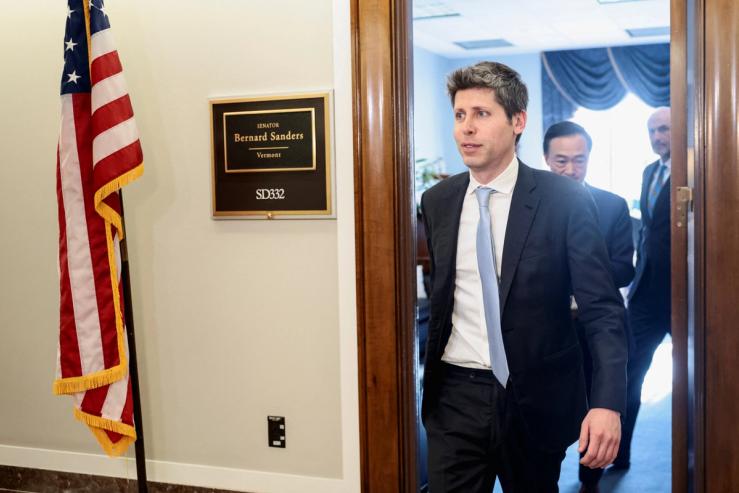
Trump’s Tuesday order suggests that AI firms share their latest models with the federal government for a 30-day review before any public release, a risk-focused proposal that still attracted notable internal pushback. Those same AI firms are hoping it strengthens their case for Congress to wade into broader AI regulation; OpenAI CEO Sam Altman made the rounds Wednesday on Capitol Hill, touting his firm’s latest blueprint for federal oversight.
Altman projected confidence on his way into House Minority Leader Hakeem Jeffries’ office, telling Semafor in a brief interview that he believed policymakers could reconcile Trump’s order with OpenAI’s latest recommendations, including for mandatory review of models: “I think people seem to have a very shared view of what we need to focus on right now.”
But several AI proposals are already vying for attention on the Hill with several weeks of active legislating until midterm elections that could hand power to Democrats, further scrambling the politics of policymaking. Past Republican efforts to quickly override state AI laws appear to have lost momentum, setting up a complex future battle.
Asked if Congress could pass something this year, Sen. Maria Cantwell, D-Wash., put it bluntly: “It’s June.” The Commerce Committee’s top Democrat, also slated to meet with Altman, added that before Trump’s recent order, “we were willing to talk.”
Optimists are pushing ahead. Reps. Jay Obernolte, R-Calif., and Lori Trahan, D-Mass., aim to release a fresh discussion draft as soon as this week that’s designed to serve as a regulatory starting point. Altman also met with Speaker Mike Johnson; Senate Minority Leader Chuck Schumer; Sen. Bernie Sanders, I-Vt.; and other House Democrats working on AI policy.
In a notable departure from the GOP’s past attempts to preempt state AI laws, OpenAI is now embracing a “reverse federalism” approach that urges Congress to build on existing state measures, including a relatively strong Illinois law that rival Anthropic also supports.
“The issue is that states are getting out ahead of the federal preemption,” one person familiar with the industry’s thinking said, and “the EO didn’t achieve what a lot of companies were hoping for. … So companies are growing impatient.”
Yet members of both parties have reservations about working with industry at all. The GOP’s anti-tech populists, like Sen. Josh Hawley of Missouri, are loath to hand AI firms anything resembling a win. And a broad swath of Democrats would rather wait until after the election, when they might claim more ownership over the final product.
“There’s a big ball to push up a hill when it comes to getting AI passed,” said Caleb Max, CEO of the National Artificial Intelligence Association, said. “Every day that passes … I increasingly think it’s probably not going to happen.”
“There is a chance that there’s a gold line here in a building of dust,” Max added. “But a lot of things have to fall into place.”
A White House proposal earlier this year laid out a “comprehensive national legislative framework.” Even if a proposal can make it through Congress this year, though, there are signs the administration itself remains divided over AI — most recently, Trump’s decision to sign the order without notice and in private.

Know More
Obernolte and Trahan’s lengthy proposal is expected to align with some of Altman’s goals by setting federal AI rules that reflect some state-level standards introduced in California, Illinois, and New York. Johnson signaled the bipartisan group would be part of a larger discussion that he promised to coordinate with the president.
Trahan said it was important for Congress to act now: “We’re going to be at this for a long time,” she said. “What I don’t want is for Congress to not act and give the power to set the rules to a couple of powerful private companies.”
Still, Washington must simultaneously heed voters’ increasingly negative view of AI as concerns mount over a shrinking workforce, child safety, and the energy consumption of data centers.
The latter has “become a big political issue,” Sen. Gary Peters, D-Mich., said, “and I can see it becoming a bigger one in the months ahead.”
“From a political standpoint, the public has turned against AI,” Peters added.
But Democrats are looking beyond the current negotiations. Rep. Ted Lieu, D-Calif., a member of party leadership who sits on an internal panel tasked with charting a potential Democratic majority’s AI policy, said federal legislation was needed and Trump’s order wasn’t enough.
Asked if next year — and a possible Democratic majority — might be too late for regulatory action, Lieu said states would have the prerogative.
“The American people are just asking for reasonable guardrails,” he told reporters. “Until Congress is able to act, you’re going to have to have states do this in the meantime.”
Other Democrats are specifically not convinced that Trump’s voluntary order can protect financial markets. Senate Banking Committee ranking member Elizabeth Warren, D-Mass., wrote to Treasury Secretary Scott Bessent on Wednesday requesting information on what steps his department has taken to protect the financial sector from AI-enabled cyberattacks.
The letter, shared first with Semafor, warns “it is deeply troubling that Treasury’s Wall Street deregulation agenda is leaving the financial system increasingly vulnerable.”
The Treasury Department did not immediately respond to a request for comment.

Room for Disagreement
The recipe for Washington to coalesce on AI before November contains three key ingredients, all highly challenging but not impossible.
“I do think if a framework comes out from Congress, Trump endorses it and puts a little bit of weight behind it, and squashes some of the [Steve] Bannons of the world, I actually do think it could pass,” Max said, referencing the onetime Trump adviser’s call for more stringent regulations around the technology.
“That is our biggest hope.”

Eleanor and Nicholas’ View
Congress has a hard enough time passing noncontroversial legislation. With a laundry list of agenda items left to get through this year, it’s hard for us to imagine a deal coming together.
Consider that internal Republican opposition doomed last year’s effort to preempt state laws, a debate that feels like light years away from the more bipartisan conversation that’s already happening. Tuesday’s unexpected Trump order is another wrench in the works.
Sen. Mike Rounds, R-S.D., asked about the path forward for AI legislation, may have spoken for quite a few members on Wednesday: “Give me a few days back here to put everything together again.”

Notable
- Politico reported on the Democratic Caucus dynamics around Trahan’s AI policy push.
Morgan Chalfant contributed.