


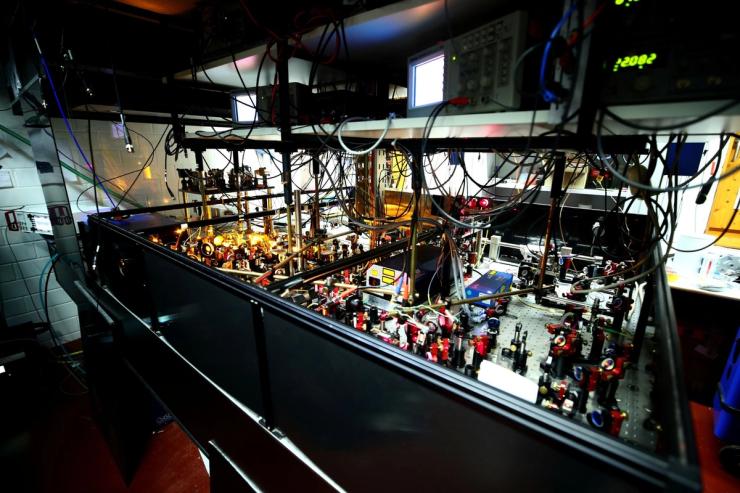
Physicists put a single chunk of metal into two places at once, the largest object ever shown to obey quantum mechanics’ weirdest rule.
At atomic scales, matter behaves like both wave and particle, meaning an electron, say, is not in one location but is smeared across space in a probabilistic “wave function.” At macro scales, this quantum superposition becomes undetectable — the objects we see tend to just be in one place — and scientists have long sought the boundary between the quantum and the everyday world.
The bundle of 10,000 sodium atoms, about the size of a modern transistor gate, is an order of magnitude larger than previous records, but still significantly smaller than Erwin Schrödinger’s pet cat.