



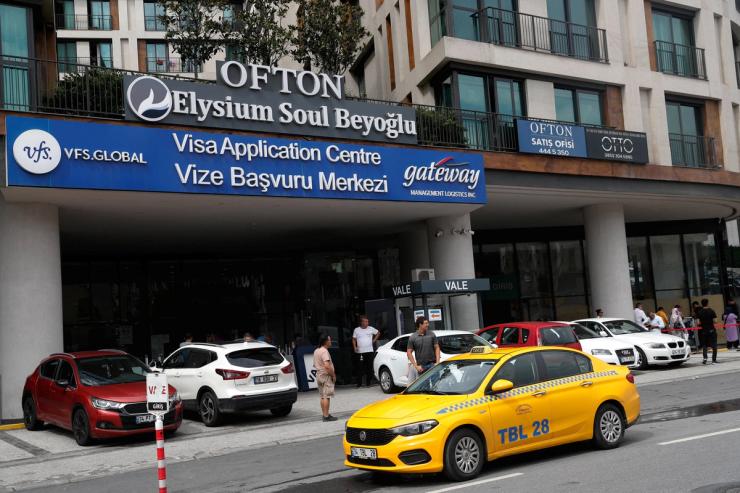

The News
A multibillion-dollar outsourcing agency used by European countries to process visa applications in Africa has amassed millions of dollars in profits from services that are often sold without proper disclosure to applicants, a new investigation alleges.
VFS Global, which is majority owned by US asset manager Blackstone began operations in India two decades ago, is the top processor of visa applications for countries in the European Union, and the United Kingdom. It has contracts with 71 governments and operates in more than 160 countries across Africa, Asia and the Middle East.
The firm’s essential product is to process visa applications — for which it charges a mandatory application fee. But ancillary services such as SMS updates, courier return services and access to premium lounges (supposedly to help an applicant sidestep a long queue), which staff are encouraged to sell in order to augment their salaries, have increasingly made up VFS Global’s revenue, said the findings by Lighthouse Reports, a nonprofit investigations outfit based in the Netherlands.
Multiple agency staff in Kenya, Nigeria and Ethiopia who gave information for the investigation said they were trained by VFS Global to include charges for these services. But they often ended up doing so without applicants’ consent, the investigation found. One former staffer in India said customers were “compelled or fooled into buying the services,” according to Lighthouse’s findings shared with Semafor.
VFS Global’s operating profit rose fourfold between 2017 and 2024 to €172 million ($200 million) on account of the sale of these services despite the fact that visa applications within the period only grew by 15%. The agency processed about 26 million people in 2024, with revenue per application rising 41% since pre-pandemic levels.
In 2022 Blackstone bought a 75% share in the agency and then two years later sold part of its VFS Global stake to state-owned Singaporean investment firm Temasek for $950 million, banking about $475 million as profit, according to Lighthouse.
In a response to the investigation, VFS Global said suggestions tying its financial growth to improper conduct are “false” and that visa applicants are “clearly informed” of “optional” value-added services.

Know More
Work, study, and tourism visits by Africans drive huge demand for visas to Europe and North America. Demand remains strong, despite growing efforts to restrict migration and controversial deportation campaigns such as that carried out by the US government under the Trump administration.
But rather than dealing directly with these countries’ embassies, visa applicants must rely on agencies such as VFS Global, a company that was valued at $7 billion in 2024 compared to about $2.5 billion at the time of Blackstone’s takeover.
The agency’s offices in major African cities like Abuja and Nairobi on any given weekday are crowded by several hundred applicants scrambling to ensure all documents needed to boost their chances of getting a coveted visa are in order. A typical applicant would have already started the application process online or through an agent, and paid the mandatory fee before visiting the office.

Step Back
VFS Global said it does not decide on visa applications and is only a procedural intermediary for embassies. But the agency’s growing profits on the back of so-called value added services owes to “a system of aggressive — and at times dishonest — upselling” by workers, Lighthouse said its investigation found. In one two-week period in 2025, the money VFS Global made from optional services on African and Asian applications for Swedish visas made up nearly a third of the agency’s revenue, according to Lighthouse data obtained from embassies.
The agency’s ability to make so much money from services whose results are not guaranteed to be in favor of the customer puts it at the center of concerns about the high cost of uncertain visa processes for people in developing countries.
EU member states implemented a 12.5% hike to the application fee in 2024 despite high rejection rates that disproportionately affect African applicants. For example, prospective visitors who apply from Ghana, Senegal and Nigeria receive rejection rates of between 40% and 50%. Africans paid $68 million for European short-term visa applications that ended up being rejected in 2024, imposing a cost that analysts have described as ‘reverse remittances’ in favour of rich countries.

Notable
- The EU is set to generate millions of euros more from the high rejection rates of visa applications by African visitors with a new increase in non-refundable fees.