




The Scene
As Lyft tries to climb out of Uber’s shadow, the ride-share company is going after the high-end travel market.
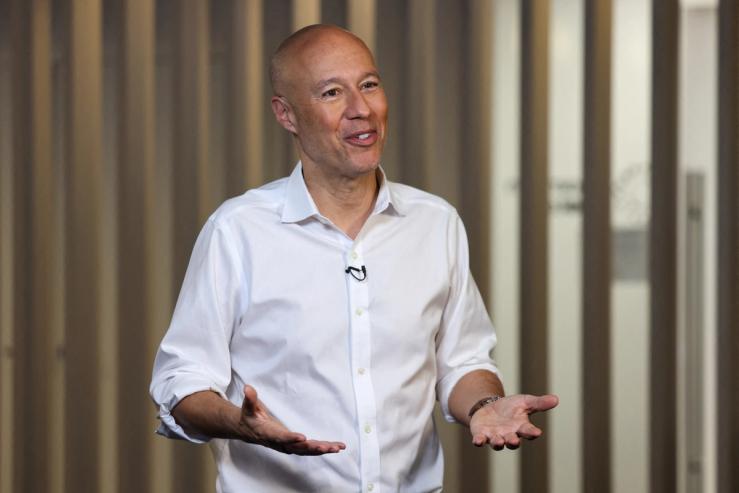
CEO David Risher said he’s already speaking with CEOs like United Airlines’ Scott Kirby about bundling Lyft with other corporate travel perks. “Maybe it looks like: get a first-class seat, and get an automatic upgrade on Lyft to a TBR chauffeur,” he said, referencing the European chauffeur service Lyft bought for $110 million last year.
“Frankly, without an asset like TBR, you can’t even get to that table,” Risher said.
After clawing its way back into the black from $2 billion in annual losses three years ago, Risher knows there’s only so long Lyft can compete on price. And while Risher — like Uber CEO Dara Khosrowshahi — expects the rise of autonomous vehicles to change the calculus for his business, he believes his higher-end clientele will still want to be driven around by humans.
“Our M&A supports what I’d call an ‘up and out’ strategy,” Risher told Semafor in a recent interview in New York. “The ‘out’ strategy is geographic expansion. The ‘up’ strategy is about appealing to a higher-end customer, [opening] up a part of the market that’s been largely closed to us.”
Conquering the corporate market is a logical place to start, Risher says. Hotels and airlines already compete fiercely for business travel dollars, offering favorable pricing at scale and even (relatively) secret loyalty tiers for key corporate executives. Since Lyft already works with many of the airlines and hotels, Risher sees a natural way to deepen those partnerships.

Know More
Lyft, like Uber (or “the other guys,” as Risher describes them) is also trying to figure out what mobility looks like as self-driving cars increase in popularity. Late last year the company struck a partnership with Waymo to launch self-driving options in Nashville, Tennessee, a program which launched this spring. It’s a little late to the game — Uber struck its own deals with Waymo three years ago — but Risher seems unbothered.
“The truth is, there are multiple approaches out there and nobody knows which one will win,” Risher said of the various AV players.
Lyft isn’t developing self-driving cars on its own, leaving that to Tesla, Waymo, and other companies. It wants to stick to serving as an asset-light platform, rather than run a fleet of its own cars, and also has a subsidiary that services and cleans autonomous vehicles.
“Partnering is a good risk-mitigation strategy,” Risher said. “Long-term, it may well make sense to develop in-house — but by the time we get there, we’ll have gone through two or three generations [of AVs,] seen what doesn’t work, and costs will presumably have come down.”