



The News
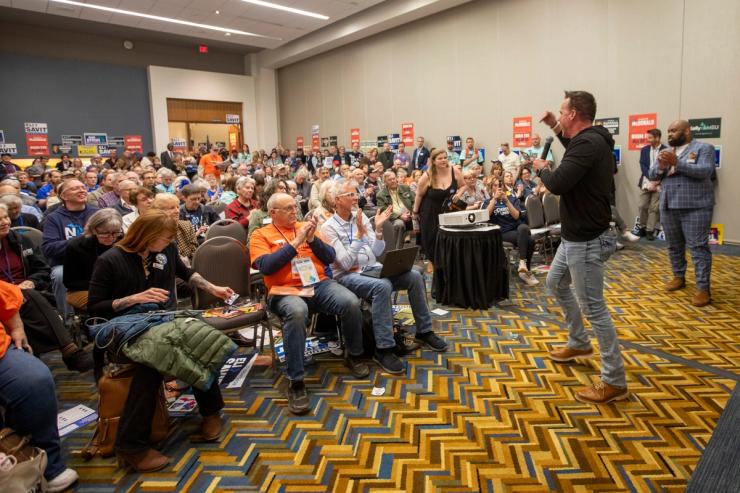
After a Michigan convention where the party’s left flank took over in an awkward hail of boos and jeers, Democrats are bracing for a sequel in Minnesota — and some are rethinking their party’s nomination rules altogether.
The role of party conventions and assemblies is sparking heated debate in the Democratic Party as it seeks to both capitalize on anti-Trump sentiment and anoint candidates who can win general elections. Some Democrats see closed, activist-driven state party events as opportunities to tap into powerful grassroots energy, but others worry that the functions are brewing a liberal version of the anti-establishment tea party.
That split will be in full view this weekend in Rochester, Minn., as Lt. Gov. Peggy Flanagan, a rising progressive star, faces off against Rep. Angie Craig, a battle-tested centrist, for the party’s Senate nomination.
“I’m perilously close to devoting the rest of my life to seeing these conventions ended,” said Joe Radinovich, a former state legislator and longtime Democratic strategist in Minnesota who supports Craig. It’s a “challenge for people who win in competitive places to then seek to elevate themselves through this process.”
Flanagan is widely expected to win the Democratic-Farmer-Labor Party endorsement, but Craig is nonetheless competing for party backing ahead of their August primary battle. Lexi Byler, a Flanagan spokesperson, predicted victory at the convention and defended the event as “one of the few places in politics where grassroots organizing and talking directly to voters still matters more than money.”
Yet nominating conventions are proving divisive for Democrats across the country. Both Colorado Sens. John Hickenlooper and Michael Bennet — who is running for governor — skipped their party’s assembly, choosing to duke it out on the primary ballot against more progressive challengers. Rep. John Larson, D-Conn., is soldiering on after losing the party’s top ballot line at his convention to former Hartford Mayor Luke Bronin.
Michigan is already weighing changes to its process after its convention devolved into a spectacle of booing by progressive activists that prompted their favorite candidate, Abdul El-Sayed, to reach out to centrist foe Rep. Haley Stevens and call the conduct “unbecoming.” The state may move its primary earlier, make some positions gubernatorially appointed, and shift some statewide races to a regular primary rather than the convention.
Sen. Elissa Slotkin, D-Mich., acknowledged to Semafor that the convention scene this spring was not helpful, advising Democrats to “root for our own candidates and organize for our own candidates without being nasty and punitive.”
“I’m kind of done with Democrats being a circular firing squad,” she added. “When we’ve got Trump in the White House doing what he’s doing. I think he’s more than happy to have Democrats at each other’s throats.”
The consequences from the Michigan convention ran deep enough for Democrats to propel a re-examination of nomination votes for university trustees and the state attorney general. El-Sayed didn’t get endorsed over Mallory McMorrow or Stevens, the preferred Senate candidate of many establishment Democrats, but Stevens got jeered for the entirety of her speech to delegates.
“Conventions should be places of enthusiasm and open dialogue and actual discussions on the issues and what Democrats ought to stand for,” said Rep. Kristen McDonald Rivet, D-Mich. “It’s when they start to get to a place of disrespect and shouting down voices and calling people names, that’s something I don’t think we have the time for.”

Know More
Flanagan’s campaign and her supporters are urging Democrats to stay respectful in Minnesota. Retiring Sen. Tina Smith, D-Minn., told Semafor that she’s reminding party members it’s “important to keep it civil” because they will need to quickly unite ahead of the general election. Craig’s campaign declined to comment for this story.
“Conventions are unpredictable. You never know exactly what’s going to happen. That’s part of the fun, right?” said Smith, who supports Flanagan and said she has “a formidable lead.”
Typically conventions have helped candidates in both parties who can turn out more committed and ideological supporters. Minneapolis Mayor Jacob Frey couldn’t get the local party’s convention endorsement in 2021 or 2025 in the wake of racial justice protests, but he went on to win reelection twice.
Minnesota’s Democratic Gov. Tim Walz backed Frey in both races and won his own nomination in 2018 without the DFL endorsement, which went to a more left-wing candidate.
Radinovich, who managed two of Frey’s races and ran for Congress in 2018, argued that conventions aren’t “particularly representative of the views of voters at large, and specifically even Democratic primary voters. More often than not, we see candidates who appeal to the ideological base of the party having an advantage within that process.”
Other Democrats are carving out similar paths in their own states. Hickenlooper said in an interview that he saw the assembly as taking up a “big chunk” of campaigning time as well as his work against Trump in Washington.
He said “most people understand” why he would skip the assembly that he’d found to be generally unrepresentative of his state’s broader Democratic Party.
“This is a year where there’s a lot of frustration and anger. So that boils out at these kinds of assemblies. It fuels their politics,” Hickenlooper said. “There’s some people that think I should be there and it’s an absolute requirement to demonstrate your party loyalty.”
Conventions also do little to prevent contentious primaries. In California, the top two vote-getters at Democrats’ state convention, former Rep. Eric Swalwell and Betty Yee, both dropped out. The Minnesota convention is unlikely to end the tough primary between Craig and Flanagan. Larson’s loss at the Connecticut convention came as House Democrats across the country grapple with a wave of primary challengers who largely lack policy differences with their rivals other than their age.
Conventions are “traditional, but they’re outmoded,” Larson told Semafor. “Is it the fairest system? No, it’s the system that we have.”
But he also argued the broader Democratic electorate might be more favorable territory for him in the end: “The good news is, your case is going to be made before the people.”

Room for Disagreement
Some Democrats don’t think any change is needed in their nomination process.
“I don’t think it’s the year to readdress all that. We just need to win the majority in the House and the Senate,” said Rep. Kelly Morrison, D-Minn., who’d briefly been floated for a Senate bid herself.
Rep. Jim Himes, D-Conn., said he didn’t think the conventions necessarily needed to change but instead wanted open primaries without party affiliation: “That would be a healthy thing.”

Burgess, Nicholas and David’s View
Minnesota is a more progressive state than Michigan, so the fears of a circus-like atmosphere at the convention aren’t unfounded. With Republicans in clear disarray and Trump’s approval ratings poor, Democrats don’t need to get distracted by infighting.
As Slotkin told us: “I’m focused on winning. And that means focusing on the thing that I think is the problem, which is majorities in the House and Senate that are enabling this guy.”

Notable
- Votebeat reported on the proposals to overhaul Michigan’s nominating process.