




The News
Three things surprised Nick Fox about ChatGPT’s breakout success in November 2022: how slow it was, how inaccurate it was, and how consumers embraced it anyway. “It was surprising to see there was appetite there,” he said.
I asked him if, in retrospect, Google should have released its own products sooner, #YOLO-style, and thrown caution to the wind over trust, speed, and reliability. “I don’t think it would have been the right thing for us to #YOLO,” he responded dryly.
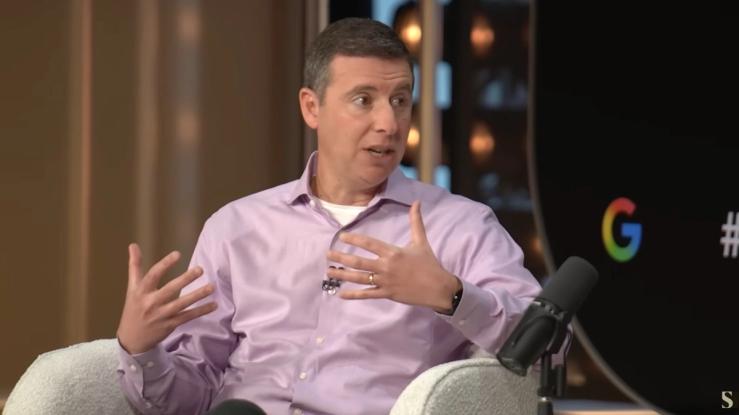
Fox was speaking to me on a big stage at Google Marketing Live last Wednesday, the company’s annual showcase for the big advertisers who drive much of its revenue. The event, and the tech event, Google I/O, the day before, had a celebratory, nearly triumphant tone: Google had clawed its way back to the front of the AI boom through a combination of technical depth and its broad reach across consumer platforms.
That’s partly because the core product values that turned Google into a juggernaut in the first place have reasserted themselves, Fox said.
“We’ve seen this play out over time. People do care about quality of information. That’s very very important. People don’t want incorrect information. People do care about speed,” he said, adding: “It’s been clear that people don’t want incorrect information — and so that bedrock of trust and accuracy has served us well.”
Speaking to the marketers, Fox said he’d recently been shopping for a charger to power his cats’ water fountain. “I wanted a white one. I wanted a flat one. I wanted it to be USB-A, for some reason. That was the product that I was looking for. A broad ad about random chargers wouldn’t have worked — would just wouldn’t have been relevant to that experience. So specificity matters. Human perspectives matter, detail matters in this moment.”
Fox helped create Google’s search as we know it, and presided over the first redesign of the company’s iconic search box in 25 years this week, expanding it to accommodate and encourage longer and more detailed questions. Some analysts believe that the shift to AI conversations will be the end of search — and perhaps with it, the end of the web. Fox rejects both ideas. “I’m incredibly excited about the future of search,” he told me. As for the web, its utility changes in an AI era, but doesn’t go away, he argued.
“The web is in particular good for expertise. It’s really good for individual, unique experiences,” he said. “If you’re looking to buy something, you don’t just want to hear what the AI says. You want to hear someone that’s used it. What did they think? What went wrong with it? What broke? What was amazing about it? What accessories did they get?”
“I think ultimately as people, as humans, we like to hear from humans,” Fox said.
In this article:

Ben’s view
Google appeared, for a moment in 2023, to be caught in a classic innovator’s dilemma, unable to remake its products for fear of disrupting its core advertising business. The packed rooms at its marketing summit (and revenue that hit $110 billion in the first quarter of this year) suggest that verdict was premature. Marketers packed Google’s Bayview campus to hear Fox explain how to sell products to consumers asking increasingly detailed and specialized queries.
I was particularly struck, though, by Fox’s view that, despite the mad scramble that followed the ChatGPT moment, Google’s own brand required letting a competitor go first — and get consumers used to a different, less reliable information experience. Google’s arc over the last three and a half years offers a glimpse at how unpredictable the AI race remains.

Room for Disagreement
“The open web is on its way out,” Richard Kramer, a financial analyst with Arete Research, told The New York Times. “With A.I., Google is reducing everyone to raw data providers.”

Notable
- Google DeepMind’s Demis Hassabis “sees the increase in machine autonomy as one of the key steps on the gradual march toward the singularity,” Semafor’s Reed Albergotti writes.
- “Consensus is forming in Silicon Valley not only that Google has recovered and caught up but that it could actually win the A.I. race, a testament to how so much can change in so little time,” writes Brian X. Chen.