




The News
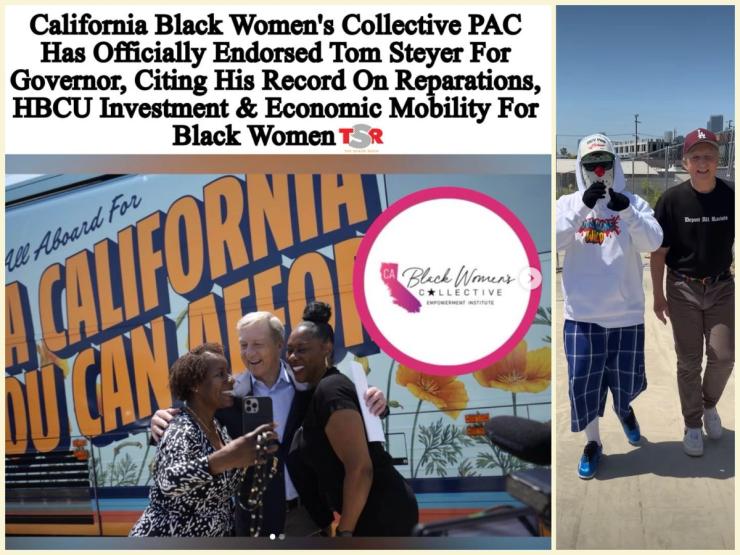
On May 15, the Instagram gossip hub The Shade Room shared a lengthy post to its 28 million followers on Instagram promoting California gubernatorial candidate Tom Steyer’s criticism of Paramount’s acquisition of Warner Bros. Discovery.
“Roommates, with a Trump ally already controlling that much of what we watch, are y’all backing Steyer’s plan to block this?” the account wrote.
The post garnered over 17,000 likes, as well as hundreds of comments and shares. Six days later, the publication updated its post with a note.
The account had received a $25,000 payment from the Steyer campaign, according to campaign spending documents shared last week.
The Shade Room is hardly alone. The latest financial disclosure forms released late last week showed that the campaign paid $400,000 to progressive influencer Carlos Eduardo Espina, as well as $25,000 to Tommy Marcus, who posts under the name Quentin Quarantino. Earlier this month, the Southern California meme and news account Foos Gone Wild posted an interview with Steyer, clad in a black t-shirt and a black LA Dodgers hat, to its 3 million Instagram followers. According to last week’s disclosure, Foos Gone Wild was later paid $50,000 by the campaign.
The California gubernatorial race has become the latest testing ground for modern digital campaigning, which in the last ten years has morphed from individual politicians doing stunts to go viral on Facebook to a system of paid outreach to creators in exchange for their support and promotion.
And Steyer’s campaign is one of the purest instances of this blurry new world of astroturfed support: His team has offered creators everything from $10 a post to nearly half a million for communications consulting in the hopes that they’ll spread the word about him, or at least take his opponents down a peg.
In this article:

Know More
Federal campaigns keep influencer spending secret, taking advantage of a gap between the authority of the Federal Trade Commission — which polices stealth advertising — and the barely functional Federal Elections Commission, which nominally polices political spending.
A wave of disclosures of Steyer’s influencer spending on social media and Substack appears to have been promoted by California’s strict campaign rules — and, perhaps, an embarrassing longread by The New York Times’s Ken Bensinger earlier this month. Now, these disclosures are offering the clearest window yet into how well-resourced modern political campaigns are deploying content creators.
Going into the race, Steyer’s team had a broadcast media plan backed up by a significant war chest. But the campaign believed that digital channels were going to be a very important piece of his campaign strategy, and not just due to changing media habits that have shifted TV eyeballs to phone screens. Steyer is 68, a liability in a post-Biden Democratic party, and is a hedge fund billionaire attempting to run on economic populism.
So the Steyer campaign and its advisers devised a series of outreach efforts to win over left-leaning influencers.
First, the campaign set up meet-and-greets with content creators to get to know Steyer personally, at one point inviting along a Washington Post reporter. Steyer’s campaign hired creator management agencies and Group Project Digital, its primary firm, to lead its strategic communications online. Group Project set up a marketplace on Side Shift, an open-market platform that connects digital content creators and brands and organizations looking to leverage creators for paid messaging.
The campaign and its firms passed along guidance to the influencers. A brief shared with Semafor lists issues Steyer wanted creators to highlight, including his policy plans for taxes, housing, and combating federal immigration enforcement, among other issues. It also included sample content, and audiences he was hoping to reach. His key demos: primarily 18-54-year-old women, Black voters, liberals in the LA and San Francisco metro areas (“The more liberal the target - liberal, not leftist - the better. Think Pod Save America listeners,” the brief said), and young voters (who “in general are anemic toward Tom and are liable to tip toward [Xavier] Becerra if they are more politically engaged”).
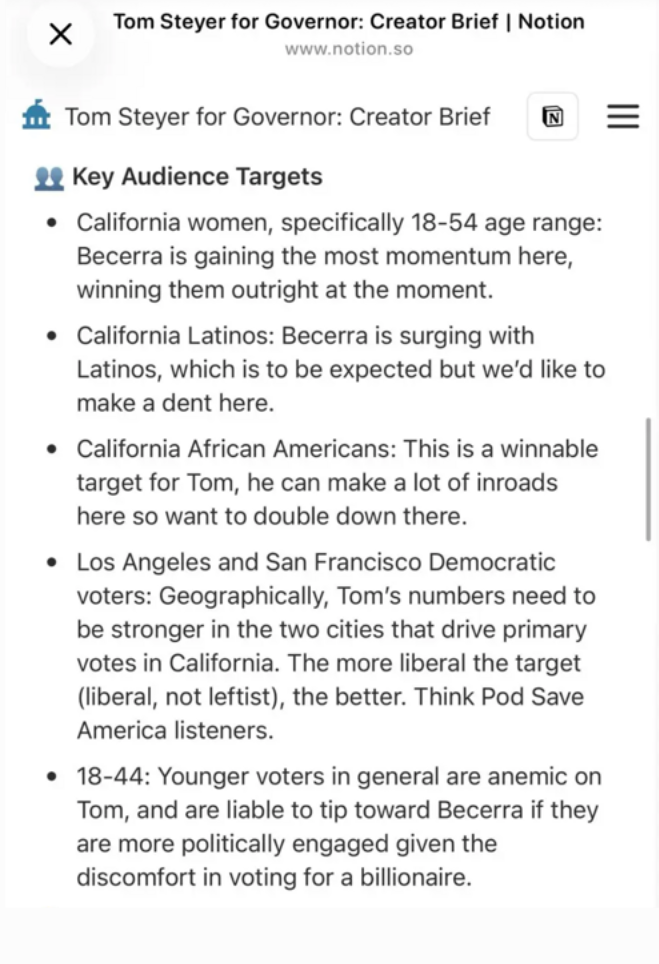 A screenshot of a Steyer creator brief.
In a bizarre twist, fake enthusiasm for Steyer has spread beyond direct payments to influencers. Engagement-farming social media accounts have sometimes scooped up pro-Steyer posts and reshared them as their own. The Foos Gone Wild pro-Steyer post was picked up and recirculated by a series of slop accounts across the world. A dozen Instagram accounts with millions of followers also simultaneously shared a different anti-Becerra meme/clip with slightly altered branding all at the same time.
Complaints about these posts sparked an investigation by California’s Fair Political Practices Commission into whether the Steyer campaign violated state transparency rules.
Steyer’s campaign has denied those accusations. A spokesperson told Semafor that influencers were told to include disclosures in their posts, and that the onus to disclose was on the content creators themselves.
It’s not clear that it matters whether the slop accounts that reshared pro-Steyer posts were paid or not. They may have just been farming engagement; they’re filled with a random assortment of content ranging from football memes to unchecked health claims clearly designed to go viral.
The Steyer campaign has sought to argue his main opponent is engaging in even more deceptive tactics. The campaign shared with Semafor a brief by a service that promises to identify fake accounts, Cyabra, suggesting there was a “cross-platform influence campaign” to target him and boost Becerra, synchronizing messaging from content creators and thousands of fake accounts to “artificially shape public discourse” against the billionaire candidate.
“Cyabra’s analysis indicates that the fake profiles involved in the anti-Steyer campaign were part of a broader recurring political influence network that had already operated together in previous U.S. political conversations,” a report from the Steyer campaign shared with Semafor said.
Payments to the real accounts Cyabra points to, however, do not appear on Becerra’s financial disclosure forms.

Max’s view
The California race is the best inside look yet at how creator marketing and promotion has radically changed the world of political communication online. And it raises the question of how long an American public that has been infuriated by having its reality shaped by secret payments since the famous “payola” scandal of the late 1950s will tolerate a media and advertising landscape flush with secret or barely-disclosed cash.
Paid influencers also played a role in shaping the 2024 election. Both Donald Trump’s and Joe Biden’s (and later, Kamala Harris’) campaigns spent millions on creators, as did a series of aligned groups focused on various elements of the race. Former Harris digital chief Rob Flaherty said some content creators approached his campaign seeking thousands for an endorsement — threatening that otherwise, they’d endorse Trump.
But while both sides knew the other was spending millions on paid influencer campaigns, the public couldn’t tell the difference. Federal laws don’t require creators to disclose paid political promotion, and few had an incentive to do so. Beyond vague payment lines for consulting or digital services, there’s little public official record of how influencers were paid.
California’s disclosure laws, signed by Gov. Gavin Newsom in 2023, provide a unique inside look into the inner workings of creator marketing by requiring creators to disclose payments for political advertising. Those disclosure rules have allowed journalists to create a road map from the campaigns to the posts themselves. What they show is how many large- and medium-sized accounts are effectively small businesses selling the followings they cultivated organically to the highest bidder for paid political speech.
The lack of regulation in other states also creates additional haziness: In Texas earlier this year, opponents of Rep. Jasmine Crockett accused various pro-Crockett influencers of taking money from the campaign without disclosing their ties, though no one could quite prove who was paid and who was not.
There have been some national efforts to require disclosures for political influencers accepting campaign cash. In March, Democrats updated a 2023 bill with new language that would require social media influencers to disclose payments made to promote or oppose a candidate. But the bill thus far has languished in Congress, lacking bipartisan support.
The tactics on display in California are likely to roll out across the country over the next few months as the midterm elections ramp up, and campaigns will take lessons from these elections into 2028. With no federal regulatory framework in sight, it seems likely that both elections will be flooded by massive, unaccounted-for spending to leverage creators to unwittingly influence voters who think what they’re seeing is organic.

The View From The feed
Traditional media is playing catch-up to influencers, who have broken open many of these stories. Ashley St. Clair, a MAGA influencer who had a child with Elon Musk and grew disillusioned with the pro-Trump movement, has shared details of a large group chat she was in with other prominent right-wing content creators. In a series of videos on social media, she said these influencers were often paid to support various causes, though the posts had no visible ad disclosures.
Meanwhile, mainstream journalists and other traditional watchdogs have struggled to understand this fast-changing, youth-dominated social media space. Two pro-Becerra influencers, Kaitlyn Hennessy and Beatrice Gomberg, were some of the first to identify the undisclosed Steyer ads, and filed a series of complaints about the lack of disclosures with the FPPC. In the complaint, a copy of which was shared with Semafor, Hennessy and Gomberg shared emails with several pro-Steyer influencers in which they said they were paid by the campaign to post three times a day across their platforms, and were given broad latitude to make their own comments with minimal feedback from the campaign on captions.
The complaints prompted some influencers working with the Steyer campaign to add the payment disclosures to their posts. While Hennessy and Gomberg have said they are not being paid by Becerra, the duo said the lack of transparency is bad for content creators.

Notable
- In 2023, I reported on early Biden-era creator efforts.
- For Wired, Taylor Lorenz reported on how Democratic influencers were coordinating with the group Chorus last year.