



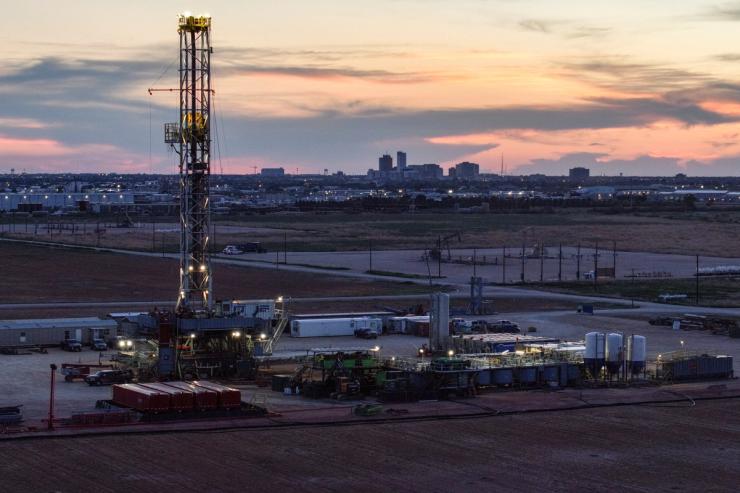
US oil companies are finally ready to listen to the siren song brought on by the war in Iran — a sign consumers shouldn’t hold their breath for lower prices soon.
When I talked to Kaes Van’t Hof, CEO of Texas independent producer Diamondback Energy, only a month ago, he was circumspect about responding to US President Donald Trump’s call for companies like his to drill their way to the rescue of a global economy reeling from the loss of barrels from the Gulf.
The trouble then, he said, was that oil futures prices for later this year still pointed to a relatively quick reopening of the Strait of Hormuz, making it hard for him to justify the capex needed to add rigs. That view was widely shared across the industry. But now the tune is changing. “Operators are starting to get more comfortable that more barrels are needed in this market,” Van’t Hof told me yesterday, adding that Diamondback is bumping up its capex budget and raising its annual production target by about 3%.
During price spikes like these — the US benchmark price is nearly 30% above where it was pre-war — oil execs have to walk a fine line. If they sit on their hands, they risk leaving profit on the table. But if they scramble to mobilize workers and equipment every time the price ticks up, they risk being overextended when it inevitably ticks back down. They’ve all been on this roller coaster long enough, and gotten an earful from enough shareholders, to usually be pretty conservative. The biggest companies, like Exxon and Chevron, are especially cautious about rushing to bring new wells online, in part because they have the efficiencies of scale to be plenty profitable even at lower prices. And so far, they’re continuing to stick to their pre-war production targets. But smaller companies that have more to gain or lose are hitting the accelerator.
“There’s a bit of hurrying happening now,” Matt Johnson, CEO of the oil industry data provider Primary Vision, told me. Johnson uses satellite imagery and other proprietary tools to track the number of “frac spreads” — the assemblage of expensive machinery needed to bring a new shale well into production — active across the US. In the past couple of weeks, that number has jumped 20% in the Permian basin, he said, and is similarly gaining momentum across other shale hotspots.
The nationwide count — 184 as of this week, up from 166 at the beginning of April — is still a little below where it was at this time the past two years, reflecting that the industry started the year with the expectation that the oil market would be oversupplied, not in shortage. And the current moment is still “best characterized as measured rig additions, not a runaway drilling boom,” Abhishek Agrawal, senior research analyst at Wood Mackenzie, told me. But using the frac spread count as a proxy for future production, Johnson said, it’s clear the US will hit a new production high above 14 million barrels per day this year.
For rival oil companies, the rising frac spread count is a warning to follow suit quickly, or risk losing access to the limited supply of gear and workers. For consumers, it’s a mixed signal: More production will help fill the supply shortfall (although many of these barrels will certainly be sold overseas, not to US refineries). But it also means people like Van’t Hof don’t think the crisis will be over anytime soon. “We’re not quite to fever pitch,” Johnson said. “But let’s see where we’re at in another month.”