




David’s view
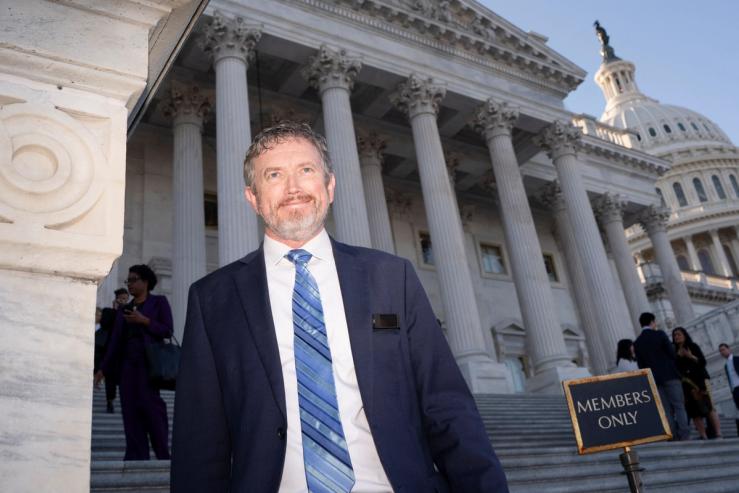
Early on Tuesday night, when Thomas Massie raised a glass of raw milk from the “Amish cartel” to honor his late wife, I flashed back to the Tea Party wave of Barack Obama’s first term. And I remembered: Tom Massie was never supposed to be here.
Before he became the president’s sharpest Republican critic in Congress, Massie was a libertarian scientist who hated government spending and the taxes that paid for it. He ran for his home county’s top elected position, and won it, to stop a new conservation tax. He ran for Congress in 2012 as a foe of regulation and backer of the Balanced Budget Amendment; debt held by the public was then an unthinkable $11 trillion. (It’s $31 trillion today.)
Massie won that race because a fellow supporter of Republican Rep. Ron Paul, a Texan who ran as the Libertarian Party presidential candidate in 1988, and his son, Sen. Rand Paul, R-Ky., sunk half a million dollars of his inheritance into a super PAC. He joined Congress during the brief “Libertarian Moment,” when it was obvious to many GOP donors that the party’s future was culturally tolerant, critical of the police state, and dead set on entitlement reform.
Most of those donors have moved on, or found new religion. The end of Massie’s House career — the “2028” chants at his party were about another job — leaves Rand Paul as the last libertarian Republican in Congress. It will conclude the alliance he formed with Rep. Ro Khanna, the ideologically expansive progressive with whom he co-wrote the Epstein Files Release Act.
“We’ve taken out two dozen CEOs, an ambassador, a prince, a prime minister, a minister of culture — and that was just six months!” Massie said at his party in Hebron.
Had Massie only broken with Trump over the Epstein files, or his refusal to support deficit spending, he likely would have won another term. (Ed Gallrein, his victorious challenger, correctly pointed out that Massie broke a term limit pledge.) In 2020, after he single-handedly delayed a COVID relief bill, Trump endorsed a weaker challenger, who Massie flattened.
What finally beat Massie was his opposition to spending on Israel, and to military support for the Jewish state. That was consistent with his isolationism — he opposed all foreign aid. In 2024, AIPAC’s super PAC ran ads attacking Massie across the state, ostensibly to make it impossible for him to run for higher office. When he rolled through that primary, he got more confident that he had built a northern Kentucky beachhead for paleo-libertarianism, immune to the most powerful forces in politics.
Even in defeat, that doesn’t sound crazy. Massie won nearly 48,000 votes on Tuesday. Fewer than 44,000 Kentuckians, total, voted in the 2012 primary that sent him to Washington. He raised at least $5.5 million for his campaign, helped by his fairly new celebrity as the anti-war Republican who wore a homemade lapel pin that displayed the national debt on an LED screen.
But he did lose, confirming that most Republican voters want their members of Congress to vote with the president and root for his success. Michigan’s Justin Amash, the other Paul-inspired libertarian who joined Congress in the Tea Party era, couldn’t win a primary after opposing Trump’s spending bills and voting to impeach him.
Massie, who opposed both Trump impeachments, couldn’t win after he opposed military intervention against Iran and linked it to the political power of the Israel lobby. He told crowds that he’d call “Tel Aviv” to concede the race if he lost — the joke of a man who expected to lose. Conservative new media, where Massie was a star, vibes with fewer voters than its old media, where Massie was the villain of the week in the Trump show.
“After 18 months of a blackout, of not letting me on Fox, they finally let me on Fox today, four hours into the election,” Massie said in Hebron. “Their slop is selling, so they’ll keep selling it.”
The clear story of May’s primaries has been the president’s ability to break and humiliate Republicans who go against him, for whatever reason. He did that in Indiana, where six state senators who rejected a Trump-requested Republican gerrymander lost to challengers who would support that gerrymander. He did it in Louisiana, a five-year revenge play; Sen. Bill Cassidy never recovered from voting in 2021 to convict Trump over Jan. 6. Republicans now expect Sen. John Cornyn to lose his primary next week, because Trump wants him to.
In each case, Republican voters are acting rationally. They’re choosing Trump over Republicans who are less interested in consolidating partisan power, destroying the Democratic Party, and neutering the progressive movement. Massie broke with Trump (and before that, with fellow House Republicans) because they were not using their power to shrink the government.
The MAGA movement sees that as an immature and doomed way of conducting politics. How could more Americans live the same rich life as Massie, a successful father of four who lived in a home he built? Shrinking the government would leave progressives in charge of major institutions, which wanted to dismantle the American system and the traditional family. Withdrawing from alliances with nationalist states would empower international left-wingers who wanted to destroy those states.
Massie had an early and acute understanding of why most Republican voters were choosing Trump’s politics over his. In early 2017, he told the Washington Examiner that the people he’d met who backed Ron Paul for president and Rand Paul for Senate were moving en masse to Trump, who shared very few of their ideas.
“I realized when they voted for Rand and Ron and me in these primaries, they weren’t voting for libertarian ideas — they were voting for the craziest son of a bitch in the race,” Massie said. “And Donald Trump won best in class, as we had up until he came along.”
Nine years later, the anti-war, anti-debt faction of the conservative movement is clearly a minority in the GOP. It feels duped by Trump, and will be harder to mobilize for Republicans than it was in 2024. But the White House figures that it has more podcasts than votes, and it may be right. And the president is forever “feuding” with those podcasters before inviting them back to the White House — entertaining kayfabe that keeps the media focused where it should be, on Trump. Unlike Massie, he’s supposed to be here.

Notable
- In The New York Times, Reason editor-in-chief Katherine Mangu-Ward poured out a glass of raw milk for Massie, who stood in the “proud American tradition to send representatives to tell an overstepping head of state to buzz off.”