




Ben’s view
Wouldn’t it be fun if the politics of the 2028 presidential campaign were about artificial intelligence? A serious, high-stakes debate about the future would be a departure from America’s fractious and low-altitude public life. This debate would be a story ripe for Washington/New York/San Francisco media, and an incredible boondoggle for the political operative classes to tap the biggest and most desperate budgets in the history of the world.
But who are we kidding? The rising consensus that AI will be a major campaign issue is a little too self-serving to be true. The original “tech-lash,” which really got going in 2017, never amounted to much in terms of national electoral politics. And the AI backlash is a polling artifact. When Gallup asks Americans if they want a local AI data center, 70% say no — a striking finding. But when Gallup asks them to volunteer the most important problem facing the US, fewer than 1% volunteer the broader category of “advancement of computers/technology.”
On top, by far: “The government/poor leadership.”
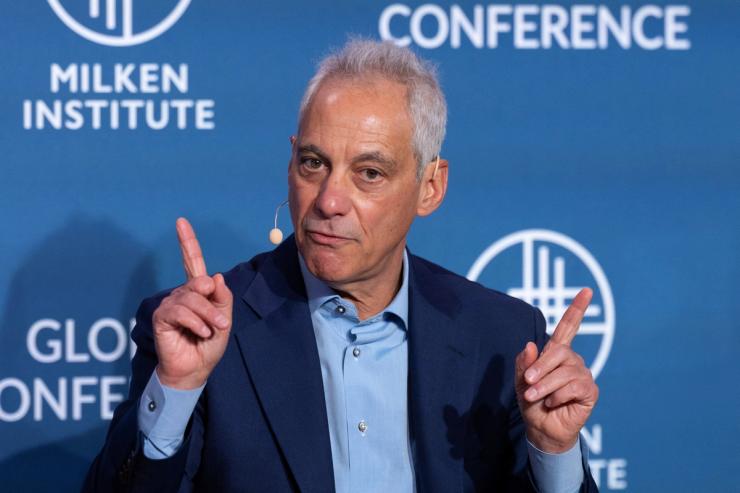
That’s another issue staring us in the face: corruption. Rahm Emanuel, who is basically already running for president and is typically ahead of the political curve, has perhaps seen this most clearly. He has been hammering it since 2024, soon after his return from Japan, where he was former President Joe Biden’s ambassador.
The brazenness of self-dealing in Washington right now “would make an alderman in Chicago embarrassed,” he told me by phone Saturday. Donald Trump’s presidency is “about making money. He wasn’t shy about it — that’s half the reason he’s gotten away with it,” Emanuel said.
Emanuel is particularly exercised that, in his view, the US has abandoned its long strategic courtship of India in favor of a crypto deal between Pakistan and the Trump-Witkoff family business World Liberty Financial.
And Emanuel believes this set of issues will bite. In 2006, he led a “culture of corruption” campaign against Republicans that played a key part in Rep. Nancy Pelosi’s rise to run the House of Representatives.
One question is whether Republican candidates will try to defend how the Trumps and Witkoffs will emerge from the patriarch’s presidency among the richest families in the world. They’ll likely just accuse Democrats of doing the same. Polling suggests that the issue is yet another partisan Rorschach, in which members of each party mostly blame the other. Thin issues like congressional stock trading — it sounds bad, lawmakers shouldn’t do it, but there’s little evidence they’re systematically beating the market — weigh as heavily as obvious ones.
The confirmation that this will be a central political front in 2028 comes from Vice President JD Vance’s new assignment: stopping various sorts of welfare fraud. “I saved a zillion dollars in fraud” is a good deflection from the Washington corruption story. And Vance, unlike some of his peers, has not been reported even to have dabbled in shady self-enrichment schemes, but has found an old-fashioned seven figure side-hustle through literature — the kids are, I hope, too young for crypto, and besides, they have conservative in-house counsel.
Emanuel may not be the fresh, angry outside face Democrats are looking for in 2028. (Graham Platner, anyone?) But his political prescriptions have been right before.
And his pugnacious talk sounds quite a bit more like American politics than sober debates about the future of technology.
This isn’t to say, of course, that some policy questions won’t define 2028. But to the degree that everything from alarm over data centers to worries about kids and bots come to the fore, I’d expect those questions, too, to be woven into what Emanuel told me he suspects to be the broader “context” of the campaign: Even Vance and Secretary of State Marco Rubio, who have mostly steered clear of the Washington bazaar, “are going to have some Trump stench that’s going to be hard to wash off.”

Room for Disagreement
Trump has considered the issue and concluded that voters do not, in fact, care whether his family gets rich or not.
“I prohibited them from doing business in my first term, and I got absolutely no credit for it,” he told The New York Times of his children. “I didn’t have to do that. And it’s really unfair to them.” He added: “I found out that nobody cared.”