



The News
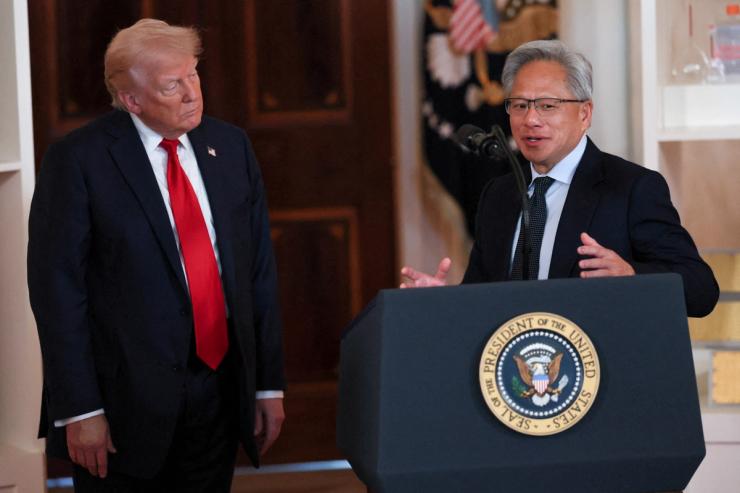
President Donald Trump restored Nvidia’s Jensen Huang to the list of CEOs accompanying him to China at the 11th hour Tuesday, in spite of worries that the chipmaker’s presence could be a political liability.
The president “called Jensen this morning after seeing reports that he wasn’t joining trip. Told him he wanted him to come. Jensen flew to Alaska to meet AF1,” a person familiar with the surprising sequence of events said Tuesday.
Huang, who’s still in Trump’s inner circle to the extent any CEOs can remain there, had previously discussed with the president how the presence in Beijing of the world’s largest chipmaker could invite unwanted scrutiny of the trip, people familiar with the conversations said. Sitting out the visit would have prevented the “awkward conversations” that surround the highly contested sale of Nvidia chips to China, one of the people said.
But after a spate of public reports — including in Semafor — that Huang would not travel with the president, the Nvidia CEO boarded Air Force One Tuesday night, where he was photographed on the tarmac by journalists on the trip with a backpack slung over one shoulder.
After Trump’s decision to let Nvidia sell China more advanced semiconductors drew pointed criticism from the Republican Party’s China hawks, bringing Huang along on Trump’s Beijing visit would have risked fueling intraparty tension that could have distracted from efforts to reset the US relationship with China.
The White House subsequently decided to invite executives from Nvidia competitors Micron and Qualcomm, an official said Monday. Coherent and Illumina, which have both partnered with Nvidia, also made the list.
The White House did not immediately respond to a request for comment for this story.
“Jensen is attending the summit at the invitation of President Trump to support America and the administration’s goals,” an Nvidia spokesperson said.
In this article:

Know More
Nvidia has been stuck in the middle of a high-stakes game of regulatory ping pong between the US, which is trying to retain its competitive edge over Beijing, and Chinese companies, which are in need of more Nvidia chips. Nvidia used to have around 90% market share in China, and today it’s at zero, Huang said in April.
“We were effectively foreclosed from competing in China’s data center computing/compute market, and our effective foreclosure from the China market helped our competitors build larger developer and customer ecosystems to challenge us worldwide,” the company said in a recent filing. “Unless we are able to return with a product that meets the approval of both the USG and the Chinese government, our lost opportunity and the benefit to our competitors will have a material and adverse impact on our business, operating results, and financial condition.”
Huang, who’s pegged China’s market for AI chips at $50 billion, told CNBC last week that “it would be a privilege” to accompany Trump on the trip. The two men have enjoyed a close relationship in recent months, with Huang tagging along on visits to the Middle East and United Kingdom.
But a broad swathe of congressional Republicans have made increasingly clear they think a freer flow of tech between the US and China carries more risk than reward. A House committee recently advanced legislation that would give lawmakers 30 days to review and block the sale of key chips to countries including China and Iran.
“The joke here is, Jensen wants us to trust the CCP,” House Foreign Affairs Chair Brian Mast, R-Fla., told CNBC at the time. “Anybody watching this should laugh.”

Reed’s view
The tensions around Nvidia have implications that go beyond China policy. AI has already begun factoring into local political races and the tech industry is facing growing opposition to automation. Fears that AI adoption will lead to widespread job losses and environmental destruction are only increasing.
While the Trump administration is largely supportive of the tech industry’s unprecedented effort to build trillions of dollars worth of compute power, it also has to balance the political repercussions of embracing AI as midterm elections approach.
That gives China an advantage as Beijing races to gain technological superiority. China doesn’t have the same kind of political hurdles to overcome when it comes to the ability to rapidly build data centers and power plants. The missing ingredient is advanced AI chips, the vast majority of which are still produced by Nvidia.

Notable
- American Enterprise Institute’s Ryan Fedasiuk told Bloomberg that not inviting Huang signals “there just isn’t much for American chip companies to talk about with the Chinese government.”