




Andy’s view
If there’s one thing that Asia-Pacific economies fear more than a US-China showdown — forcing them to choose sides — it’s the opposite: a world in which the superpowers club together to cut bilateral deals, leaving everyone else out in the cold.
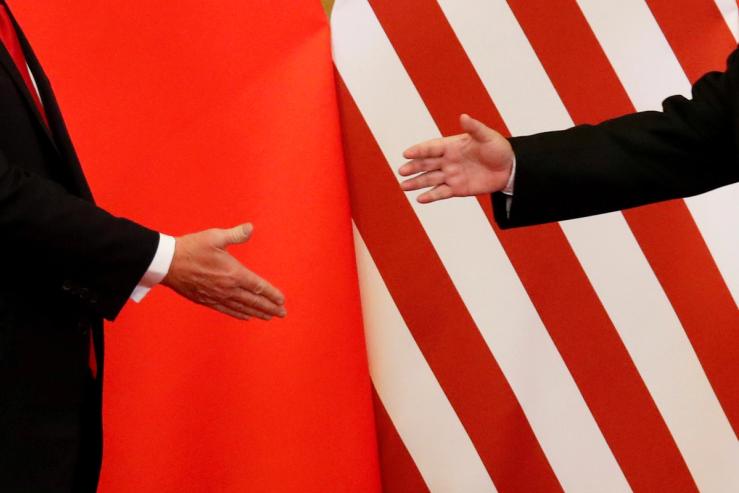
US President Donald Trump’s visit to Beijing this week has crystallized those anxieties. As he seeks to nail down agreements with Chinese leader Xi Jinping — on technology, trade, Iran — American friends and allies are feeling abandoned. National leaders are “nervous about what’s going to come out of this,” Edgard Kagan, the US ambassador to Malaysia during the first Trump administration and now an expert at the Center for Strategic and International Studies, told reporters. “All of a sudden it’s going to look like all the important decisions for the region are made in Beijing and Washington, rather than their own capitals.”
In fact, that seems to be Trump’s game plan. He’s revived language about a G2, the idea that a superpower condominium will take charge, running the affairs of the globe, with the implication that smaller countries should just fall into line.
Trade is a case in point. Indeed, the grandly named “Board of Trade” that the White House is touting as a major deliverable from the summit is all about balancing bilateral commerce. Left unresolved are deeper issues around China’s predatory trade practices that threaten to stunt industrial development — and create mass joblessness — in places like Indonesia and the Philippines, economies with neither the trade weapons, nor the political clout, to push back.
Around the region, a part of the world where US power underpinned a post World War II economic miracle, trust in Washington is sinking. The closure of the Strait of Hormuz is throttling economic activity — farmers in Thailand, the “rice bowl of Asia,” are facing the worst crisis in living memory amid soaring fertilizer prices — and the war has demonstrated, yet again, that Washington’s priorities lie elsewhere.
A crack US Marine unit has departed its naval base in Okinawa, bound for the Gulf, and an aircraft carrier strike group has sailed away from the South China Sea, a regional flashpoint. Gone, too, are missile defense batteries in South Korea, guarding against a nuclear-armed North. Kurt Campbell, the architect of the Obama administration’s “pivot to Asia,” points out that these military capabilities took time to accumulate and “once you lose it, it’s very difficult to get it back.”
Taiwan, in particular, is worried, and not just because the long-range missiles the US would need to defend the island against a Chinese blitzkrieg have been expended in Iran. White House briefers insist that Taiwan policy is not on the table in Beijing. Yet Trump told reporters this week that he would broach the topic of arms sales to Taiwan in his talks with Xi, and in any case has always appeared indifferent to the fate of the self-ruled island. By contrast, nothing matters more to China’s leader — and he has leverage; now that the latest peace plan in Iran has collapsed, Trump will be more desperate than ever for Xi to lean on Tehran, a Chinese partner that has relied on Beijing’s oil purchases for an economic lifeline.
Tokyo sees the same submissive impulse: Looking for US support last year in a spat with Beijing over Taiwan, Japan’s then-new Prime Minister Sanae Takaichi got the silent treatment from the White House. In fact, The Wall Street Journal reported that Trump called her with a request to tone down her rhetoric. Subsequently, Beijing has sanctioned 40 Japanese companies, curbed tourist travel to the country, blocked Japanese movies, and suspended cultural exchanges. Keeping Trump engaged in Asia is Takaichi’s top foreign policy priority.
Trump has made it clear there’s not much he won’t concede to get the “big deal” he wants from Xi. Often described, accurately, as the most China-friendly member of his administration, Trump has purged China hawks from his team, dropped language from a defense white paper labeling China a “strategic competitor,” and even greenlit exports to China of advanced microchips — a technology where the US still holds a wide lead over China. Writing in the Financial Times, Ely Ratner, a security adviser in the Biden administration, scathingly referred to Trump’s efforts to build goodwill with Xi as “strategic deference.”
A little over half a century ago, after the fall of Saigon, Southeast Asian countries responded by scrambling to Beijing to set up diplomatic relations, hedging their bets on America. There’s a similar dynamic at work today. “In capital after capital,” writes Ratner, “the question being asked is not whether China is a threat, but whether the US will show up.”

Notable
- Asian nations are watching the summit with a degree of dread, The New York Times wrote, fearing that Trump will trade security commitments for favorable economic terms with Beijing.
- The summit is “the first real test of Trump’s true alignment in an increasingly contested and divided Asia,” Kurt Campbell writes in Foreign Affairs.