




The News
The investor Warren Buffett once told Squawk Box host Becky Quick that he would pay “any amount of money” to watch the show. “He cares about the internet, he cares about his private plane, and he cares about CNBC,” she recalled in an interview Friday.
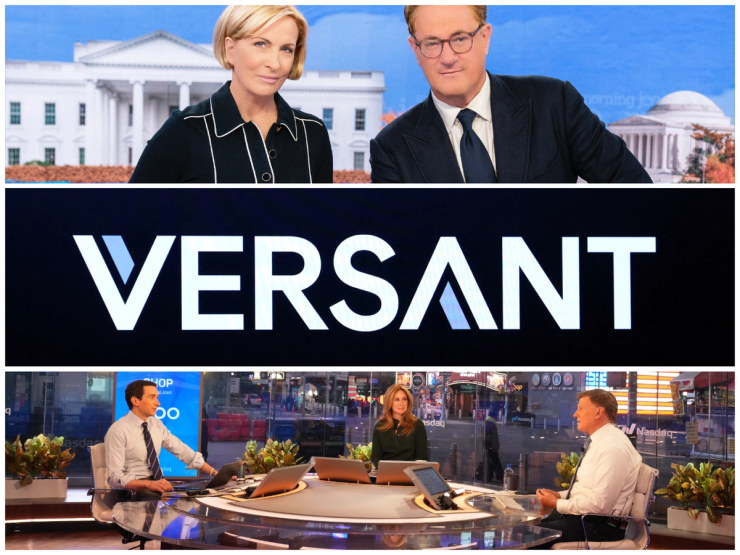
One of the puzzles of contemporary fragmented media is how to find value in media companies that can’t match Google and Meta in sheer scale and reach. One answer is to look at the media outlets that appeal to specific, and sometimes quite powerful, audiences. CNBC’s new parent company, Versant, is trying to answer that question at this week’s upfronts, the annual advertising industry showcase. It will be represented there by the hosts of Squawk Box and Morning Joe, from Versant’s other network, MS NOW.
(NBCUniversal owned CNBC and, as it was known, MSNBC, from their launches in 1989 and 1996, respectively, until this year. NBCU is still selling the channels’ ads, and so the hosts will appear in its annual upfront presentation at Radio City Music Hall Monday morning.)
Versant’s decision to pair Morning Joe and Squawk Box for advertisers suggests that its most valuable properties don’t have to be the ones with the largest reach — that remains MS NOW’s primetime shows — but can also be those most important to influential Americans.
“We corner the market as far as influencers go on Washington and Wall Street,” Morning Joe co-host Joe Scarborough said in an interview.
“The North Star is trying to reach the important and influential people at the intersection of business and policy,” said Squawk Box’s Andrew Ross Sorkin.
The shows’ prominence reflects their unusual status in the declining medium of linear television: As audiences have moved to digital platforms — and often away from live feeds — morning television has, broadly, lost political and cultural relevance. Big news breaks more rarely than ever on TV, though Fox News still plays a central role on the right, and broadcast Sunday morning political talk shows are hanging on. CNN, in particular, has struggled to develop either influence or scale across its programming.
The two Versant shows, however, continue to be watched by CEOs and political leaders, as any guest will find when they check their text messages as soon as they’re off the air.
“These people are the busiest people on the planet. Their days stretch 18-20 hours, and once they get going in their day, they’re gone. They’re not going to see anything that’s on TV, but they all are up in those early hours, and they’re watching and they’re paying attention,” said Quick. Squawk Box boasts the most affluent audience in cable, while Morning Joe is the most-watched cable morning show in Washington, DC, according to Nielsen.
Both shows have evolved toward those influential audiences, hosts said. One defining moment came in 2007, when Morning Joe co-host Mika Brzezinski refused, on air, to deliver a story about Paris Hilton’s release from jail on a newsy day during the Iraq War. Squawk Box’s Joe Kernen recalled that the show initially addressed retail investors, but changed its focus as markets and politics shifted.
There’s also the question of what exactly can be gotten out of live news in 2026. Television is no longer the fastest or most efficient way to deliver information, so the shows must find relevance in the relationship between the hosts, guests, and audience, and sometimes the banter between the hosts. “You can have Bloomberg on with the mute button and see all the data,” Kernen said. “But I think it’s important that people appreciate the interplay between Andrew, Becky and me.”

Ben’s view
The endurance of these two cable morning shows fascinates me because I’ve watched, and followed, this shift in value from scale to influence. I began my career at Politico, which built a business around its access to powerful people, then spent eight years at BuzzFeed, where we tried and failed to chase the tech companies’ scale. At Semafor, we’ve built a business in holding direct conversations among and with business and political leaders, through our convenings and briefings.
I’ve also been an occasional and grateful (media reporting is nothing if not fraught with conflicts of interest) guest on these two shows for years. And one thing you realize, if you do that, is there’s a class of viewers at the top of politics and business who seem often to consume both simultaneously — and text you if you appear on either.
That reflects a kind of convergence of politics and business that Kernen said he dates to Donald Trump’s first election. “Around 2016-2017, I think, we became more involved with Washington issues,” he said. “Ever since the first Trump presidency, it has been a different country.”
Now the battle for that elite audience may be less with cable or broadcast competitors and more with a range of new media, from business-focused podcasts like All-In, Bloomberg’s Odd Lots, and Acquired, as well as more general-interest conversations led by The New York Times’s Ezra Klein Show. If Versant’s shows retain an edge in the face of declining cable economics, it may be because they are live and on-air at 6 am.
“If you tape something — three hours later, the world might have changed,” Quick said.