



The News
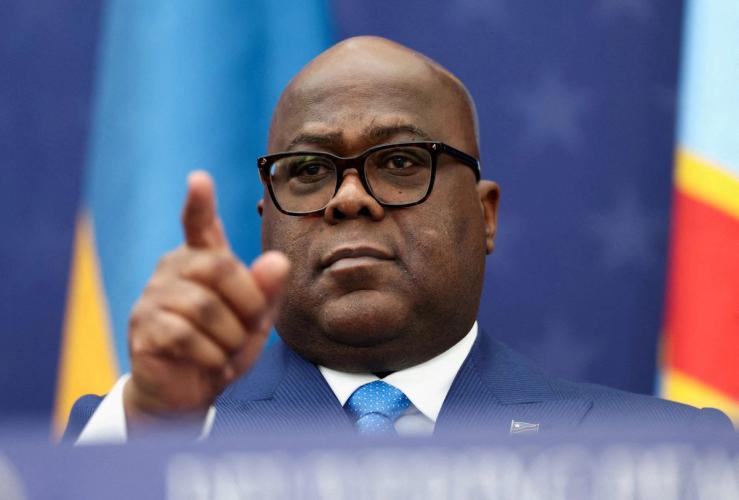
DR Congo President Félix Tshisekedi opened the door to seeking a third presidential term — ostensibly blocked by his country’s constitution — saying during a nationally televised press conference on Wednesday that he would remain available for office if the Congolese people demanded it.
Tshisekedi, first elected in 2019, is due to complete his second and final term in December 2028. “I did not ask for a third term, but I tell you this: if the people want me to have a third term, I will accept,” he said during the hours-long exchange with domestic and international media.
The Congolese president’s comments come amid mounting opposition concerns that proposed constitutional changes could weaken presidential term limits. “This must not be linked to any third term,” Tshisekedi insisted, emphasizing that any constitutional revisions would require a referendum.
Tshisekedi also used the press conference to endorse the Trump administration’s recent sanctions against former President Joseph Kabila, saying Washington had validated his government’s longstanding claims that Kabila supported destabilizing M23 forces in eastern Congo.
He said Washington’s overriding interest was securing peace to facilitate investment and strategic supply chains in the mineral-rich country. “They see anyone who would obstruct that process as a troublemaker, as an enemy of both the Democratic Republic of Congo and their own interests,” he said.
In this article:

Know More
The comments underscored how Kinshasa increasingly views US engagement through the prism of critical minerals diplomacy and strategic competition with China. Tshisekedi also suggested the sanctions reflected a broader alignment between his administration and Washington, dismissing any notion that the US had acted impulsively. “Do not take the Americans for naive people,” he said.
Analysts said the increasing public convergence between Washington and Tshisekedi’s government may further embolden the Congolese leader domestically, particularly as his coalition tests public opinion around constitutional reform and future succession debates.

Yinka’s view
The US decision to sanction Kabila has reinforced perceptions that Tshisekedi has become the centerpiece of Washington’s strategy in Central Africa, particularly as Washington seeks preferential access to cobalt, copper, and other critical minerals essential to energy transition technologies.
Analysts say the sanctions serve multiple purposes at once: pressuring alleged spoilers to peace efforts in eastern Congo while simultaneously weakening a long-feared rival to Tshisekedi.
Cameron Hudson, a former White House official, described the move as “a two-for-one,” arguing that Washington was effectively “doing Tshisekedi a solid” by constraining Kabila politically and financially while protecting a peace process favorable to US interests.
But the move also deepens US exposure to DR Congo’s volatile internal politics, Tshisekedi himself came to power after a controversial election in 2019 where several observers disputed key electoral results.
The Kabila sanctions, coming soon after sanctions on senior Rwanda officials, have given Tshisekedi the comfort to speak of a third term more openly. Several observers fear the sanctions are being interpreted domestically as evidence that Washington is prepared to tolerate constitutional changes so long as Tshisekedi remains aligned with US strategic interests.
Christian Geraud Neema, a fellow with the Carnegie Africa Program, called the sanctions “counterproductive,” arguing they signal Washington is openly siding with Tshisekedi at a delicate political moment. It could also embolden Kabila if the US is “not willing to sustain its engagement over the long term,” noted Benjamin Mossberg of Washington firm Field Focus.
The broader geopolitical calculation remains clear. Washington is attempting to loosen China’s grip over DR Congo’s mining sector while stabilizing a region critical to future global supply chains. But the strategy increasingly hinges on one political figure whose own democratic intentions are now under heightened scrutiny.
If Tshisekedi pushes ahead with constitutional revisions that allow him to remain in office, Washington could find itself accused of prioritizing minerals and geopolitical competition over democratic norms in one of Africa’s most strategically important states.

Notable
- The role China and the US play in the move for peace in DR Congo was explored in a 2025 article for the Carnegie Endowment for International Peace.