




The Scoop
In a bid to assert more control over Davos, Switzerland, during the World Economic Forum’s annual meeting each January, the municipality of Davos will no longer allow media companies to build temporary structures along the ski town’s main street, according to an April memo from the local government.
“The new rules are about restricting representations of companies which are not directly connected with the main event, in order to avoid overburdening the infrastructure — regardless of whether they have been present in Davos in the past or only intend to come to Davos in the future,” the document outlines.
The document, a person familiar with discussions about the new rules said, is aimed at further codifying rules that limit temporary construction on the Promenade to official partners of the World Economic Forum — primarily large global companies that pay up to seven figures for the relationship.
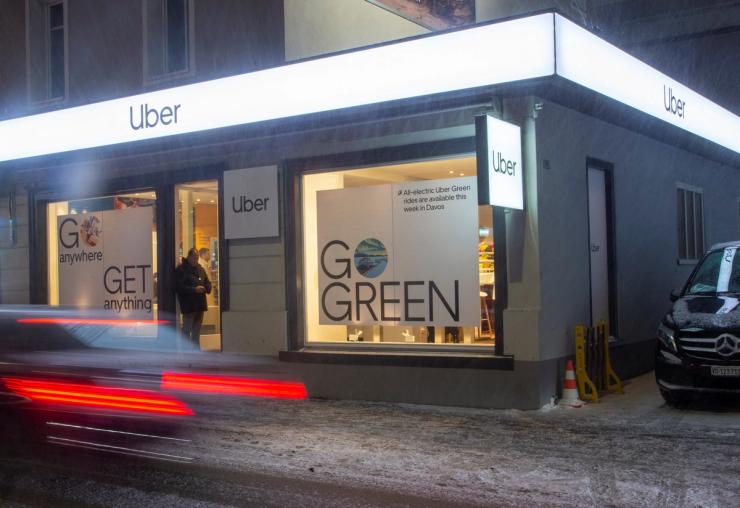
Media organizations and advocacy groups slipped through those cracks last year and were prominent on the Promenade, where storefronts are converted each year into tricked-out headquarters for companies, governments, and other organizations.
“To prevent NGOs or NPOs from being used merely as a pretext, the municipality requires various documents proving that the registered organisation is in fact a charitable, non-profit-oriented entity,” according to the document. “Social entrepreneurs, for example, are not NGOs.”
Of the media organizations that pack the event, it says: “Going forward, no further temporary construction projects will be permitted for accredited media, especially since the WEF itself already provides workspaces to these media.”
The municipality didn’t immediately respond to requests for comment.

Know More
A spokesman for the World Economic Forum, Yann Zopf, noted that permitting rules are set by local authorities, not the Forum. Media companies that are paying Forum members aren’t subject to the restrictions, Zopf added. Those include Bloomberg, Dow Jones, the New York Times, Financial Times parent Nikkei, Axios parent Cox Communications, and CNBC. Other companies can hold events on the Promenade but can’t build temporary structures, he said.
The memo seems to reflect a longstanding sense among the elite CEOs who come to the forum that an exclusive event has turned into a circus where they’re regularly chased down the street by everyone from would-be business partners to the financial press to right-wing agitators with YouTube channels. Some of those leaders prefer closed environments akin to Idaho’s Sun Valley, where outsiders are barred and journalists are kept at a safe distance.
In the document, though, the municipality warns that additional rules could be added at any point and that the rules are subject to change.
The municipality is “closely monitoring the implementation of the (new) rules. If these prove to be insufficiently effective in certain areas, stricter rules / a stricter interpretation must be considered for the coming years,” according to the document. “The possibility of further tightening for the upcoming year, and the corresponding communication by early May at the latest, is signalled every year. It has been known for some time that restrictions, up to and including a quota system, are possible.”
A person familiar with conversations about the regulations said the rules could also change if they are contested by powerful local landlords through the painstaking mechanisms of Swiss democracy.
Still welcome: Food trucks. “Gastronomic offerings” won’t count toward the quota of temporary structures, the document outlines.
Liz Hoffman contributed to this report.