



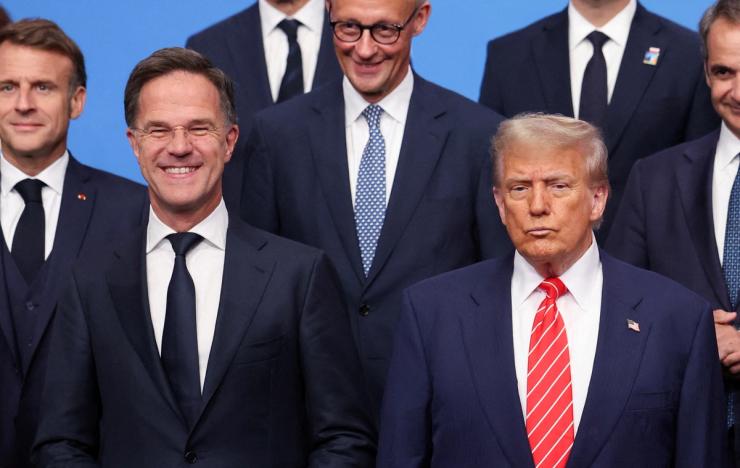

what’s at stake
President Donald Trump can’t officially leave the North Atlantic Treaty Organization without a vote in Congress. On his own, he can — and has — shaken up the alliance.
Experts and officials agree that some of his moves have been positive, like the push that began during his first term to pressure NATO member states to spend more on defense. Last year, countries agreed to raise security-related spending to 5% of their gross domestic product by 2035.
Some of Trump’s other decisions, though, have strained transatlantic relations and caused Europe to question America’s commitment to ensuring the shared security of NATO members. Trump continues to take other steps to punish member nations he feels have not adequately supported the US — like his recent decision to reduce US troops in Germany. The question is: How far will he go?
In this article:
who’s making the case
Matthew Kroenig, senior director of the Atlantic Council’s Scowcroft Center for Strategy and Security, argued Trump could do “a lot” of damage to NATO short of withdrawing from the alliance, but predicted he ultimately wouldn’t go far:
“There are two camps: one who fears that they see the trendline clearly and the other shoe is about to drop, and that Trump — even if legally he can’t do it, will do something kind of equivalent to pulling out of NATO, drastically reducing US forces, kind of quiet-quitting NATO in a way that would really destroy the alliance or sell out Ukraine. I think the other, more cautiously optimistic group thinks that this is a pattern we’ve seen for 10 years, that Trump is expressing frustration with NATO, criticizing NATO, but that at the end of the day he’s not going to make any major changes.
“I’m probably more in that second camp I described, who sees this as a pattern — but that ultimately he doesn’t do anything that’s really damaging to the alliance. But if he wanted to, there is a lot that he could do. So for example, US extended nuclear deterrence is an important part of the security of Europe; all of our European allies rely on that. There is nothing in the NATO charter that requires the US to extend nuclear deterrence. … He could declare tomorrow that US nuclear deterrence no longer extends to Europe, that America’s not going to fight a nuclear war for Estonia. He could withdraw US nuclear weapons from Europe.”
Rose Gottemoeller, the alliance’s former deputy secretary general from 2016 to 2019, argued that Trump has already withdrawn the US from its status as the preeminent leader of NATO — thereby raising important questions for Europe about who should step up to replace the US:
“In general, I think it’s positive that we have this ‘Europeanization’ of NATO going on, and the NATO member states are more willing to grasp the reins for responsibility and leadership in NATO. But the issue is, as it has been for eons in Europe, how to arrange the leadership now so that the countries are pulling together instead of quarreling.
“Indeed, it will have to be more of a joint effort at leadership than we have had in the past, with the US always dominating the picture. To me, that’s the biggest uncertainty at the moment, and Trump has definitively removed the US from NATO leadership in that ‘first among equals’ way.”

Notable
- There are some restrictions to a US president’s ability to cut troops in Europe, Euro News reports.