




Alaa’s view
The failure of US policy in Iraq more than two decades ago is now haunting US President Donald Trump’s war against Iran — and threatening the security of Washington’s Gulf allies.
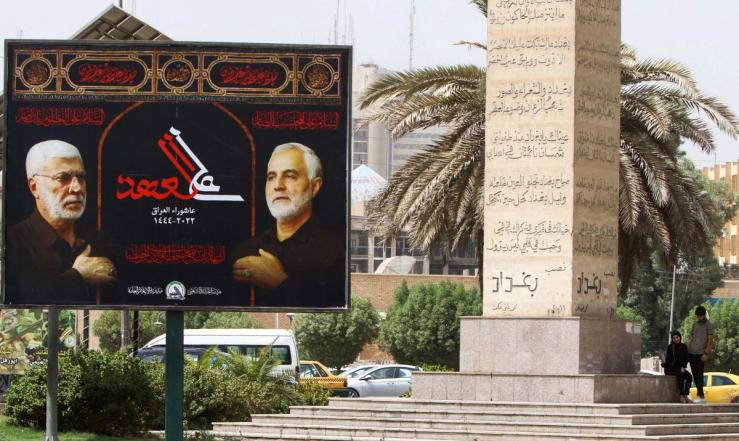
Much like today’s conflict with Iran, the 2003 invasion of Iraq to topple Saddam Hussein went ahead despite warnings from Arab allies. Few, however, anticipated that Washington’s mismanagement of the post-Saddam order would open the door for Iran to penetrate a former adversary and build influence from within. What started as attacks targeting US forces evolved over the years into something far more entrenched — political leverage over Shia parties alongside military power exercised through militias.
Since the start of US-Israeli strikes on Iran in February, those militias have rallied to Tehran’s defense, launching attacks on Gulf states including Kuwait and Saudi Arabia as Iran sought to raise the cost of the war for Washington. There is no official tally, but one estimate reported by The Wall Street Journal suggests that roughly half of the nearly 1,000 drone attacks on Saudi Arabia originated from Iraq.
These attacks — and the Iraqi government’s inability to prevent them — highlight the complexity of the conflict, and how hard it will be for Trump to navigate a way out. They also raise a question about how Gulf monarchies will deal with Iraq once fighting subsides and attention turns to shaping the region’s post-war future.
This points to a deep, yet familiar problem: the cost of US military interventions in a region too often seen through the prism of Israeli security, or reduced to black-and-white clichés about oil, religion, and tribes.
Iraq today is a deeply divided country, with a dysfunctional democracy and a weak central government. Corruption is endemic, and the economy remains a one-trick pony: roughly 90% of central government revenue comes from hydrocarbon exports, most of which flow through the Strait of Hormuz. A significant share of the gas needed to power its electricity grid is actually imported from Iran (while Iraq flares much of its associated gas because it hasn’t built enough processing capacity to capture the fuel).
The standoff at the Strait of Hormuz between Iran and the US — Baghdad’s two dominant external power brokers — has already inflicted serious damage on Iraq. Oil exports have plunged, prompting the IMF to forecast an economic contraction of nearly 7% this year. Jihad Azour, the fund’s director for the Middle East and Central Asia, told me last week that current legislative limitations (read: delays in forming a government) have left authorities unable to borrow from markets or request official support from multilateral institutions. That leaves Baghdad with few options: cut spending or draw down on foreign reserves.
Many of Iraq’s problems today can be traced back to US policy after the invasion, which contributed to the erosion of state institutions, the rise of ISIS, and the empowerment of Shia militias. The dismantling of Iraq’s army left tens of thousands of trained but disenfranchised men without jobs, while a political system built along sectarian lines entrenched religious divisions at the heart of the state.
None of this was inevitable. Yet the scale of the damage has led many in the Middle East to conclude that it must have been deliberate — part of a secret plan to sow chaos in the region. Confronted with that view at an event I attended in Dubai years ago, Paul Krugman, a Nobel Prize-winning economist, responded along the lines of: “Trust me. I know these guys. They’re not that smart.”
Having covered the region for nearly three decades, including a brief stint in Iraq in 2007 while working for Reuters, I came to a similar conclusion: We tend to underestimate how little US policymakers understand the Arab world. The problem is that the region is often left to pick up the pieces.
For much of the past decade, Gulf states — led by Saudi Arabia — have tried to do exactly that, using diplomatic overtures and economic incentives to stabilize Iraq and draw it back into the Arab fold.
But these efforts struggled to loosen Iran’s grip, which remains deeply embedded.
In response to the latest militia attacks, the US has withheld physical shipments of dollars generated from Iraq’s own oil sales, according to The New York Times. Trump has also effectively torpedoed the political comeback of former pro-Iranian Prime Minister Nouri al-Maliki, who had been a contender to form a government before the war. Iraqi politicians have instead nominated Ali al-Zaidi, a businessman with little political experience, as prime minister-designate.
Whether al-Zaidi can form a government remains uncertain. What is clearer is that the future of Iran’s influence in Iraq is likely to be shaped less by who occupies Baghdad’s Green Zone than by the outcome of the war.
The bigger question is whether we in the region will once again be left to pick up the pieces.
Alaa Shahine Salha is a senior executive at Saudi Research & Media Group and an economics contributor for Asharq Business with Bloomberg. He previously served as Bloomberg News managing editor for the Middle East and managing editor for economics in Europe.

Notable
- Iran-backed Iraqi militias are escalating attacks at home and abroad, forcing Baghdad to choose between confronting and risk of conflict or ceding control of the state, writes Victoria J. Taylor of the Atlantic Council, a former US diplomat who worked on Iraq under the Biden and Trump administrations.